 Back
BackImpulse, Momentum, and Collisions: Study Notes
Study Guide - Smart Notes
 Tailored notes based on your materials, expanded with key definitions, examples, and context.
Impulse and Momentum
Definition of Linear Momentum
Linear momentum is a fundamental concept in physics that describes the quantity of motion an object possesses. It is defined as the product of an object's mass and its velocity.
Formula:
Units: kilogram meter per second (kg·m/s)
Vector Quantity: Momentum has both magnitude and direction, matching the direction of velocity.
Example: A bowling ball striking pins demonstrates the transfer and conservation of momentum in a collision.

Changing Momentum
Momentum can be changed by altering the velocity of an object, which requires acceleration. Acceleration, in turn, is produced by a net force acting over a period of time.
Newton's Second Law (in terms of momentum):
To change momentum: Apply a net force for a certain time interval.
Impulse
Definition of Impulse
Impulse is the product of the average force applied to an object and the time interval over which it acts. It quantifies the effect of a force acting over time in changing an object's momentum.
Formula:
Units: Newton-second (N·s)
Vector Quantity: Impulse has the same direction as the average force.
Impulse-Momentum Theorem
The impulse delivered to an object is equal to the change in its momentum. This is a direct consequence of Newton's second law.
Impulse-Momentum Theorem:
Example: Bouncing Ball
Consider a 1.0-kg ball that strikes the ground with a velocity of 12 m/s downward and rebounds with 12 m/s upward. The change in momentum is:
kg·m/s upward
Conservation of Linear Momentum
System and Forces
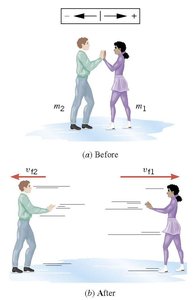
Momentum is conserved in a system if the net external force acting on the system is zero. Internal forces (forces objects within the system exert on each other) cancel due to Newton's third law.
Conservation Law: (if )
System: Define the objects included; external forces are those from outside the system.
Example: Skaters on Ice
Two skaters push off each other on frictionless ice. If one skater (54 kg) moves at +2.5 m/s, the other (88 kg) recoils at:
m/s
Collisions
Types of Collisions
Collisions are classified based on whether kinetic energy is conserved:
Elastic Collision: Both momentum and kinetic energy are conserved.
Inelastic Collision: Momentum is conserved, but kinetic energy is not. If objects stick together, the collision is completely inelastic.
Elastic Collisions in One Dimension
For two objects (masses and ) with initial velocities and , the final velocities after an elastic collision are found using:
Momentum:
Kinetic Energy:

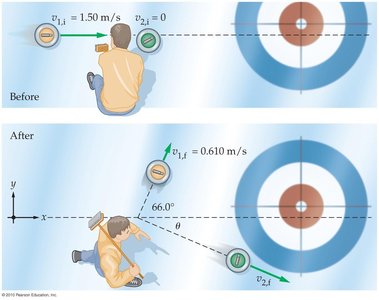
Collisions in Two Dimensions
In two-dimensional collisions, momentum is conserved in both the x and y directions. The analysis involves resolving velocities into components and applying conservation laws to each direction.
Completely Inelastic Collisions
In a completely inelastic collision, the colliding objects stick together and move with a common velocity after the collision. Only momentum is conserved.
Formula:

Explosions
An explosion is the reverse of a completely inelastic collision: a single object breaks into two or more pieces. The total momentum before and after the explosion is conserved.
Formula:
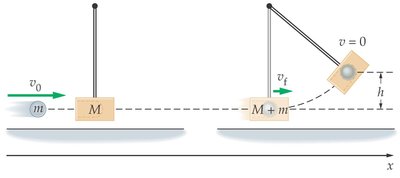
Ballistic Pendulum
The ballistic pendulum is a device used to measure the velocity of a projectile. It combines the principles of momentum conservation (during the collision) and mechanical energy conservation (after the collision as the pendulum rises).
After the projectile embeds in the block, use momentum conservation to find the combined velocity.
Use energy conservation to relate the rise in height to the velocity just after the collision.
Summary Table: Types of Collisions
Type of Collision | Momentum Conserved? | Kinetic Energy Conserved? | Objects Stick Together? |
|---|---|---|---|
Elastic | Yes | Yes | No |
Inelastic | Yes | No | Sometimes |
Completely Inelastic | Yes | No | Yes |
Additional info: The notes above expand on the brief points in the lecture slides, providing full academic context, definitions, and examples for each concept. Images are included only where they directly reinforce the explanation of the adjacent paragraph.
