 Back
BackInclined Planes and Dynamics of Circular Motion: Study Notes for University Physics I
Study Guide - Smart Notes
 Tailored notes based on your materials, expanded with key definitions, examples, and context.
Inclined Planes
Static and Kinetic Friction
When analyzing motion on inclined planes, friction plays a crucial role in determining whether an object will move or remain stationary. Static friction prevents motion up to a certain threshold, while kinetic friction acts when the object is already moving.
Static friction: The force that resists the initiation of sliding motion between two surfaces.
Kinetic friction: The force that opposes the motion of two surfaces sliding past each other.
On the verge of slipping: The maximum static friction is reached, and any additional force will cause motion.
Free-Body Diagrams and Force Analysis
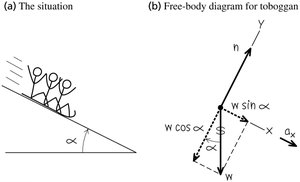
To solve problems involving inclined planes, it is essential to draw free-body diagrams and resolve forces into components parallel and perpendicular to the plane.
Weight (w): Acts vertically downward.
Normal force (n): Acts perpendicular to the surface.
Friction force (f): Acts parallel to the surface, opposing motion.
Force components: (perpendicular), (parallel)
Exercise: Block and Pulley System
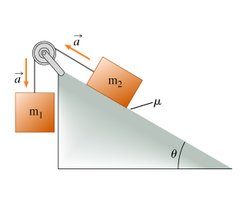
Consider a system where a block on an inclined plane is connected via a string and pulley to a hanging block. The analysis involves drawing force diagrams and writing force equations for each block.
Force equations: For block on incline: ; For hanging block:
Criterion for motion: The system moves if the net force on block 1 exceeds the friction and component of gravity on block 2.
Exercise: Block and Slab System
In this scenario, a block rests on a slab, and both are subject to acceleration. The maximum acceleration before slipping is determined by the coefficient of static friction.
Maximum acceleration:
Force equations: ;
Dynamics of Circular Motion
Newton’s Second Law for Circular Motion
Newton’s second law applies to circular motion, where the net force is directed toward the center of the circle (centripetal force).
Centripetal force:
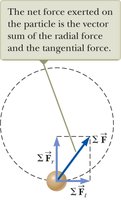
Radial and tangential components: The net force is the vector sum of radial and tangential forces.
Conceptual Exercise: Path of a Rolling Ball
When a ball rolls along a circular track and leaves the track, it will move tangentially to the circle at the point of exit due to inertia.

SpinLaunch: Suborbital Accelerator
The SpinLaunch Suborbital Accelerator demonstrates the application of circular motion in engineering, using a large vacuum chamber to accelerate payloads to high velocities for orbital launches.
Application: Centripetal acceleration is used to launch objects into space.
Engineering relevance: Demonstrates practical use of circular motion principles.

Period of Rotation
The period of rotation is the time taken for an object in uniform circular motion to complete one full revolution.
Period (T):
Frequency (f):
Car on a Flat Curve
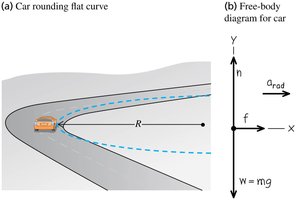
When a car rounds a flat curve, the maximum speed without slipping is determined by the friction between the tires and the road.
Maximum speed:
Free-body diagram: Shows normal force, friction, and weight.
Car on a Banked Curve
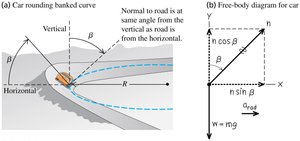
On a banked curve, the normal force provides a component of centripetal force, allowing the car to turn even without friction.
Maximum speed (no friction):
Free-body diagram: Shows normal force components and weight.
Conical Pendulum
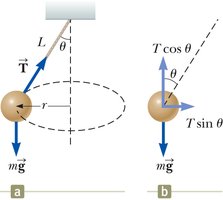
A conical pendulum consists of an object tied to a string and rotated in a horizontal circle. The forces involved are tension and gravity, and the dynamical equations relate these to the period and angle.
Tension components: ,
Period:
Example Calculation: Tension and Angle in Conical Pendulum
Given a ball of mass 1 kg attached to a rope of length 0.5 m, with a period of rotation of 1 second, calculate the tension and angle with respect to the vertical.
Step 1: Find angular velocity:
Step 2: Use and to solve for and .
Universal Law of Gravity and Motion of Satellites
Universal Law of Gravity
The universal law of gravity describes the attractive force between two masses.
Equation:
Applications: Explains satellite motion and planetary orbits.
Motion of Satellites
Satellites move in circular or elliptical orbits due to the gravitational force acting as the centripetal force.
Orbital speed:
Period:
Additional info: The notes cover key aspects of Chapter 5 (Applying Newton's Laws), Chapter 9 (Rotation of Rigid Bodies), and Chapter 13 (Gravitation), as well as relevant exercises and applications in engineering and everyday physics.
