 Back
BackInductors, Magnetic Fields, and Circuits – Step-by-Step Physics Guidance
Study Guide - Smart Notes
 Tailored notes based on your materials, expanded with key definitions, examples, and context.
Q1. The inductor in Fig. E30.9 has inductance 0.260 H and carries a current in the direction shown that is decreasing at a uniform rate, . (a) Find the self-induced emf. (b) Which end of the inductor, a or b, is at a higher potential?

Background
Topic: Electromagnetic Induction (Inductors)
This question tests your understanding of how an inductor responds to a changing current, specifically how to calculate the self-induced emf and determine the relative potential at the ends of the inductor.
Key Terms and Formulas
Inductance (): A measure of an inductor's ability to oppose changes in current.
Self-induced emf (): The voltage generated across an inductor due to a changing current.
Key formula:
Step-by-Step Guidance
Identify the known values: , .
Recall the formula for self-induced emf: .
Plug the values into the formula, being careful with the sign of (negative means current is decreasing).
Consider the physical meaning: The negative sign in the formula indicates that the induced emf opposes the change in current (Lenz's Law).
To determine which end (a or b) is at a higher potential, think about the direction of the induced emf and how it relates to the current direction and its decrease.
Try solving on your own before revealing the answer!
Final Answer:
End a is at a higher potential than end b. The induced emf opposes the decrease in current, so the potential at a is greater.
Q2. A resistor and an inductor are connected in series to a battery with emf 240 V and negligible internal resistance. The circuit is completed at time . At a later time the current is 5.00 A and is increasing at a rate of 20.0 A/s. After a long time the current in the circuit is 15.0 A. What is the value of , the time when the current is 5.00 A?
Background
Topic: RL Circuits (Transient Analysis)
This question tests your ability to analyze the time-dependent behavior of current in an RL circuit after the circuit is closed, using the concepts of time constant and exponential growth.
Key Terms and Formulas
RL Circuit: A circuit with a resistor (R) and inductor (L) in series.
Time constant ():
Current as a function of time:
Rate of change of current:
Step-by-Step Guidance
Identify the known values: , , at , and .
Recall that , so you can solve for .
Use the formula for to relate the current at time to the circuit parameters.
Use the formula for at time to relate the rate of change of current to the circuit parameters.
Set up the equations and solve for using the values for and , but stop before plugging in the final numbers.
Try solving on your own before revealing the answer!
Final Answer:
By solving the exponential equations for the RL circuit, you find the time when the current reaches 5.00 A.
Q3. Two very long insulated wires perpendicular to each other in the same plane carry currents as shown in Fig. E28.25. Find the magnitude of the net magnetic field these wires produce.
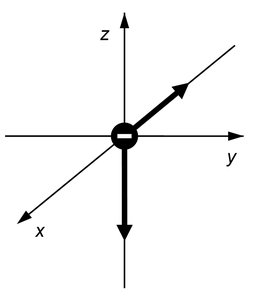
Background
Topic: Magnetic Fields from Currents
This question tests your ability to calculate the magnetic field produced by two perpendicular current-carrying wires at a point in space, using the principle of superposition.
Key Terms and Formulas
Magnetic field from a long straight wire:
Superposition: The net field is the vector sum of the fields from each wire.
: Permeability of free space ()
Step-by-Step Guidance
Identify the direction and magnitude of current in each wire.
Calculate the magnetic field produced by each wire at the point of interest using .
Determine the direction of each field using the right-hand rule.
Combine the fields vectorially to find the net magnetic field.
Set up the expression for the magnitude of the net field, but stop before calculating the final value.
Try solving on your own before revealing the answer!
Final Answer:
The net magnetic field is in the direction.
By vector addition, the fields from each wire combine to give the net field.
Q4. The diagram shows part of a circuit, with two inductors and one resistor in series. The potential at three points is indicated. What is the potential at point P?
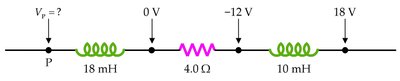
Background
Topic: Circuit Analysis with Inductors
This question tests your ability to analyze the potential differences in a circuit containing inductors and resistors, using the concept of voltage drops across each element.
Key Terms and Formulas
Inductor voltage:
Resistor voltage:
Potential difference: The sum of voltage changes across each element gives the total change in potential.
Step-by-Step Guidance
Identify the given potentials at the three points in the circuit.
Write the loop equation for the circuit, summing the voltage drops across each element.
Express the potential at point P in terms of the known values and the voltage drops across the inductors and resistor.
Set up the equation for but stop before plugging in the final numbers.
Try solving on your own before revealing the answer!
Final Answer:
By summing the voltage drops across the inductors and resistor, you find the potential at point P.
Q5. Two very long uniform lines of charge are parallel and are separated by 0.300 m. Each line of charge has charge per unit length . What magnitude of force does one line of charge exert on a 0.0500 m section of the other line of charge?
Background
Topic: Electrostatics (Forces between Line Charges)
This question tests your ability to calculate the electrostatic force between two parallel lines of charge using Coulomb's law for continuous charge distributions.
Key Terms and Formulas
Line charge density (): Charge per unit length.
Force per unit length between parallel lines:
: Permittivity of free space ()
Step-by-Step Guidance
Identify the known values: , , .
Recall the formula for the force between two parallel lines of charge.
Plug the values into the formula, being careful with units (convert to ).
Set up the expression for the force, but stop before calculating the final value.
Try solving on your own before revealing the answer!
Final Answer:
The force is .
By plugging in the values, you find the magnitude of the force exerted on the section.
Q6. When the current in a long, straight, air-filled solenoid is changing at the rate of 2000 A/s, the voltage across the solenoid is 0.600 V. The solenoid has 1200 turns and uniform cross-sectional area 25.0 mm. What is the magnitude of the magnetic field in the interior of the solenoid when the current in the solenoid is 3.00 A?
Background
Topic: Magnetic Field in a Solenoid
This question tests your ability to calculate the magnetic field inside a solenoid using the formula for solenoids and to relate the induced emf to the rate of change of current.
Key Terms and Formulas
Induced emf in a solenoid:
Inductance of a solenoid:
Magnetic field inside a solenoid: where
Step-by-Step Guidance
Identify the known values: , , , , .
Calculate the inductance using the formula for a solenoid.
Use the formula for induced emf to check the value of .
Calculate the magnetic field inside the solenoid using .
Set up the expression for , but stop before plugging in the final numbers.
Try solving on your own before revealing the answer!
Final Answer:
By plugging in the values, you find the magnitude of the magnetic field inside the solenoid.
