 Back
BackEXAM #3 DAY 16: Interacting Objects and Newton’s Third Law: Force Pairs, Free-Body Diagrams, and Multiple Object Systems
Study Guide - Smart Notes
 Tailored notes based on your materials, expanded with key definitions, examples, and context.
Interacting Objects and Force Pairs
Introduction to Multiple Object Systems
In physics, analyzing systems with more than one object requires careful consideration of the forces acting on each object and the interactions between them. This topic is foundational for understanding Newton's Laws, especially when objects interact directly (contact) or indirectly (via strings and pulleys).
Multiple objects of interest require separate analysis for each object.
Interactions can be direct (contact forces) or indirect (tension in strings, forces via pulleys).
Mathematical Strategies for Systems of Equations
Solving for Unknowns in Interacting Systems
When analyzing forces in systems with multiple objects, you often encounter systems of equations. These can be solved using several methods:
Guess and Check: Substitute possible values for variables to see if both equations are satisfied.
Algebraic Substitution: Solve one equation for a variable and substitute into the other equation.
Graphical Inspection: Plot both equations and find their intersection point.
Example: Given the equations 150 – y = 10x and y = 5x, solve for x and y.
Substitute y = 5x into the first equation: 150 – 5x = 10x → 150 = 15x → x = 10
Then y = 5x = 50
Free-Body Diagrams (FBDs) for Multiple Objects
Drawing and Interpreting FBDs
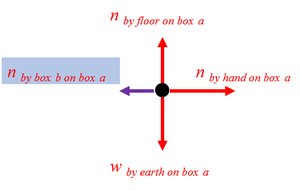
Free-body diagrams are essential tools for visualizing all the forces acting on each object in a system. Each force is represented as an arrow pointing in the direction of the force, with its tail at the point of application.
Draw a separate FBD for each object.
Include all forces: normal, weight, applied, friction, tension, etc.
Label each force clearly, indicating both the agent and the object acted upon.
Newton’s Third Law and Force Pairs
Definition and Identification of Force Pairs
Newton’s Third Law states that for every action, there is an equal and opposite reaction. This means that forces always come in pairs, known as force pairs or action-reaction pairs.
Each force in a pair acts on a different object.
The forces are equal in magnitude and opposite in direction.
Force pairs are always of the same type (e.g., both are normal forces, both are tension forces).
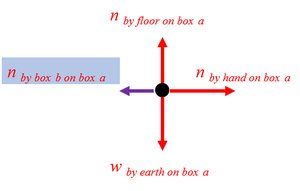
Example: The force by box A on box B and the force by box B on box A are a force pair.
Practice: Identifying Force Pairs
Force by hand on box A → Force by box A on hand
Normal force by floor on box A → Normal force by box A on floor
Analyzing Multiple Interacting Objects
Contact Forces and Internal Forces
When two or more objects are in contact, they exert forces on each other. These internal forces are crucial for understanding the motion of the system.
Draw FBDs for each object to identify all forces.
Internal forces (e.g., force by box A on box B) are equal and opposite to the force by box B on box A.
Example Problem: Two Boxes in Contact
Suppose a hand pushes on box A (10 kg), which is in contact with box B (5 kg), with a force of 150 N. If friction is negligible:
Write Newton’s Second Law for each box:
Solve for F and a:
Newton’s Third Law in Experiments
Types of Interactions
Tug-o-War: Two objects pull on each other.
Collision: Two objects crash into each other.
Moving as One: Two objects are pressed together and move together.
In all cases, the force pairs are equal in magnitude and opposite in direction, as predicted by Newton’s Third Law.
Indirect Interactions: Strings and Pulleys
Ideal Strings and Pulleys
When objects interact via strings and pulleys, the tension force transmits the interaction. For ideal strings and pulleys (massless and frictionless), the tension is nearly the same throughout the string.
Conditions for equal tension:
String mass is negligible compared to the objects.
Pulley mass and friction are negligible compared to the tension force.
Example: Pulley System with Two Masses
Consider two masses, M and m, connected by a massless string over a frictionless pulley. The tension in the string is the same on both sides, and both masses have the same magnitude of acceleration.
Draw FBDs for each block.
Write Newton’s Second Law for each block and solve the system of equations.
Summary Table: Key Concepts for Interacting Objects
Concept | Description | Key Equation |
|---|---|---|
Newton’s Third Law | For every action, there is an equal and opposite reaction. | |
Free-Body Diagram | Diagram showing all forces acting on an object. | Sum of forces: |
System of Equations | Used to solve for unknowns in multi-object systems. | e.g., , |
Ideal String/Pulley | Transmits force with negligible mass and friction. |
Key Takeaways
Always draw separate FBDs for each object in a system.
Identify and label all force pairs according to Newton’s Third Law.
Use systems of equations to solve for unknown forces and accelerations.
For ideal strings and pulleys, tension is nearly the same throughout the string.
