 Back
Internal Energy, Thermodynamics, and Potential Energy in Physics
Study Guide - Smart Notes
 Tailored notes based on your materials, expanded with key definitions, examples, and context.
Internal Energy and the First Law of Thermodynamics
Definition and Components of Internal Energy
Internal energy is the total energy contained within a system, arising from the microscopic motions and interactions of its constituent particles. It is a central concept in thermodynamics and is crucial for understanding energy transfer processes.
Kinetic Energy: Associated with the motion of molecules within the system.
Potential Energy: Associated with interactions between molecules, often due to electric forces.
Key Formulas:
Kinetic Energy:
Potential Energy (gravitational):
Example: The internal energy of a block includes both the kinetic energy of its atoms vibrating and the potential energy from the forces between them.
The First Law of Thermodynamics
The first law of thermodynamics states that the change in internal energy of a system is equal to the energy added to the system via heat and work. This law is a statement of energy conservation applied to thermodynamic systems.
Mathematical Form:
Q: Heat absorbed by the system from the environment.
W: Work done on the system by the environment.
Energy can be transferred mechanically (work) or thermally (heat). The internal energy changes accordingly.
Comparison: Physics vs Chemistry Formulation
In physics, the first law is often written to emphasize cause and effect, with the change in internal energy on one side and the sum of heat and work on the other. In chemistry, conventions may differ, especially regarding the sign of work.
Thermal Energy and Heat
Thermal Energy
Thermal energy is the portion of internal energy associated with the random motion of particles. It is closely related to temperature, but temperature is a measure of the average kinetic energy per particle, not the total thermal energy.
Temperature: Indicates the average kinetic energy of particles.
Thermal Energy: Total energy due to random motion and interactions.
Example: Heating a block increases the kinetic energy of its atoms, raising its internal energy.
Potential Energy and Forces
Relationship Between Force and Potential Energy
The force experienced by a particle in a potential energy field is related to the slope of the potential energy curve. The force points in the direction of decreasing potential energy.
General Formula:
For discrete changes:
Example: For a spring, the force is and the potential energy is .
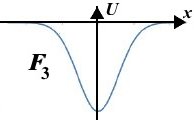
Types of Potential Energy
Gravitational: ,
Spring: ,
Electric: ,
Electric Potential Energy Between Charges
Attractive and Repulsive Interactions
Electric potential energy depends on the nature of the charges involved. Opposite charges attract, while like charges repel.
Attraction: Between positive and negative charges.
Repulsion: Between like charges (positive-positive or negative-negative).
Potential Energy Between Neutral Atoms and Molecules
Most atoms are neutral but can be polarized, leading to van der Waals forces. The Lennard-Jones potential describes the interaction between neutral atoms and molecules, capturing both attractive and repulsive components.
Lennard-Jones Potential:
Describes interactions felt by gas molecules.
Can lead to bound states, but covalent bonding is more complex.
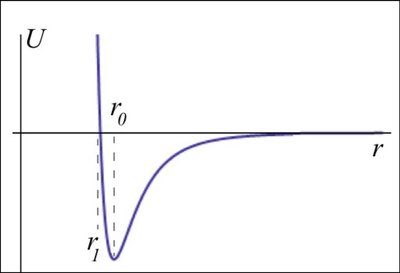
Force Analysis Using the Lennard-Jones Potential
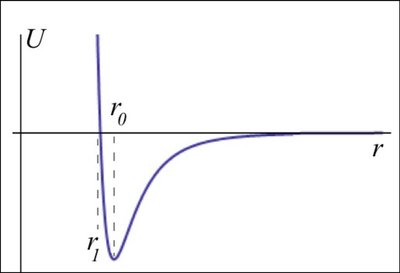
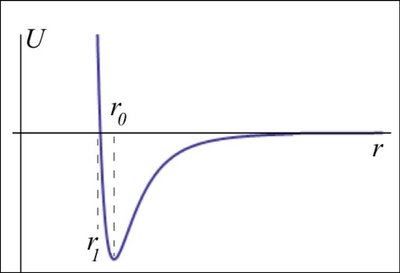
The force between two atoms is largest where the slope of the potential energy curve is steepest. The minimum of the curve (r0) corresponds to the equilibrium separation, while the zero crossing (r1) marks the transition between attractive and repulsive forces.
Repulsive Region: For , the force is repulsive.
Attractive Region: For , the force is attractive.
Summary Table: Types of Potential Energy and Associated Forces
Type | Potential Energy Formula | Force Formula | Example |
|---|---|---|---|
Gravitational | Object near Earth's surface | ||
Spring | Mass on a spring | ||
Electric | Two point charges | ||
Lennard-Jones | Neutral atoms/molecules |
Second Law of Thermodynamics (Brief Mention)
While the first law ensures energy conservation, the second law addresses the directionality of processes. It states that certain processes, such as spontaneous heat flow, are highly unlikely to occur in reverse, even though energy would be conserved.
Key Distinctions
Work vs Heat: Work is mechanical energy transfer; heat is thermal energy transfer.
Temperature vs Thermal Energy: Temperature is a measure of average kinetic energy; thermal energy is the total internal energy due to random motion.
Additional info: The notes briefly mention chemical bonding and the complexity of covalent bonds, which are not fully described by the Lennard-Jones potential. The summary table is inferred for completeness and clarity.
