 Back
BackIntroduction to Science and Physics: Foundations, Methods, and Attitudes
Study Guide - Smart Notes
 Tailored notes based on your materials, expanded with key definitions, examples, and context.
About Science
What is Science?
Science is both a body of knowledge and an ongoing human activity. Its roots extend back before recorded history, and it continues to evolve as new discoveries are made. Science seeks to understand the natural world through observation, experimentation, and reasoning.
Body of Knowledge: Science accumulates facts, theories, and principles about the universe.
Ongoing Activity: Scientists continually test, revise, and expand our understanding.
Historical Context: The pursuit of scientific knowledge predates written records.
Mathematics—The Language of Science
Mathematics is essential to science, providing a precise language for expressing scientific ideas and relationships. The integration of mathematics and science began about four centuries ago, allowing for unambiguous communication and logical reasoning.
Equations: Express relationships between concepts and serve as guides to thinking.
Clarity: Mathematical language removes ambiguity from scientific statements.
Scientific Measurements: Early Examples
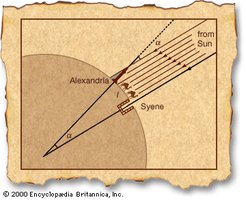
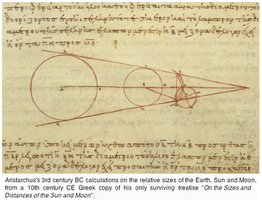
Ancient scientists used geometric reasoning to measure the Earth, Moon, and Sun. Their methods illustrate the power of observation and logic in science.
Eratosthenes (235 BC): Measured the Earth's circumference using shadows and geometry.
Aristarchus (240 BC): Estimated the sizes and distances of the Moon and Sun using geometric methods.
The Scientific Method and Attitude
Scientific Methods
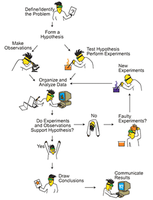
There is no single scientific method, but most scientific investigations share common steps. These steps help ensure that scientific conclusions are based on evidence and logical reasoning.
1. Observe
2. Question (formulate a hypothesis)
3. Predict
4. Test predictions (experiments)
5. Draw a conclusion
The Scientific Attitude
The scientific attitude is characterized by inquiry, experimentation, and a willingness to admit error. Scientists must be open to changing their minds, accept experimental findings, and test for erroneous beliefs.
Inquiry: Constant questioning and investigation.
Experimentation: Testing ideas through controlled experiments.
Willingness to Admit Error: Revising beliefs when faced with new evidence.

Facts, Hypotheses, Laws, and Theories
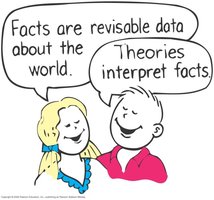
Fact: A close agreement by competent observers about the same phenomenon.
Hypothesis: An educated guess presumed to be factual until supported or refuted by experiment. A hypothesis is scientific if it can be tested and potentially proven wrong (falsifiable).
Law or Principle: A hypothesis that has been tested repeatedly and has not been contradicted.
Theory: A synthesis of a large body of information that encompasses well-tested and verified hypotheses about certain aspects of the natural world.
Scientific Hypotheses: Examples and Non-Examples
For a statement to be a scientific hypothesis, there must be a test for proving it wrong. For example, the statement "The Moon is made of green cheese" is a scientific hypothesis because it can be tested and potentially disproven. In contrast, "Undetectable particles are some of nature’s secrets" is not a scientific hypothesis because it cannot be tested or falsified.
Change in Science
Both facts and theories can change over time as new evidence is discovered. This adaptability is a strength of science, allowing it to refine and improve its understanding of the natural world.
Science and Other Subjects
Science is distinct from other fields such as art, literature, and religion, but all contribute to human understanding. Science focuses on observable, repeatable, and objective phenomena, while art interprets human experience and religion addresses questions of purpose and meaning.
Science: Natural order and phenomena (cosmic order)
Art: Interpretation and expression of human experience (cosmic beauty)
Religion: Faith and worship (cosmic purpose)

Science, Technology, and Physics
Science and Technology
Science is concerned with gathering and organizing knowledge, while technology applies scientific knowledge for practical purposes and to provide tools for further exploration.
Physics—The Basic Science
Physics is the foundation of the physical sciences, which also include geology, astronomy, and chemistry. Life sciences such as biology, zoology, and botany are built upon the principles of physics and chemistry. Physics is often considered the simplest and most fundamental science, providing the groundwork for understanding more complex fields.
Physical Sciences: Geology, astronomy, chemistry, physics
Life Sciences: Biology, zoology, botany
Physics: Underlies all other sciences
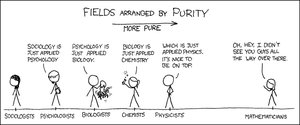
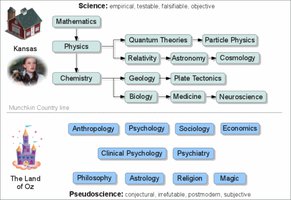
Example: Physics provides the laws of motion and energy that are essential for understanding chemical reactions in chemistry, biological processes in biology, and geological phenomena in geology.
Additional info: The adaptability of science, its reliance on evidence, and its foundational role in other disciplines make it a central pillar of modern knowledge and technology.
