 Back
BackKepler’s Laws and Simple Harmonic Motion: Foundations of Planetary Motion and Oscillatory Systems
Study Guide - Smart Notes
 Tailored notes based on your materials, expanded with key definitions, examples, and context.
Kepler’s Laws of Planetary Motion
Kepler’s First Law: The Law of Ellipses
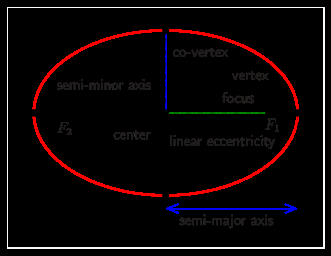
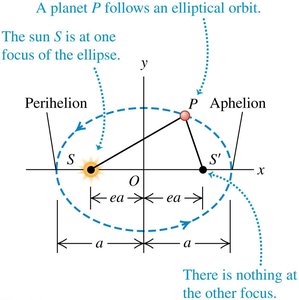
Kepler’s first law states that the orbit of each planet is an ellipse, with the Sun at one focus. This means that planetary orbits are not perfect circles, but elongated shapes called ellipses. The Sun is not at the center, but at one of the two foci of the ellipse.
Ellipse: A closed curve where the sum of the distances from any point on the curve to two fixed points (foci) is constant.
Semi-major axis (a): The longest radius of the ellipse.
Semi-minor axis (b): The shortest radius of the ellipse.
Eccentricity (e): A measure of how much the ellipse deviates from being a circle (0 = circle, closer to 1 = more elongated).
Kepler’s Second Law: The Law of Equal Areas
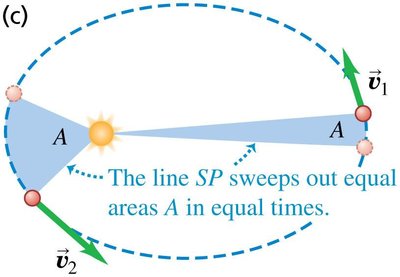
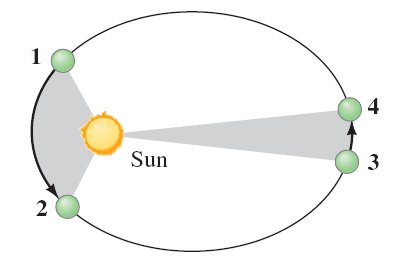
Kepler’s second law states that a line joining a planet and the Sun sweeps out equal areas in equal times. This means that planets move faster when they are closer to the Sun (perihelion) and slower when farther away (aphelion).
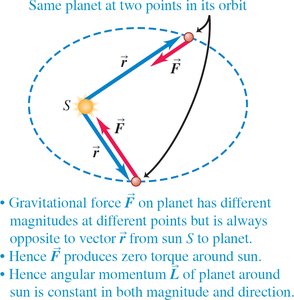
Angular momentum conservation: The gravitational force produces zero torque about the Sun, so the planet’s angular momentum remains constant.
Implication: The speed of a planet increases as it nears the Sun and decreases as it moves away.
Kepler’s Third Law: The Law of Periods
Kepler’s third law relates the period of a planet’s orbit to the size of its orbit. Specifically, the square of the orbital period (T) is proportional to the cube of the semi-major axis (a):
Mathematical form:
Generalized (Newton’s version): where M is the mass of the Sun.
Application: This law applies to all objects orbiting the Sun, including asteroids and comets.
Period independence: The period does not depend on the eccentricity of the orbit.
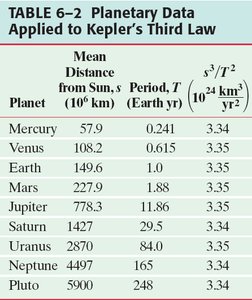
Example: If a planet’s semi-major axis is 4 AU, its period is years.
Simple Harmonic Motion (SHM) and Oscillatory Systems
Equilibrium and Oscillation
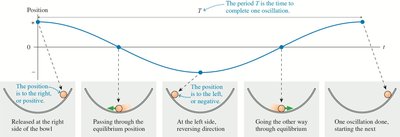
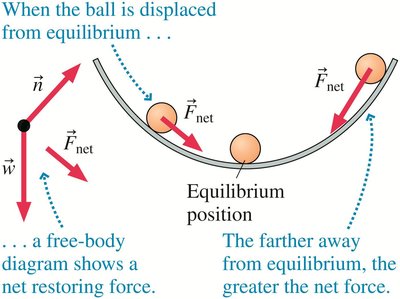
Oscillatory motion occurs when a system moves back and forth about an equilibrium position due to a restoring force. The equilibrium position is where the net force on the object is zero.
Restoring force: Acts to return the system to equilibrium when displaced.
Periodic motion: The motion repeats in a regular cycle.

Simple Harmonic Motion (SHM)
Simple harmonic motion is a type of periodic motion where the restoring force is directly proportional to the displacement and acts in the opposite direction.
Mathematical model: (Hooke’s Law for springs)
Position as a function of time:
Velocity:
Acceleration:
Period:
Frequency:

Physical Examples of SHM
Mass-spring system: A mass attached to a spring oscillates with SHM when displaced from equilibrium.
Pendulum (small angles): For small angular displacements, a simple pendulum exhibits SHM with period .
Other examples: Vibrating guitar strings, swings, and rulers clamped at one end.

Energy in Simple Harmonic Motion
In SHM, energy oscillates between kinetic and potential forms, but the total mechanical energy remains constant (in the absence of damping):
Kinetic energy:
Potential energy (spring):
Total energy:
Summary Table: Key Equations in SHM
Quantity | Equation |
|---|---|
Position | |
Velocity | |
Acceleration | |
Period (spring) | |
Period (pendulum) | |
Total Energy |
Connection Between Circular Motion and SHM
Simple harmonic motion can be viewed as the projection of uniform circular motion onto one axis. The equations for SHM are derived using trigonometric functions, similar to those describing circular motion.
Summary Table: Comparison of SHM and Uniform Circular Motion
Aspect | Simple Harmonic Motion | Uniform Circular Motion |
|---|---|---|
Path | Linear (back and forth) | Circular |
Displacement | Varies about equilibrium | Constant radius |
Velocity | Changes magnitude and direction | Constant magnitude, changing direction |
Acceleration | Proportional to displacement | Directed toward center |
Additional info: The above content integrates and expands on the provided slides and images, ensuring a comprehensive, self-contained study guide for college-level physics students.
