 Back
Kinematics and Vectors: Foundations of Physics with Calculus
Study Guide - Smart Notes
 Tailored notes based on your materials, expanded with key definitions, examples, and context.
Kinematics: Motion in One Dimension
Instantaneous Velocity
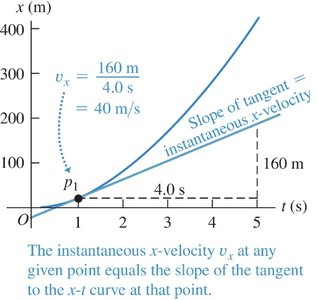
The instantaneous x-velocity of a particle in straight-line motion is a fundamental concept in kinematics. It describes the rate at which the position of a particle changes with respect to time at a specific instant.
Definition: The instantaneous velocity is the limit of the average velocity as the time interval approaches zero.
Mathematical Expression:
This value equals the instantaneous rate of change of the particle's x-coordinate.

Average Velocity and Displacement
The average velocity of an object is defined as the total displacement divided by the total time taken. It is a vector quantity, indicating both magnitude and direction.
Formula:
Displacement () is the difference between the final and initial positions:
Direction matters: Displacement is positive if the object moves to the right of the origin, negative if to the left.
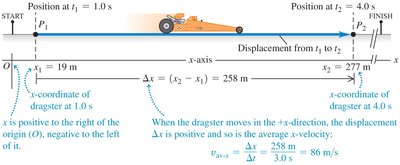
Graphical Interpretation of Velocity
On a position vs. time graph, the slope of the line connecting two points represents the average velocity over that interval. As the interval becomes smaller, the slope approaches the instantaneous velocity at a point.
Average velocity: Slope of the secant line between two points.
Instantaneous velocity: Slope of the tangent to the curve at a single point.
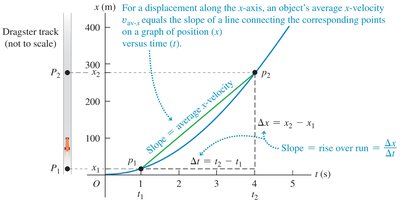
Calculating Instantaneous Velocity from Graphs
As the time interval () used to calculate average velocity becomes shorter, the average velocity approaches the instantaneous velocity. This is visually represented by the tangent to the curve at a point on the position-time graph.
For s, m, m/s
For s, m, m/s
At a single instant, the slope of the tangent gives the instantaneous velocity.
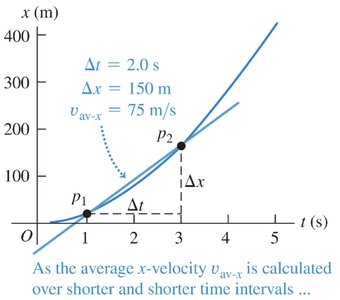
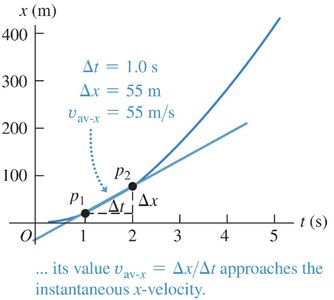
Vectors and Relative Motion
Vector Addition in Relative Motion
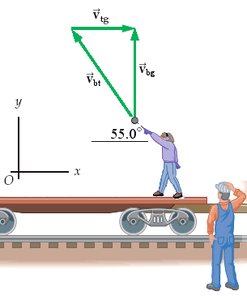
Relative motion problems often require the use of vector addition. The velocity of an object as observed from one reference frame can be found by vectorially adding the velocity of the object relative to another frame and the velocity of that frame relative to the observer.
Formula:
Example: A person throws a ball on a moving train; the velocity observed by someone on the ground is the vector sum of the ball's velocity relative to the train and the train's velocity relative to the ground.
Equilibrium of Forces
Tension in Strings: Example of a Hanging Picture
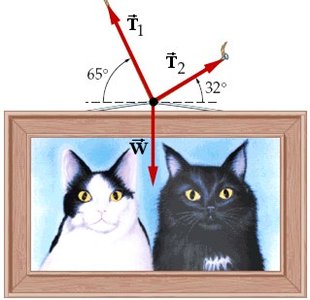
When an object is suspended by two strings, the tensions in the strings can be found by resolving forces into components and applying equilibrium conditions.
The sum of the vertical components of the tensions must balance the weight of the object.
The sum of the horizontal components must be zero for equilibrium.
Angles of the strings affect the magnitude of the tensions.
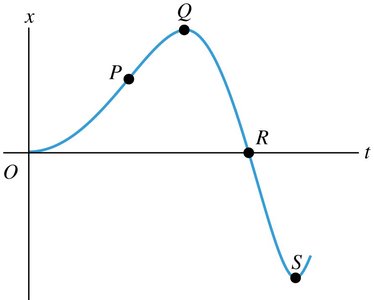
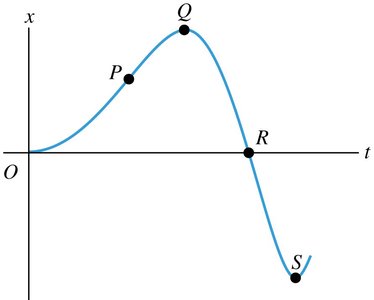
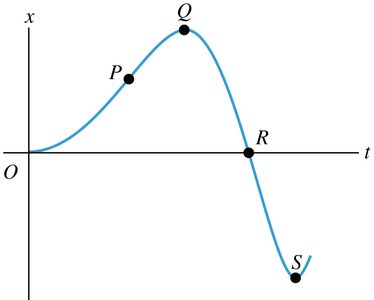
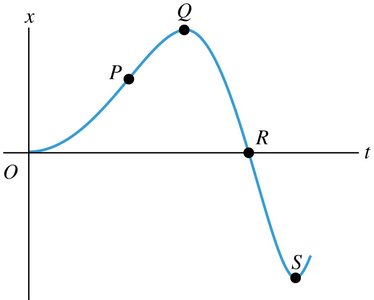
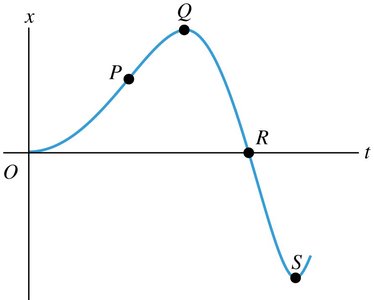
Analyzing Position-Time Graphs
Interpreting x-t Graphs: Velocity and Acceleration
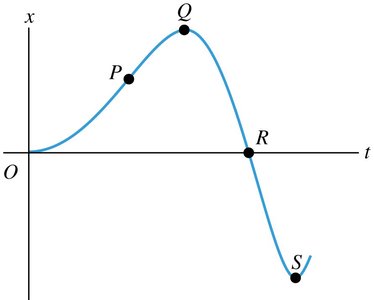
Position-time (x-t) graphs provide valuable information about an object's motion. The slope at any point gives the velocity, and the curvature indicates acceleration.
Velocity: Greatest where the slope is steepest.
Acceleration: Greatest where the curve bends most sharply (i.e., where the rate of change of slope is highest).
At points where the curve is flat, velocity is zero.
Summary Table: Key Kinematic Quantities
Quantity | Symbol | Definition/Formula | SI Unit |
|---|---|---|---|
Displacement | meter (m) | ||
Average Velocity | meter/second (m/s) | ||
Instantaneous Velocity | meter/second (m/s) | ||
Acceleration | meter/second2 (m/s2) |
