 Back
BackKinematics: Describing Motion in One Dimension
Study Guide - Smart Notes
 Tailored notes based on your materials, expanded with key definitions, examples, and context.
Kinematics
Introduction to Kinematics
Kinematics is the branch of physics that describes the motion of objects without considering the forces that cause the motion. It focuses on the concepts of position, displacement, velocity, and acceleration, providing the mathematical framework to analyze how objects move.
Position and Displacement
Position (x): The location of an object relative to a chosen reference point or system. The standard unit is meters (m).
Displacement (\( \Delta x \)): The change in position of an object. It is a vector quantity, meaning it has both magnitude and direction.
The formula for displacement is:
where \( x_f \) is the final position and \( x_i \) is the initial position.
Velocity
Velocity (v): The rate of change of position with respect to time. It is a vector quantity and its unit is meters per second (m/s).
The formula for average velocity is:
where \( \Delta x \) is displacement and \( \Delta t \) is the time interval.
Acceleration
Acceleration (a): The rate of change of velocity with respect to time. It is a vector quantity and its unit is meters per second squared (m/s2).
The formula for average acceleration is:
where \( \Delta v \) is the change in velocity and \( \Delta t \) is the time interval.
Uniform Rectilinear Motion (MRU)
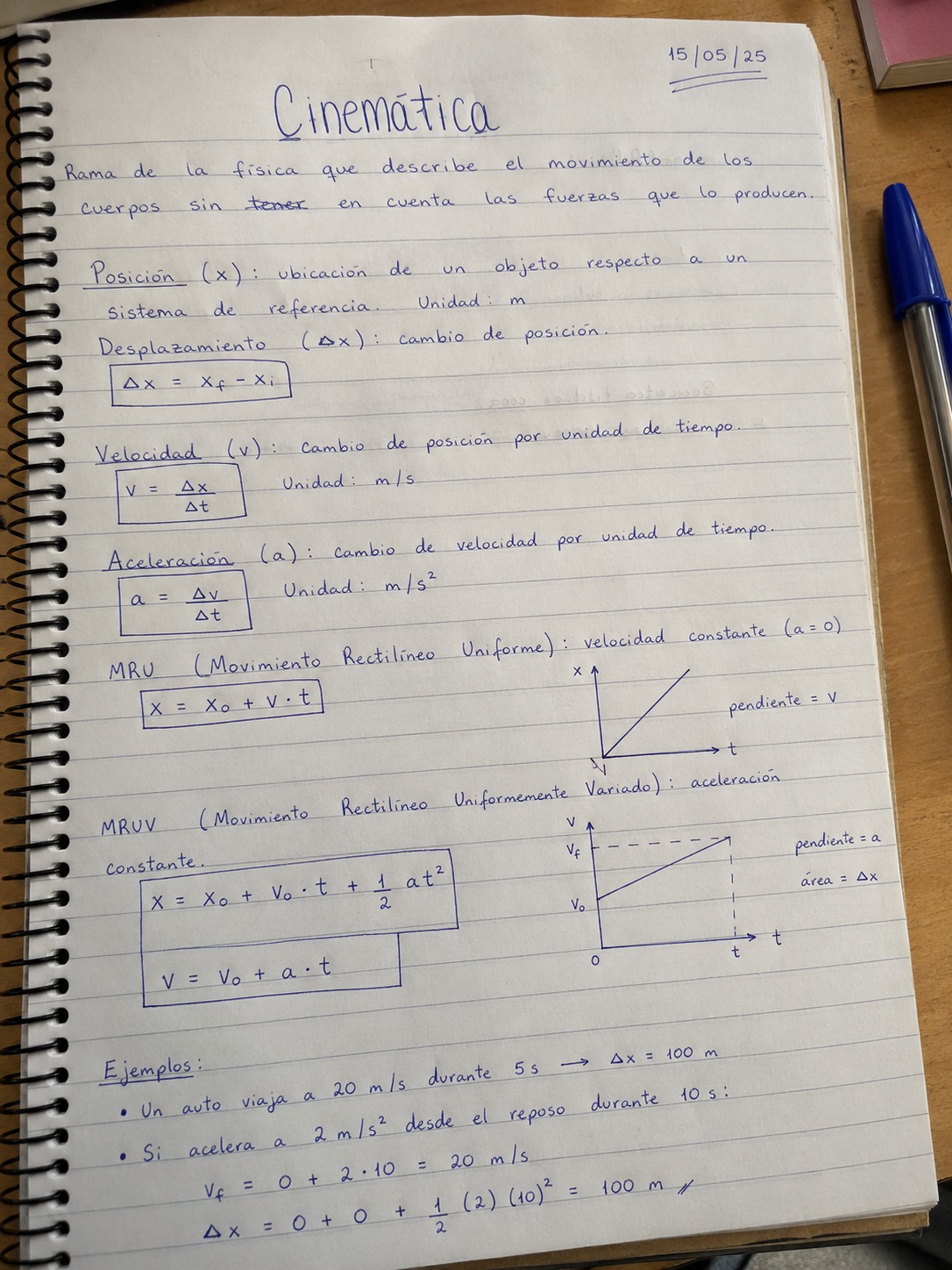
Uniform Rectilinear Motion (MRU): Describes motion in a straight line with constant velocity (a = 0). The position as a function of time is given by:
where \( x_0 \) is the initial position, \( v \) is the constant velocity, and \( t \) is the time elapsed.
Uniformly Accelerated Rectilinear Motion (MRUV)
Uniformly Accelerated Rectilinear Motion (MRUV): Describes motion in a straight line with constant acceleration. The main equations are:
where \( x_0 \) is the initial position, \( v_0 \) is the initial velocity, \( a \) is the constant acceleration, and \( t \) is the time elapsed.
Examples
Example 1: A car travels at 20 m/s for 5 seconds. The displacement is:
Example 2: A car accelerates from rest at 2 m/s2 for 10 seconds.
Final velocity:
Displacement:
Additional info: The graphs included in the notes visually represent the relationships between position, velocity, and time for both uniform and uniformly accelerated motion. The slope of the position-time graph in MRU gives the velocity, while the slope of the velocity-time graph in MRUV gives the acceleration. The area under the velocity-time graph represents displacement.
