 Back
Kinematics in One Dimension: Acceleration, Motion, and Applications
Study Guide - Smart Notes
 Tailored notes based on your materials, expanded with key definitions, examples, and context.
Kinematics in One Dimension
Acceleration and Its Applications
Kinematics in one dimension focuses on describing the motion of objects along a straight line, emphasizing the concepts of position, velocity, and acceleration. Acceleration is a key quantity, representing the rate of change of velocity with respect to time.
Average velocity:
Average acceleration:
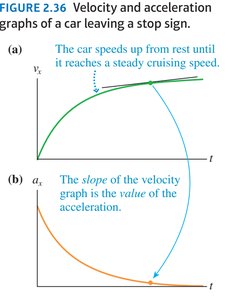
Instantaneous acceleration: The acceleration at a specific moment, given by the slope of the velocity-time graph.
Units of acceleration:
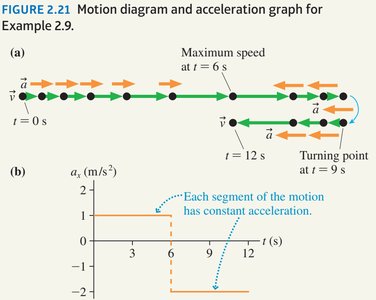
Sign of acceleration: Since acceleration is a vector, its sign indicates direction. If velocity and acceleration have the same sign, the object speeds up; if opposite, it slows down.
Example: If and , after 1 s, ; after 2 s, .

Graphical Analysis of Motion
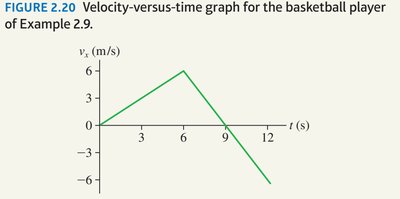
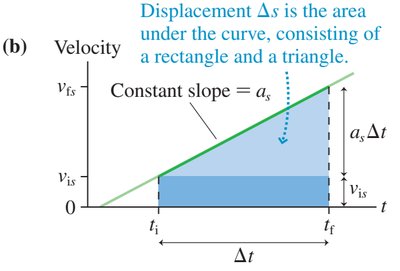
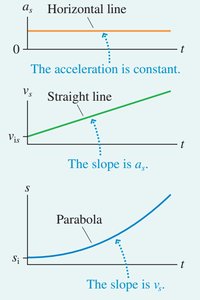
Graphs are essential tools for visualizing and analyzing motion. The slope of a velocity-time graph gives acceleration, while the area under the velocity-time graph gives displacement.
Velocity-time graph: The slope at any point gives the instantaneous acceleration.
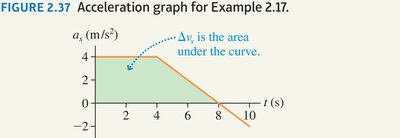
Acceleration-time graph: The area under the curve gives the change in velocity.
Constant Acceleration and Kinematic Equations
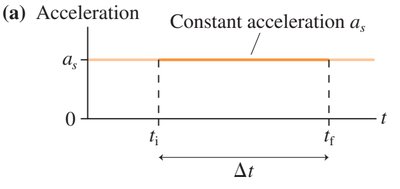
When acceleration is constant, the motion can be described using kinematic equations. These equations relate displacement, velocity, acceleration, and time.
Choose the equation based on the known and unknown quantities in the problem.
Application: Rocket Sled Problem
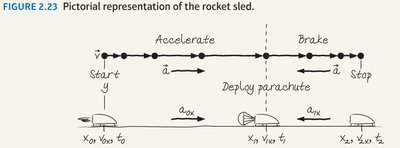
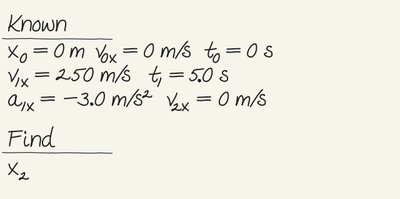
Problems involving multiple intervals of motion, such as a rocket sled that accelerates and then decelerates, require breaking the motion into segments and applying the kinematic equations to each.
First interval: Acceleration from rest to a certain velocity.
Second interval: Deceleration to rest (e.g., using a parachute).
Relative Motion and Overtaking Problems
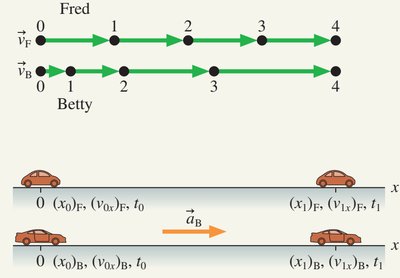
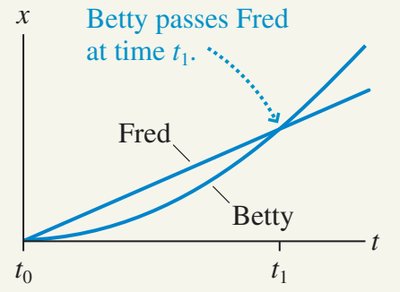
When two objects move along the same line, their positions as functions of time can be compared to determine when one overtakes the other. This often involves setting their position equations equal and solving for time.
Uniform motion:
Uniformly accelerated motion:
Free Fall and Gravity
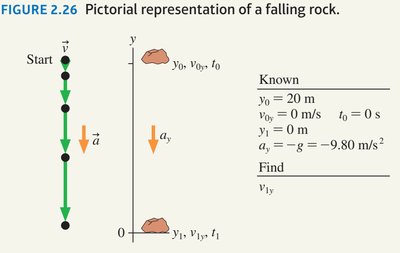
Free fall describes motion under the influence of gravity alone, neglecting air resistance. The acceleration due to gravity is downward. All objects in free fall near Earth's surface experience the same acceleration, regardless of mass.
Choose upward as positive:
At the highest point of upward motion, velocity is zero but acceleration is still .

Instantaneous Acceleration and Calculus
When acceleration varies with time, calculus is used to find instantaneous acceleration and velocity. The instantaneous acceleration is the derivative of velocity with respect to time, and the area under the acceleration-time graph gives the change in velocity.
Summary Table: Kinematic Quantities and Their Relationships
Quantity | Definition | Graphical Interpretation |
|---|---|---|
Displacement () | Change in position | Area under velocity-time graph |
Velocity () | Rate of change of position | Slope of position-time graph |
Acceleration () | Rate of change of velocity | Slope of velocity-time graph |
