 Back
BackKinematics in One Dimension: Describing Motion
Study Guide - Smart Notes
 Tailored notes based on your materials, expanded with key definitions, examples, and context.
Chapter 2: Describing Motion – Kinematics in One Dimension
Reference Frames and Displacement
Kinematics is the study of how objects move, focusing on their position, velocity, and acceleration with respect to a defined reference frame. A reference frame is a coordinate system or point of view from which measurements are made. The choice of reference frame affects how motion is described.
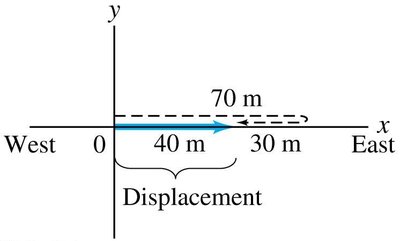
Displacement is the straight-line distance from the initial to the final position, including direction.
Distance is the total length of the path traveled, regardless of direction.
Displacement can be positive or negative, depending on the direction relative to the coordinate system.
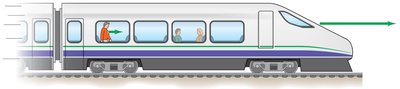
All measurements of position, distance, or speed must be made with respect to a reference frame.
Example: A person walking inside a moving train has a different speed relative to the train than to the ground.
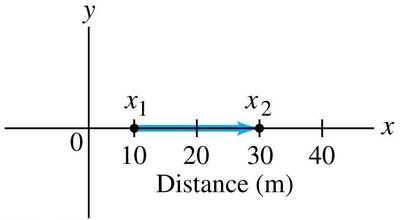
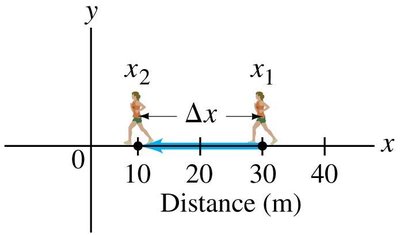
Formula for displacement:
Average Velocity and Speed
Speed is a scalar quantity representing how far an object travels in a given time interval. Velocity is a vector quantity that includes both speed and direction. Average velocity is calculated using displacement, not total distance.
Average speed:
Average velocity:


Example: If a runner moves from m to m in 4 s, the average velocity is m/s.
Instantaneous Velocity
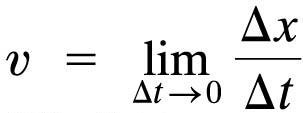
The instantaneous velocity is the velocity at a specific moment in time. It is defined as the limit of the average velocity as the time interval becomes infinitesimally short.
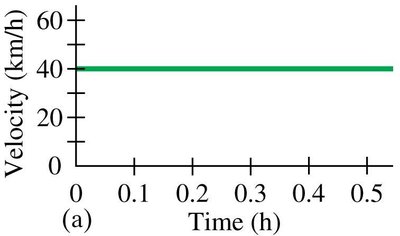
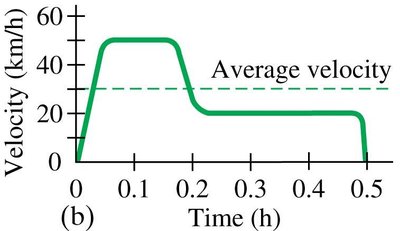
Graphically, constant velocity is shown as a horizontal line, while varying velocity changes with time.
Acceleration
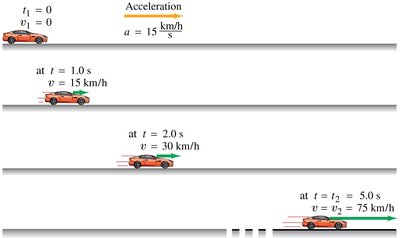
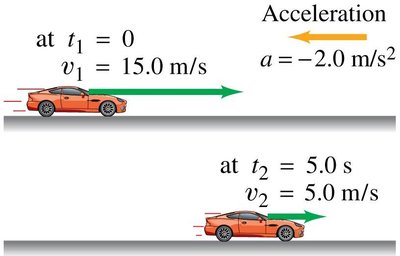
Acceleration is the rate of change of velocity with respect to time. It is a vector quantity, but in one-dimensional motion, only the sign (positive or negative) is needed to indicate direction.
Average acceleration:
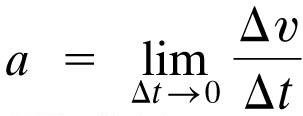
Instantaneous acceleration:
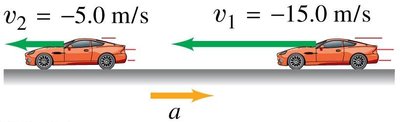
Positive acceleration increases velocity in the positive direction; negative acceleration decreases it or increases velocity in the negative direction.
Deceleration occurs when acceleration is opposite to the direction of velocity.

Motion at Constant Acceleration
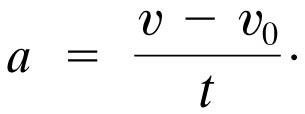
When an object moves with constant acceleration, its velocity changes at a uniform rate. Several equations describe this motion, allowing us to solve for unknown quantities such as position, velocity, and time.

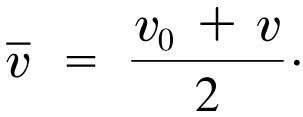
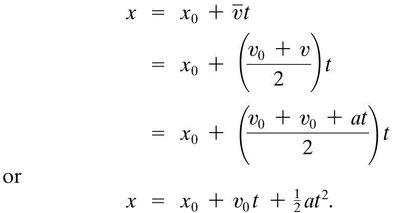
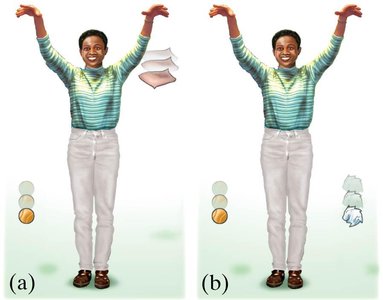
Example: If two objects accelerate from rest with the same acceleration, but one accelerates for twice the time, the distance traveled is four times greater (since ).
Solving Kinematics Problems
Solving problems in kinematics involves a systematic approach:
Read and understand the problem.
Identify the objects and time interval.
Draw a diagram and choose coordinate axes.
List known and unknown quantities.
Determine which physics principles apply.
Select appropriate equations and solve algebraically.
Calculate and round the answer.
Check if the result is reasonable and units are correct.
Freely Falling Objects
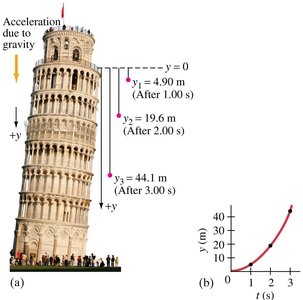
Near Earth's surface, all objects experience the same acceleration due to gravity, approximately . In the absence of air resistance, all objects fall with the same acceleration, regardless of mass.
Acceleration due to gravity:
Example: A ball dropped from a tower falls a distance after time .
Objects thrown upward decelerate at until they reach their highest point, then accelerate downward at .

Summary of Key Concepts
Kinematics describes how objects move with respect to a reference frame.
Displacement is the change in position of an object.
Average speed is the distance traveled divided by the time taken.
Average velocity is the displacement divided by the time taken.
Instantaneous velocity is the velocity at a specific instant, found as the time interval approaches zero.
Acceleration is the rate of change of velocity, and for freely falling objects near Earth's surface, it is .
