 Back
BackKinematics in One Dimension: Describing Motion
Study Guide - Smart Notes
 Tailored notes based on your materials, expanded with key definitions, examples, and context.
Kinematics in One Dimension
Introduction to Kinematics
Kinematics is the branch of physics that describes the motion of objects without considering the causes of motion. It focuses on quantities such as position, displacement, velocity, and acceleration, and how these change over time.
Reference Frames and Displacement
All measurements of position, distance, or speed must be made relative to a reference frame. A reference frame is a coordinate system or point of view from which motion is observed and measured.
Reference Frame: The perspective from which position and motion are measured. It can be stationary or moving.
Position: The location of an object within a reference frame, often given as a coordinate value.
Displacement (\(\Delta x\)): The straight-line distance and direction from the starting point to the ending point. It is a vector quantity.
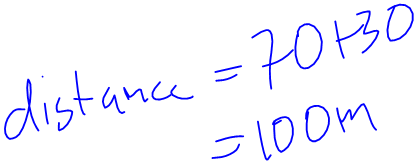
Distance: The total length of the path traveled, regardless of direction. It is a scalar quantity.
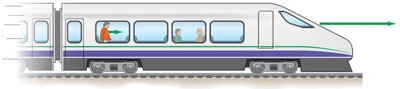
For one-dimensional motion, the reference frame can be represented by a number line. For two-dimensional motion, Cartesian coordinates are used.
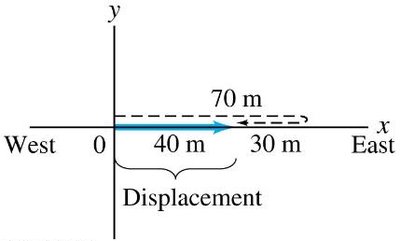
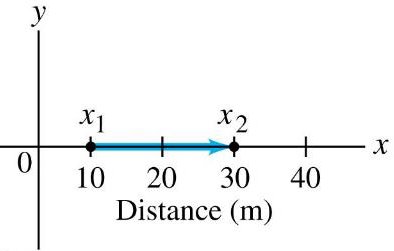
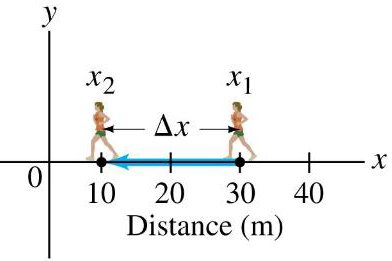
Displacement Equation: $\Delta x = x_2 - x_1$
By convention, right (or east) is positive, left (or west) is negative.
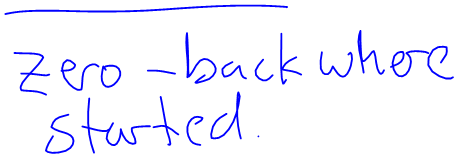
Distance vs. Displacement
Distance is the total path length traveled, while displacement is the straight-line change in position. For example, running around a block and returning to the starting point results in zero displacement but a nonzero distance traveled.
Speed and Velocity
Speed and velocity describe how fast an object moves, but velocity also includes direction.
Speed: The rate of change of distance with time. Scalar quantity.
Velocity: The rate of change of displacement with time. Vector quantity.
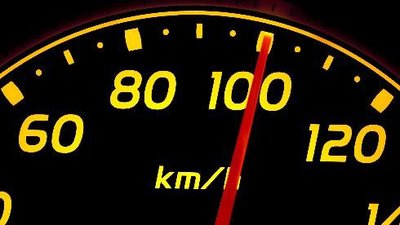
Speed, distance, and time are scalars; velocity, displacement, and position are vectors.
Average Velocity
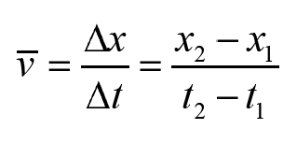
Average velocity is defined as the total displacement divided by the total time interval.
Formula: $\overline{v} = \frac{\Delta x}{\Delta t} = \frac{x_2 - x_1}{t_2 - t_1}$
Example: If a pebble is dropped from a bridge and falls 62 m in 3.5 s, the average velocity is $\overline{v} = \frac{-62\,\text{m}}{3.5\,\text{s}} = -17.7\,\text{m/s}$ (negative sign indicates downward direction).
Instantaneous Velocity
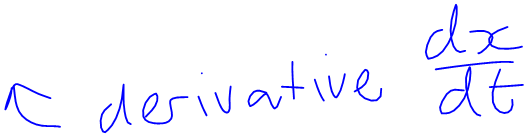
Instantaneous velocity is the velocity at a specific instant in time. It is the slope of the position vs. time graph at a given point.
Mathematical Definition: $v = \lim_{\Delta t \to 0} \frac{\Delta x}{\Delta t} = \frac{dx}{dt}$
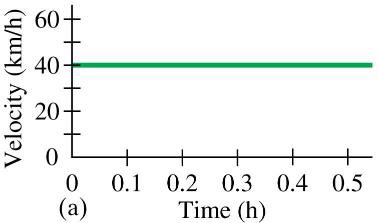
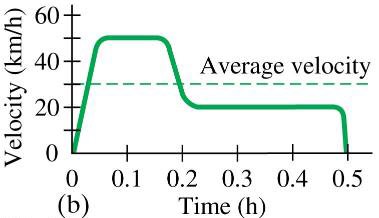
On a position-time graph, the instantaneous velocity is the slope of the tangent line at the point of interest.
Acceleration
Acceleration is the rate of change of velocity with respect to time. It can be constant or variable.
Average Acceleration: $\overline{a} = \frac{\Delta v}{\Delta t} = \frac{v_2 - v_1}{t_2 - t_1}$
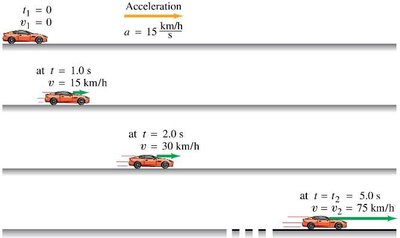
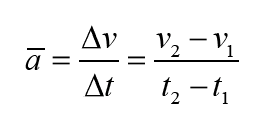
If acceleration is not constant, the instantaneous acceleration is the slope of the velocity vs. time graph at a given point.
Negative Acceleration vs. Deceleration
Negative acceleration refers to acceleration in the negative direction as defined by the coordinate system. Deceleration occurs when acceleration is opposite to the direction of velocity.
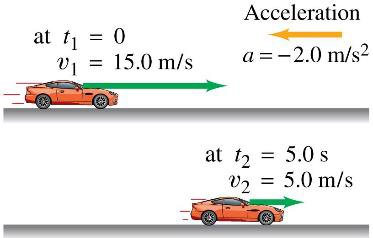
Negative Acceleration: Acceleration in the negative direction.
Deceleration: Acceleration opposite to the direction of velocity.
Equations of Motion for Constant Acceleration
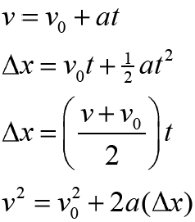
When acceleration is constant, the following equations can be used to solve kinematics problems:
$v = v_0 + at$
$\Delta x = v_0 t + \frac{1}{2} a t^2$
$\Delta x = \left(\frac{v + v_0}{2}\right)t$
$v^2 = v_0^2 + 2a(\Delta x)$

Problem-Solving Strategy in Kinematics
To solve kinematics problems, follow these steps:
Understand the problem: Read carefully, draw diagrams, and list knowns and unknowns.
Devise a strategy: Decide which equations and principles apply.
Carry out the plan: Perform calculations, keeping track of units.
Check your answer: Ensure the result is reasonable and consistent with the problem.
State the answer clearly: Include units and significant figures.
Freely Falling Objects
In the absence of air resistance, all objects near Earth's surface fall with the same constant acceleration, called g.
Acceleration due to gravity: $g = 9.80\,\text{m/s}^2$ (downward)
For free-fall, use the kinematic equations with $a = -g$ (if up is positive).
Common equations for free-fall (up is positive):
$v = v_0 - gt$
$v^2 = v_0^2 - 2g\Delta y$
$\Delta y = v_0 t - \frac{1}{2} g t^2$
$\Delta y = \frac{v + v_0}{2} t$
Example: If a ball is thrown straight up at 5.0 m/s and caught at the same height, you can use these equations to find the time in the air and the maximum height reached.
Summary Table: Scalars vs. Vectors
Quantity | Type | Definition |
|---|---|---|
Distance | Scalar | Total path length traveled |
Displacement | Vector | Straight-line change in position |
Speed | Scalar | Rate of change of distance |
Velocity | Vector | Rate of change of displacement |
Acceleration | Vector | Rate of change of velocity |
Key Takeaways
Always define your reference frame and indicate positive and negative directions.
Use the correct kinematic equations for constant acceleration problems.
Distinguish between scalar and vector quantities in all calculations.
Check units and significant figures in all answers.
