 Back
BackKinematics in One Dimension: Motion, Velocity, and Acceleration
Study Guide - Smart Notes
 Tailored notes based on your materials, expanded with key definitions, examples, and context.
Concepts of Motion in One Dimension
Uniform Motion
Uniform motion refers to the movement of an object along a straight line at a constant speed. In this case, the object's position changes by equal amounts in equal time intervals, and the position vs. time graph is a straight line.
Definition: Motion with unvarying speed along a straight line.
Average velocity: , where is the displacement and is the time interval.
Graphical interpretation: The slope of the position vs. time graph gives the average velocity.
Vertical motion: For vertical motion, , but the behavior is analogous.
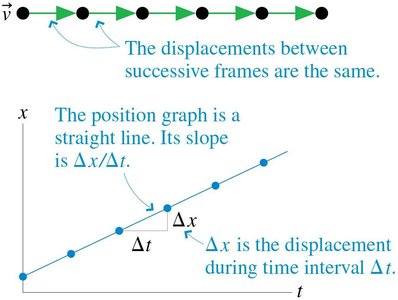
Interpreting Position vs. Time Graphs
Position vs. time graphs provide valuable information about an object's motion. The slope of the graph at any point indicates the object's velocity.
Steeper slopes correspond to faster speeds.
Negative slopes indicate negative velocities (motion to the left or down).
Slope calculation: The slope is a ratio of intervals, , not simply .
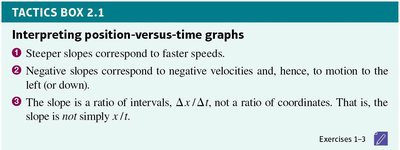
The Mathematics of Uniform Motion
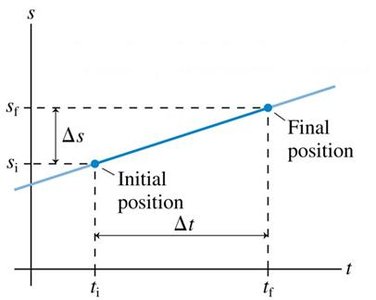
Uniform motion can be described mathematically using the following equations:
Displacement:
Time interval:
Velocity:
Final position:
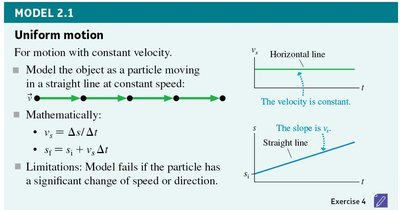
Uniform Motion Model
The uniform motion model applies when an object moves with constant velocity. The position changes linearly with time, and the velocity remains constant.
Mathematical model: and
Limitations: The model fails if the particle's speed or direction changes significantly.
Velocity and Calculus in Kinematics
Instantaneous Velocity
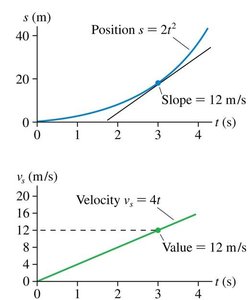
Instantaneous velocity is the velocity of an object at a specific instant in time. It is defined as the derivative of position with respect to time.
Definition:
Graphical meaning: The instantaneous velocity is the slope of the tangent to the position vs. time curve at a given point.
Using Derivatives to Find Velocity
If the position of a particle is given as a function of time, , the velocity is found by differentiating $s(t)$ with respect to .
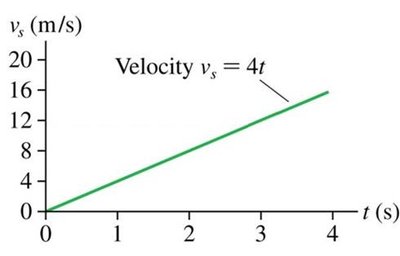
Example: If , then .
At s, m/s.
Finding Position from Velocity (Integration)
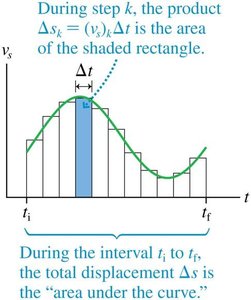
To determine an object's position from its velocity, we use integration. The total displacement is the area under the velocity vs. time curve.
Discrete sum:
Continuous case:
Graphical interpretation: The area under the vs. curve between and gives the displacement.
Motion with Constant Acceleration
Acceleration and Its Graphical Representation
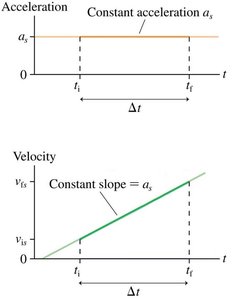
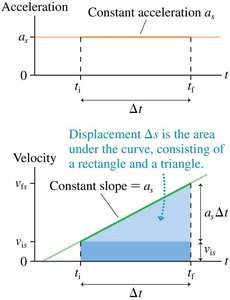
Acceleration is the rate of change of velocity. For constant acceleration, the velocity changes linearly with time, and the acceleration vs. time graph is a horizontal line.
Average acceleration:
Units: m/s2
Constant acceleration:
Kinematic Equations for Constant Acceleration
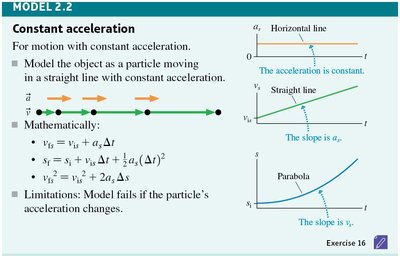
The kinematic equations relate displacement, velocity, acceleration, and time for motion with constant acceleration:
Problem-Solving Strategy: Kinematics with Constant Acceleration
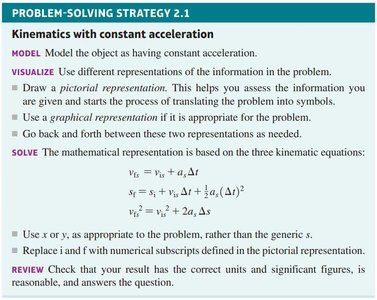
To solve kinematics problems involving constant acceleration:
Model the object as having constant acceleration.
Visualize the problem using pictorial and graphical representations.
Solve using the appropriate kinematic equations.
Review the result for correct units, significant figures, and reasonableness.
Special Cases in One-Dimensional Motion
Free Fall
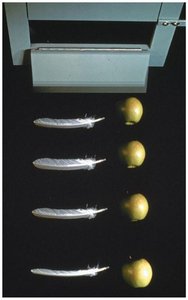
Free fall describes the motion of objects under the influence of gravity alone. All objects in free fall near Earth's surface experience the same acceleration, regardless of mass (neglecting air resistance).
Acceleration due to gravity: , where m/s2 (downward).
Key point: In a vacuum, all objects fall at the same rate.
Example: The Springbok's Leap
The springbok, an antelope, demonstrates projectile motion by leaping vertically into the air. The leap consists of two phases: acceleration while on the ground, and free fall after takeoff.
Phase 1: Accelerates at $35 m to determine takeoff velocity.
Phase 2: Rises under gravity alone (free fall).

Motion on an Inclined Plane
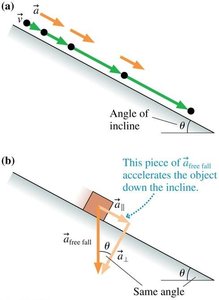
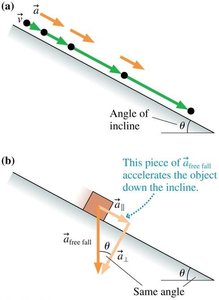
When an object slides down an inclined plane, the acceleration due to gravity can be resolved into components parallel and perpendicular to the incline.
Parallel component:
Perpendicular component:
The motion along the incline is governed by (sign depends on direction).
Instantaneous Acceleration and Non-Constant Acceleration
Instantaneous Acceleration
Instantaneous acceleration is the rate of change of velocity at a specific instant. It is the derivative of velocity with respect to time.
Definition:
Graphical meaning: The slope of the velocity vs. time graph at a given point.
Finding Velocity from Acceleration (Integration)
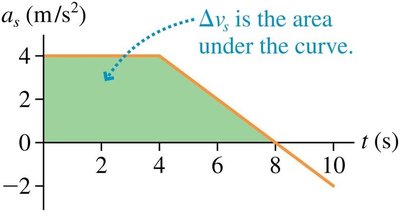
If acceleration is a function of time, velocity can be found by integrating acceleration over time. The area under the acceleration vs. time curve gives the change in velocity.
Equation:
Graphical interpretation: The area under the vs. curve between and gives the change in velocity.
Summary Table: Kinematic Equations for Constant Acceleration
Equation | Variables | When to Use |
|---|---|---|
Final velocity, initial velocity, acceleration, time | When time is known or needed | |
Final position, initial position, initial velocity, acceleration, time | When time is known or needed | |
Final velocity, initial velocity, acceleration, displacement | When time is not given |
