 Back
BackKinematics in One Dimension: Position, Velocity, and Acceleration
Study Guide - Smart Notes
 Tailored notes based on your materials, expanded with key definitions, examples, and context.
Kinematics in One Dimension
Introduction to Kinematics
Kinematics is the branch of physics that describes the motion of objects without considering the causes of motion. In one-dimensional motion, we focus on the movement of a particle along a straight line, typically the x-axis. The primary quantities of interest are position, displacement, velocity, speed, and acceleration.
Position and Displacement
Position
The position of a particle is its location along a coordinate axis, usually denoted as x. The position can change as the particle moves.
Coordinate x: The value of x specifies the location of the particle relative to the origin (x = 0).
Displacement
Displacement is the change in position of a particle. It is a vector quantity, meaning it has both magnitude and direction.
Formula:
Displacement can be positive, negative, or zero, depending on the direction of motion.
Displacement differs from distance traveled, which is the total length of the path taken, regardless of direction.
Example: If a particle moves from x = 2 m to x = 5 m, then back to x = 2 m, the displacement is 0 m, but the distance traveled is 6 m.
Average Velocity and Speed
Average Velocity
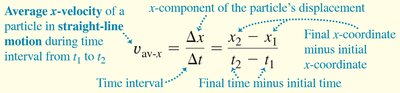
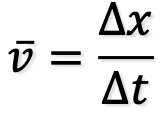
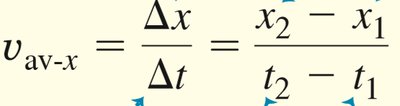
Average velocity is the displacement divided by the time interval during which the displacement occurs. It is a vector quantity.
Formula:
Units: meters per second (m/s)
Direction is important; a negative velocity indicates motion in the negative x-direction.
Average Speed
Average speed is the total distance traveled divided by the time interval. It is a scalar quantity and does not have a direction.
Formula:
Always positive or zero.
Position-Time Graphs
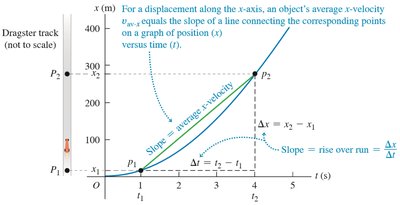
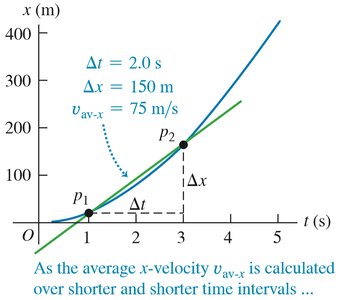
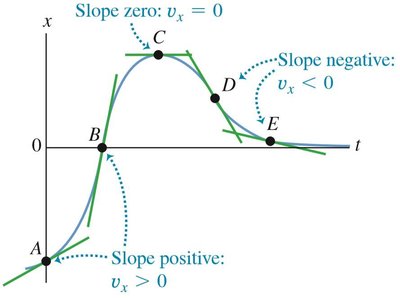
Position-time graphs visually represent how the position of a particle changes over time. The slope of the line on a position-time graph gives the velocity.
A straight line indicates constant velocity.
A curved line indicates changing velocity (acceleration).
Instantaneous Velocity
Definition and Calculation
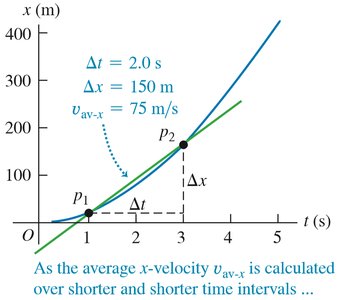
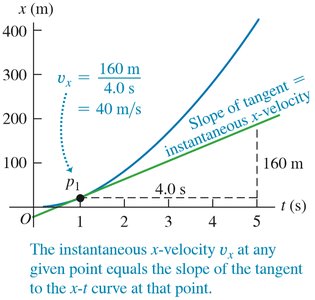
Instantaneous velocity is the velocity of a particle at a specific instant in time. It is the derivative of position with respect to time.
Formula:
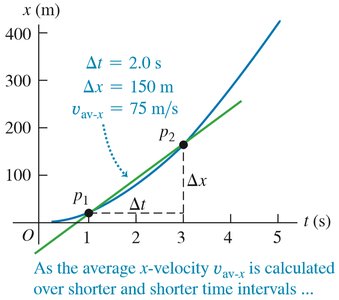
It represents the slope of the tangent to the position-time curve at a given point.

Graphical Interpretation
The instantaneous velocity at a point on a position-time graph is found by drawing a tangent to the curve at that point and calculating its slope.
Sign of Velocity
Interpreting Velocity Direction
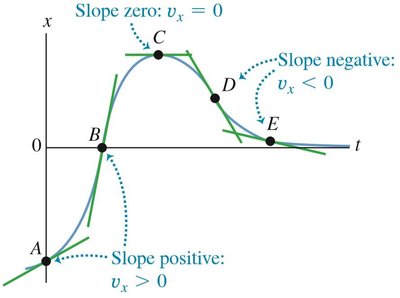
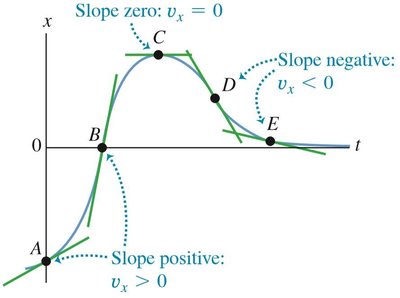
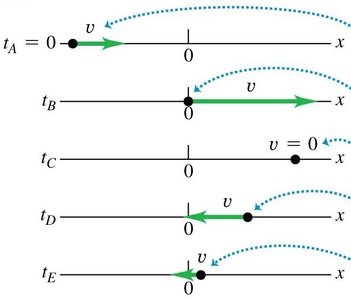
The sign of velocity indicates the direction of motion along the x-axis.
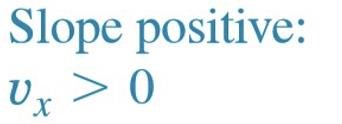
Positive velocity: motion in the +x direction.
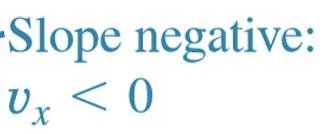
Negative velocity: motion in the -x direction.
Zero velocity: particle is momentarily at rest.
Motion Diagrams
Connecting Graphs and Physical Motion
Motion diagrams use a series of images or arrows to represent the position and velocity of a particle at different times. These diagrams help visualize the relationship between position, velocity, and time.
Acceleration
Average Acceleration
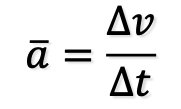
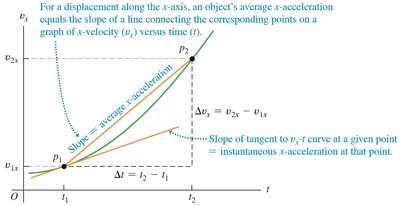
Acceleration is the rate of change of velocity with respect to time. Average acceleration is calculated over a time interval.
Formula:
Units: meters per second squared (m/s2)
Instantaneous Acceleration
Instantaneous acceleration is the acceleration at a specific instant in time. It is the derivative of velocity with respect to time.
Formula:

Graphical Interpretation of Acceleration
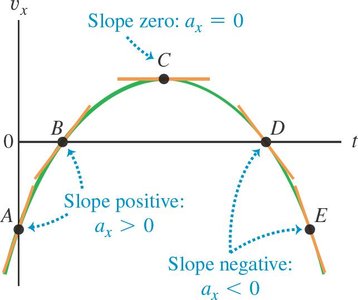
On a velocity-time graph, the slope at any point gives the instantaneous acceleration. A straight line indicates constant acceleration, while a curve indicates changing acceleration.
Summary Table: Key Kinematic Quantities
Quantity | Definition | Formula | Units | Vector/Scalar |
|---|---|---|---|---|
Displacement | Change in position | m | Vector | |
Distance | Total path length | — | m | Scalar |
Average velocity | Displacement per time interval | m/s | Vector | |
Average speed | Distance per time interval | m/s | Scalar | |
Instantaneous velocity | Rate of change of position | m/s | Vector | |
Average acceleration | Change in velocity per time interval | m/s2 | Vector | |
Instantaneous acceleration | Rate of change of velocity | m/s2 | Vector |
Key Takeaways
Kinematics describes motion using position, velocity, and acceleration.
Displacement and velocity are vector quantities; distance and speed are scalars.
Graphs are powerful tools for visualizing and interpreting motion.
Instantaneous quantities are found using derivatives; average quantities use finite intervals.
