 Back
BackKinematics in One Dimension: Position, Velocity, and Acceleration
Study Guide - Smart Notes
 Tailored notes based on your materials, expanded with key definitions, examples, and context.
Chapter 2: Kinematics in One Dimension
Introduction to Kinematics
Kinematics is the branch of physics that describes the motion of objects without considering the causes of motion. In one-dimensional kinematics, we analyze motion along a straight line, focusing on position, velocity, and acceleration as functions of time.

Uniform Motion
Definition and Representation
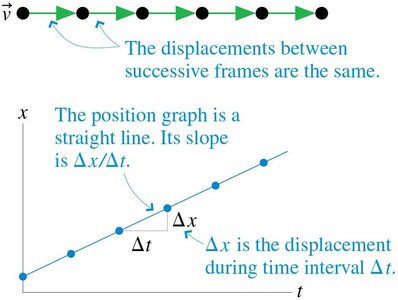
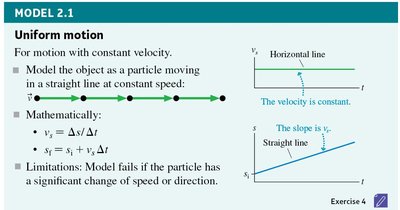
Uniform motion refers to motion along a straight line at a constant speed. The position-versus-time graph for uniform motion is a straight line, indicating that the object covers equal displacements in equal time intervals.
Position (x or s): The location of an object along a straight line.
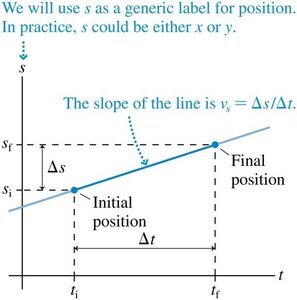
Displacement (Δx): The change in position, Δx = xf - xi.
Average velocity (vavg): The rate of change of position, .
Mathematical Model of Uniform Motion
The position at any time t is given by:
Interpreting Position-versus-Time Graphs
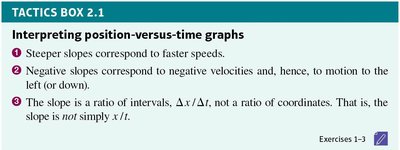
Steeper slopes correspond to faster speeds.
Negative slopes indicate negative velocities (motion to the left or down).
The slope is a ratio of intervals, not simply x/t.
Scalars and Vectors in Kinematics
Key Quantities
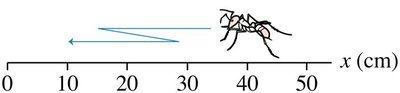
Distance: Scalar quantity representing the total path length traveled, independent of direction.
Displacement: Vector quantity equal to the straight-line change in position.
Speed: Scalar, always positive, representing how fast an object is moving.
Velocity: Vector, includes both magnitude and direction. In one dimension, direction is indicated by sign (+ or –).
Relating Position and Velocity Graphs
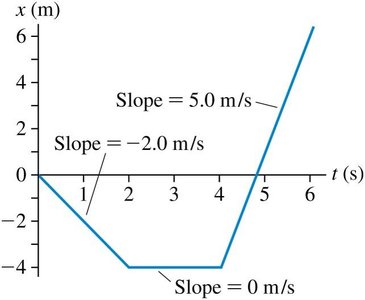
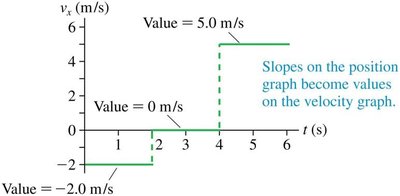
Example: Car Motion Analysis
The slope of the position-versus-time graph at any interval gives the velocity during that interval. For piecewise linear graphs, each segment's slope corresponds to a constant velocity.
Instantaneous Velocity
Definition and Calculus Connection
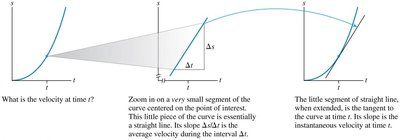
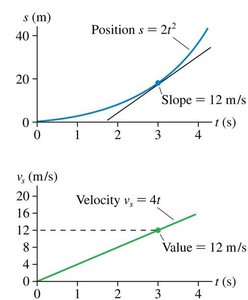
Instantaneous velocity is the velocity at a specific instant, defined as the derivative of position with respect to time:
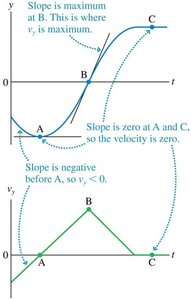
Graphically, it is the slope of the tangent to the position-versus-time curve at a given point.
Analyzing Motion Graphically
Velocity from Position Graphs
The value of the velocity graph at any instant equals the slope of the position graph at that instant. Maximum and minimum points on the position graph correspond to zero velocity (turning points).
Calculus in Kinematics
Derivatives and Integrals
The derivative of position with respect to time gives velocity:
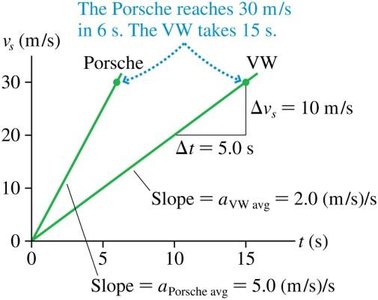
The derivative of velocity with respect to time gives acceleration:
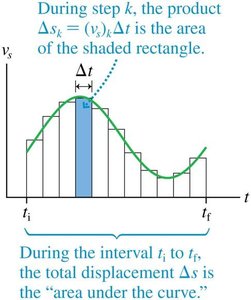
The integral of velocity over time gives displacement:
Motion with Constant Acceleration
Definition and Equations
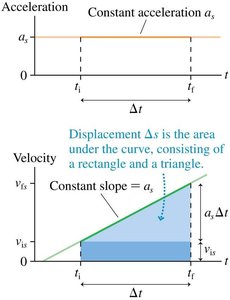
Acceleration is the rate of change of velocity. For constant acceleration, the following kinematic equations apply:
Free Fall and Gravity
Free Fall Motion
Objects in free fall experience constant acceleration due to gravity, downward near Earth's surface. All objects, regardless of mass, fall with the same acceleration in the absence of air resistance.
Summary of Key Concepts
Position, velocity, and acceleration are related through derivatives and integrals.
Displacement is the area under the velocity-time curve.
Uniform motion yields straight-line position-time graphs; constant acceleration yields parabolic position-time graphs.
Turning points on position graphs correspond to zero velocity.
Table: Summary of Kinematic Quantities
Quantity | Symbol | Definition | SI Unit |
|---|---|---|---|
Position | x or s | Location along a line | m |
Displacement | Δx | Change in position | m |
Velocity | v | Rate of change of position | m/s |
Acceleration | a | Rate of change of velocity | m/s² |
Additional info: This summary includes foundational calculus concepts (derivatives and integrals) as applied to kinematics, as well as the interpretation of motion graphs, which are essential for Physics with Calculus students.
