 Back
Kinematics in One Dimension: Position, Velocity, and Calculus in Motion
Study Guide - Smart Notes
 Tailored notes based on your materials, expanded with key definitions, examples, and context.
Ch. 2: Kinematics in One Dimension
Uniform Motion
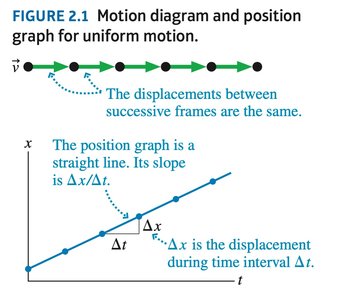
Kinematics in one dimension studies the motion of objects along a straight line, focusing on position, velocity, and acceleration. Uniform motion refers to motion at a constant velocity, where the object's displacement is the same during equal time intervals.
Position (x): The location of an object along a straight line, measured from a reference point.
Displacement (\( \Delta x \)): The change in position over a time interval \( \Delta t \).
Uniform Velocity (v): The rate of change of position, given by the slope of the position-time graph.
Key Equation:
Position and Velocity Graphs
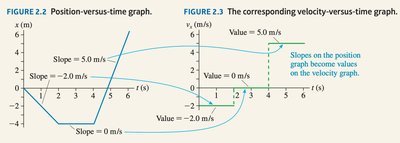
The position-versus-time graph for uniform motion is a straight line, and its slope represents the velocity. The velocity-versus-time graph is a horizontal line for uniform motion, indicating constant velocity.
Positive Slope: Object moves in the positive direction.
Negative Slope: Object moves in the negative direction.
Zero Slope: Object is at rest.
Example: Solving Uniform Motion Problems
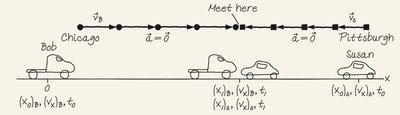
To solve problems involving two objects moving toward each other, set up equations for each object's position as a function of time and solve for the meeting point.
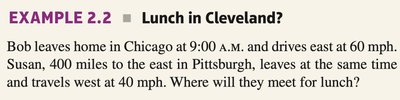
Example: Bob leaves Chicago at 60 mph east, Susan leaves Pittsburgh (400 miles east of Chicago) at 40 mph west. Where do they meet?
Solution Outline:
Let Bob's position:
Susan's position:
Set and solve for to find the meeting time and position.
Non-Uniform Motion and Acceleration
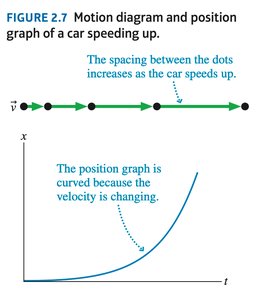
When an object's velocity changes, it experiences acceleration. The position-versus-time graph becomes curved, and the velocity-versus-time graph is no longer a horizontal line.
Acceleration (a): The rate of change of velocity with respect to time.
For constant acceleration, the position graph is a parabola, and the velocity graph is a straight line with nonzero slope.
Calculus in Kinematics: Derivatives and Integrals
Calculus provides tools to relate position, velocity, and acceleration:
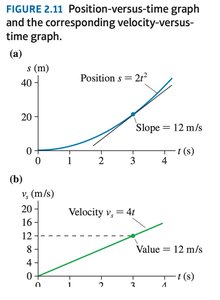
Velocity is the derivative of position:
Acceleration is the derivative of velocity:
Position is the integral of velocity:
Graphical Interpretation: Slope and Area
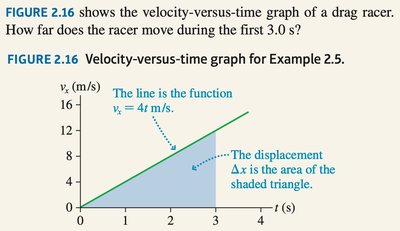
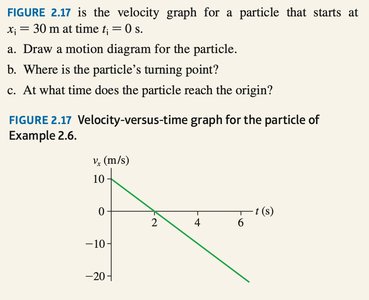
The slope of the position-time graph gives velocity, while the area under the velocity-time graph gives displacement.
Example: For , the velocity is .
The area under the velocity-time graph between and equals the change in position.
Practice: Matching Graphs and Calculus Applications
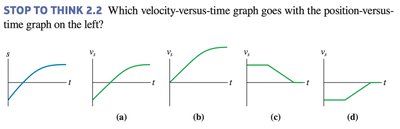
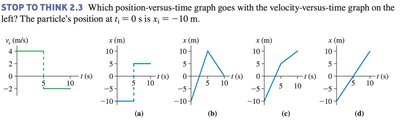
Understanding how to match position and velocity graphs is essential for interpreting motion. Practice problems often ask which velocity graph corresponds to a given position graph, or vice versa.
Summary Table: Kinematic Quantities and Their Relationships
Quantity | Symbol | Definition | Graphical Meaning |
|---|---|---|---|
Position | x | Location along a line | y-axis on position-time graph |
Velocity | v | Rate of change of position | Slope of position-time graph |
Acceleration | a | Rate of change of velocity | Slope of velocity-time graph |
Displacement | \( \Delta x \) | Change in position | Area under velocity-time graph |
Key Formulas for One-Dimensional Kinematics
Uniform motion:
Constant acceleration:
Velocity with constant acceleration:
Additional info: These notes cover the essential calculus-based relationships between position, velocity, and acceleration in one-dimensional motion, including graphical interpretations and problem-solving strategies. Practice matching graphs and using calculus to move between position, velocity, and acceleration for a complete understanding of kinematics in one dimension.
