 Back
Kinematics in One Dimension: Structured Study Notes
Study Guide - Smart Notes
 Tailored notes based on your materials, expanded with key definitions, examples, and context.
Describing Motion: Kinematics in One Dimension
Introduction to Kinematics
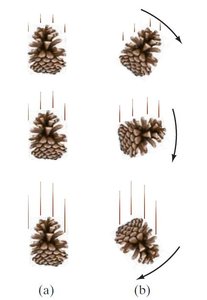
Kinematics is the branch of classical mechanics that describes the motion of objects without considering the causes of motion. In this chapter, we focus on one-dimensional translational motion, where objects move along a straight line. The particle model is often used, treating objects as points to simplify analysis when size and shape are not important.
Kinematics: Describes how objects move (position, velocity, acceleration).
Dynamics: Explains why objects move (forces, torques, energy).
Particle Model: Useful for analyzing motion when the object's size and rotation are negligible.
Example: A billiard ball or a spacecraft can be modeled as a particle for many calculations.
Reference Frames and Displacement
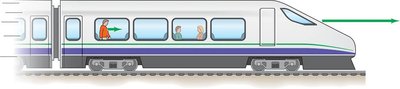
All measurements of position, speed, or distance depend on the chosen reference frame. A coordinate system (usually x and y axes) is used to define position and direction. For one-dimensional motion, the x-axis (horizontal) or y-axis (vertical) is typically used.
Reference Frame: The perspective from which motion is measured.
Origin: The point where x = 0, y = 0.
Relative Motion Example: A person walking inside a moving train has different speeds relative to the train and the ground.

Distance and Displacement
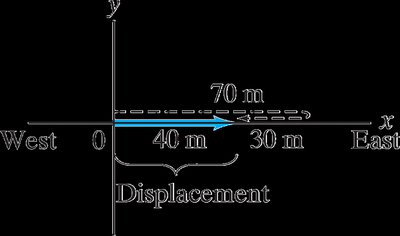
Distance is the total length traveled, regardless of direction, while displacement is the straight-line change from the starting point to the endpoint. Displacement is a vector, having both magnitude and direction.
Distance: Scalar quantity; total path length traveled.
Displacement: Vector quantity; change in position from initial to final point.
Example: Walking 70 m east and then 30 m west results in a total distance of 100 m but a displacement of 40 m east.
Calculating Displacement
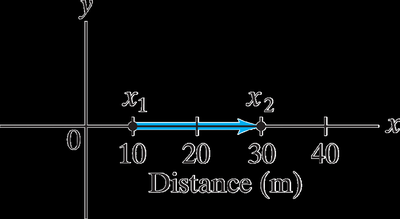
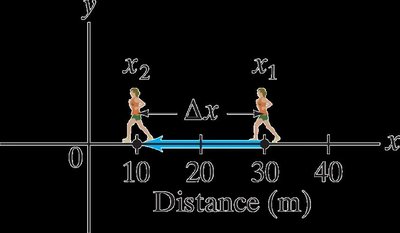
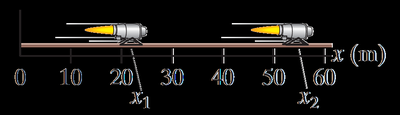
Displacement is calculated as the difference between the final and initial positions. The sign indicates direction (positive for right/up, negative for left/down).
Formula:
Example 1: , , so (rightward).
Example 2: , , so (leftward).
Average Speed and Velocity
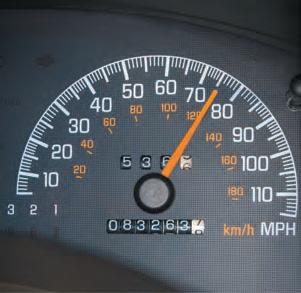
Speed and velocity describe how fast an object moves. Speed is a scalar (no direction), while velocity is a vector (includes direction). Average speed is total distance divided by time, while average velocity is displacement divided by time.
Average Speed:
Average Velocity:
Example: Walking 70 m east and 30 m west in 70 s: average speed = 1.43 m/s, average velocity = 0.57 m/s east.
Instantaneous Velocity
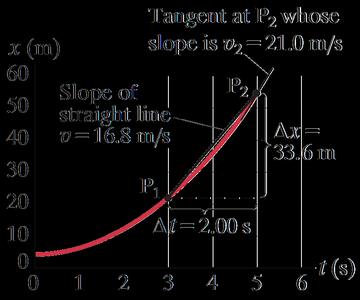
Instantaneous velocity is the velocity at a specific moment in time. It is the derivative of position with respect to time and is shown by the slope of the tangent to the position-time graph at a point.
Definition:
Instantaneous Speed: The magnitude of instantaneous velocity.
Graphical Interpretation: Slope of the tangent line at a point on the x vs. t graph.
Acceleration
Acceleration measures how quickly velocity changes. It is a vector and can be positive or negative depending on direction. Average acceleration is the change in velocity divided by the time interval.
Average Acceleration:
Units: m/s2 (meters per second squared)
Example: A car accelerates from 0 to 25 m/s in 5 s:
Deceleration and Direction of Acceleration
Acceleration can be positive or negative. Deceleration refers to an object slowing down, which occurs when acceleration and velocity are in opposite directions.
Deceleration: Object slows down; acceleration opposes velocity.
Example: Car moving right (+x) and slowing down has negative acceleration.
Instantaneous Acceleration
Instantaneous acceleration is the derivative of velocity with respect to time, or the second derivative of position with respect to time. On a velocity-time graph, it is the slope of the tangent at a point.
Definition:
Second Derivative:
Equations of Motion for Constant Acceleration
When acceleration is constant, the following kinematic equations relate position, velocity, acceleration, and time:
These equations are fundamental for solving problems involving constant acceleration.
Freely Falling Objects
In the absence of air resistance, all objects near Earth's surface fall with the same constant acceleration due to gravity, , directed downward. The kinematic equations apply, with replaced by and position variables often denoted as and for vertical motion.
Galileo's Discovery: Distance fallen is proportional to time squared ().
Direction: Choose upward or downward as positive, but be consistent.
Variable Acceleration and Calculus
When acceleration is not constant, calculus is used to derive velocity and position as functions of time. Integration of the acceleration function yields velocity, and integration of velocity yields position.
Velocity from Acceleration:
Position from Velocity:
Example: For , , (after integration).
Additional info: These notes cover the essential concepts and equations for one-dimensional kinematics, including calculus-based approaches for variable acceleration, as required in a Physics with Calculus college course.
