 Back
BackKinematics in Two Dimensions: Acceleration and Projectile Motion
Study Guide - Smart Notes
 Tailored notes based on your materials, expanded with key definitions, examples, and context.
Kinematics in Two Dimensions
Finding the Acceleration Vector
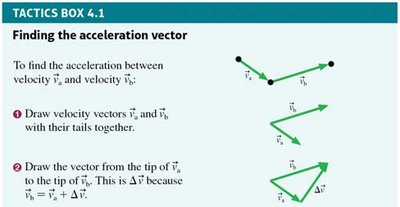
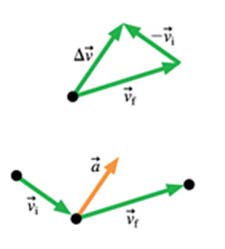
In two-dimensional motion, acceleration is a vector quantity that describes how the velocity of an object changes over time. To determine the acceleration vector between two velocity vectors, follow these steps:
Draw velocity vectors \( \vec{v}_i \) and \( \vec{v}_f \) with their tails together.
Construct the change in velocity vector \( \Delta \vec{v} = \vec{v}_f - \vec{v}_i \) by drawing a vector from the tip of \( \vec{v}_i \) to the tip of \( \vec{v}_f \).
Average acceleration is then \( \vec{a}_{avg} = \frac{\Delta \vec{v}}{\Delta t} \).
Decomposing Acceleration
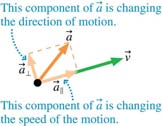
Acceleration can be decomposed into two components relative to the velocity vector:
Parallel component \( \vec{a}_\parallel \): Changes the speed of the object.
Perpendicular component \( \vec{a}_\perp \): Changes the direction of the object.
Any change in direction requires a perpendicular acceleration component.
Mathematical Description of Acceleration
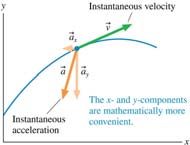
Acceleration is defined as the rate of change of velocity with respect to time. For a particle moving in the x-y plane:
Instantaneous acceleration is given by
It can be decomposed into x and y components:
Projectile Motion
Definition and Characteristics
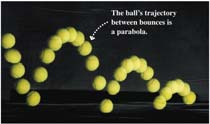
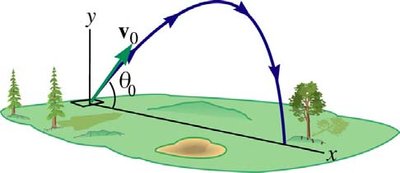
Projectile motion describes the motion of an object moving in two dimensions under the influence of gravity alone, neglecting air resistance. The trajectory is always a parabola.
Examples: Baseballs, tennis balls, and divers exhibit projectile motion.
Trajectory: Parabolic path due to constant acceleration in the vertical direction.
Initial Velocity and Launch Angle
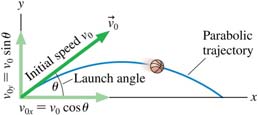
The initial velocity of a projectile can be broken into horizontal and vertical components using the launch angle \( \theta \):
Equations of Motion for Projectiles
Projectile motion is governed by the following equations, assuming constant acceleration:
Horizontal motion:
Vertical motion:
Graphical Representation of Projectile Motion
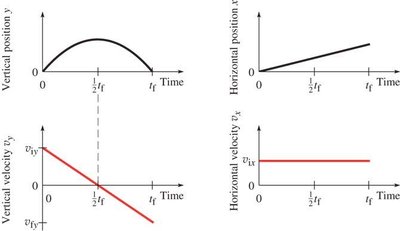
The position and velocity of a projectile as functions of time can be represented graphically:
Vertical position y vs. time: Parabolic curve.
Horizontal position x vs. time: Linear increase.
Vertical velocity v_y vs. time: Linear decrease.
Horizontal velocity v_x vs. time: Constant.
Equation of the Trajectory
The trajectory of a projectile can be described by eliminating time from the position equations:
Substitute into the equation for y:
This is the equation of a parabola.
Range, Maximum Height, and Flight Time
Key quantities for projectile motion:
Range (R): The horizontal distance traveled.
Maximum height (h):
Flight time (T):
Maximum range occurs at .
Independence of Horizontal and Vertical Motions
The horizontal and vertical components of projectile motion are independent, connected only by the time of flight. This principle explains why two objects dropped from the same height, one horizontally and one vertically, hit the ground simultaneously (neglecting air resistance).
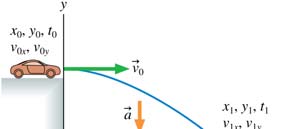
Example: Horizontal Launch from a Cliff
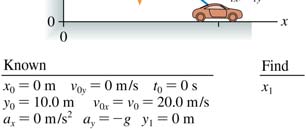
Consider a car driving off a cliff horizontally:
Initial vertical velocity
Initial horizontal velocity
Vertical displacement
Horizontal displacement
Time to hit the ground:
Horizontal distance traveled:
Reasoning About Projectile Motion
When two balls are released from the same height, one dropped vertically and one launched horizontally, both hit the ground at the same time if air resistance is neglected. This demonstrates the independence of horizontal and vertical motions.
Summary Table: Key Equations for Projectile Motion
Quantity | Equation | Description |
|---|---|---|
Horizontal position | Linear motion, constant velocity | |
Vertical position | Parabolic motion, constant acceleration | |
Range | Maximum horizontal distance | |
Maximum height | Highest point reached | |
Flight time | Total time in air |
Additional info: The notes above expand on brief points and diagrams, providing full academic context and explanations suitable for college-level physics students. All images included are directly relevant to the explanation of the adjacent paragraphs, visually reinforcing the concepts of acceleration vectors and projectile motion.
