 Back
Kinematics in Two Dimensions and Vectors – Study Notes
Study Guide - Smart Notes
 Tailored notes based on your materials, expanded with key definitions, examples, and context.
Chapter 3: Kinematics in Two Dimensions; Vectors
Introduction
This chapter explores the mathematical and conceptual tools needed to describe motion in two dimensions, focusing on vectors, their operations, and applications such as projectile motion and relative velocity. Mastery of these concepts is essential for analyzing a wide range of physical phenomena in physics with calculus.
Vectors and Scalars
Definitions and Examples
Vector: A quantity with both magnitude and direction. Examples include displacement, velocity, force, and momentum.
Scalar: A quantity with only magnitude (no direction). Examples include mass, time, and temperature.
Vectors are represented graphically by arrows, where the length indicates magnitude and the arrowhead indicates direction.
Addition and Subtraction of Vectors
Graphical Methods in One Dimension
In one dimension, vectors can be added or subtracted arithmetically, but attention must be paid to their signs (directions).
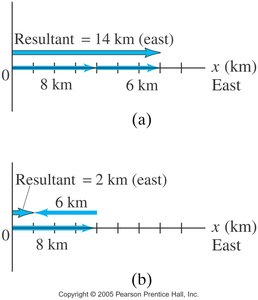
Resultant: The sum of two or more vectors is called the resultant vector.
Subtraction is equivalent to adding the negative of a vector.
Graphical Methods in Two Dimensions
When vectors are not along the same line, they can be added using the tail-to-tip method or the parallelogram method. If vectors are perpendicular, the Pythagorean theorem can be used to find the magnitude of the resultant.
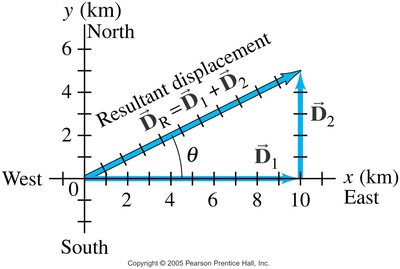
Magnitude:
Direction: (measured counterclockwise from the x-axis)
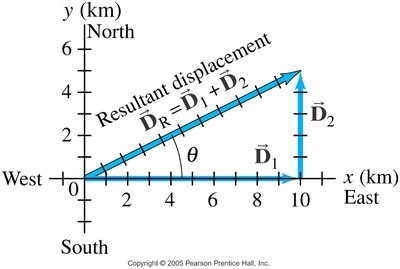
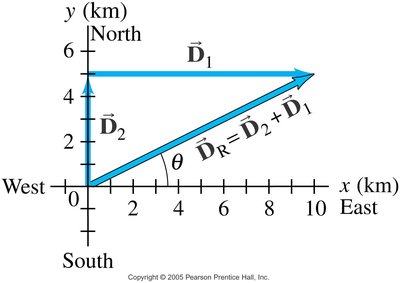
Order of addition does not affect the resultant vector (commutative property).
Subtraction of Vectors
To subtract a vector, add its negative (same magnitude, opposite direction).
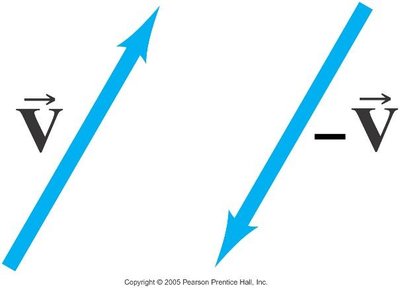

Multiplication of a Vector by a Scalar
Multiplying a vector by a scalar changes its magnitude but not its direction (unless the scalar is negative, in which case the direction reverses).
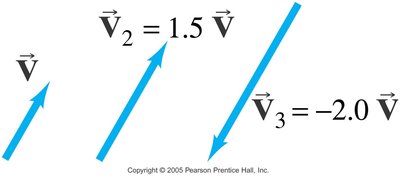
Adding Vectors by Components
Component Method
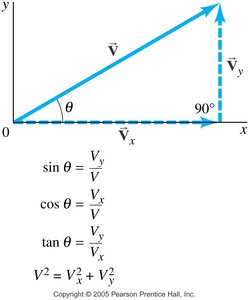
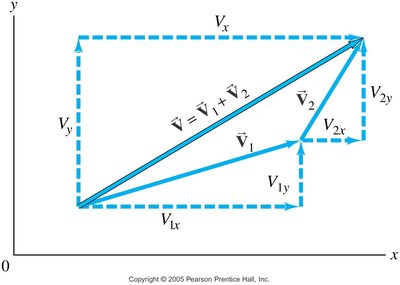
Any vector in a plane can be expressed as the sum of two perpendicular components, usually along the x and y axes. This method simplifies vector addition and subtraction.
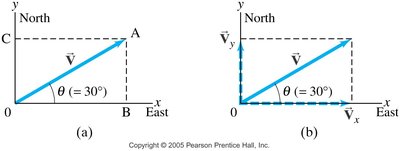
Unit vectors and are used to denote directions along the x and y axes, respectively.
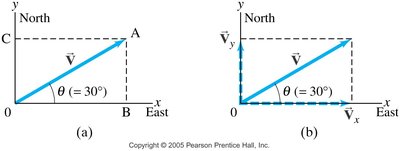
Components can be found using trigonometric functions:
Steps for Adding Vectors by Components
Draw a diagram and add vectors graphically.
Choose x and y axes.
Resolve each vector into x and y components.
Calculate each component using sines and cosines.
Add the components in each direction.
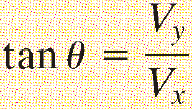
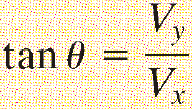
Find the magnitude and direction of the resultant vector.
Projectile Motion
Definition and Characteristics
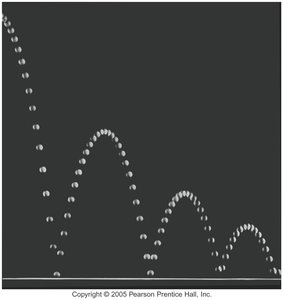
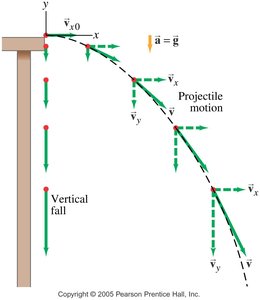
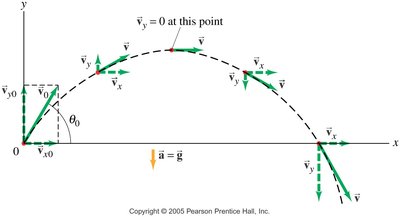
A projectile is any object moving in two dimensions under the influence of gravity alone. Its path is a parabola.
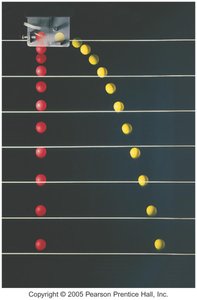
Horizontal motion: constant velocity ()
Vertical motion: constant acceleration ()
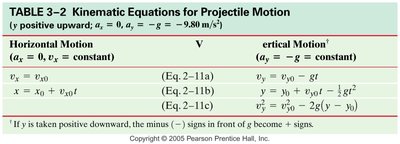
Kinematic Equations for Projectile Motion
Horizontal Motion | Vertical Motion |
|---|---|
Solving Projectile Motion Problems
Read the problem carefully and identify the object(s) to analyze.
Draw a diagram and choose a coordinate system.
Decide on the time interval (same for x and y directions).
Analyze x and y motions separately using the kinematic equations.
List known and unknown quantities; remember is constant and at the highest point.
Plan your solution and use appropriate equations, combining them if necessary.
Maximum Range of a Projectile
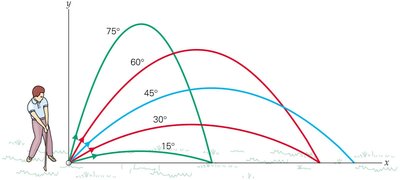
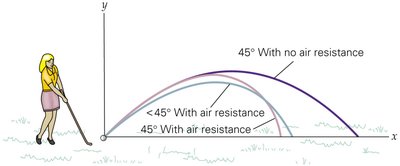
The maximum range occurs when the launch angle is 45° (without air resistance). The range is given by:
Relative Velocity
Concept and Notation
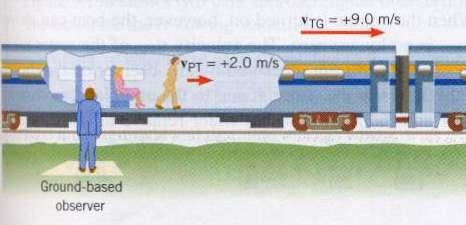
Relative velocity describes the velocity of one object as observed from another moving reference frame. In one dimension, velocities add or subtract arithmetically; in two dimensions, they are added as vectors.
Notation: = velocity of person relative to ground, = velocity of person relative to train, = velocity of train relative to ground.
General formula:
Summary of Key Points
A vector has both magnitude and direction; a scalar has only magnitude.
Vectors can be added graphically (tail-to-tip, parallelogram) or by components.
The resultant is the sum of two or more vectors.
Projectile motion is the motion of an object under gravity, analyzed by separating horizontal and vertical components.
Relative velocity involves adding or subtracting velocities as vectors, depending on the reference frames involved.
