 Back
BackKinematics in Two Dimensions: Motion, Acceleration, and Projectile Motion
Study Guide - Smart Notes
 Tailored notes based on your materials, expanded with key definitions, examples, and context.
Kinematics in Two Dimensions
Motion in a Plane
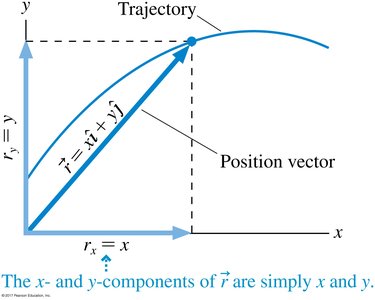
Motion in two dimensions involves tracking the position, velocity, and acceleration of a particle as it moves along a trajectory in the xy-plane. The position of the particle is described by a position vector \( \vec{r} \), which has both x and y components.
Position Vector: \( \vec{r} = x \hat{i} + y \hat{j} \) where x and y are the coordinates in the plane.
Trajectory: The path traced by the particle, which can be curved or straight.
Graphical Representation: The trajectory is a graph of y versus x, showing the actual path of motion.
Example: The motion of a ball or a fountain jet can be visualized as a trajectory in the xy-plane.
Acceleration in Two Dimensions
Acceleration is a vector quantity that describes how the velocity of a particle changes with time. In two dimensions, acceleration can change the magnitude (speed) and/or the direction of the velocity vector.
Average Acceleration: Defined as the change in velocity divided by the change in time:
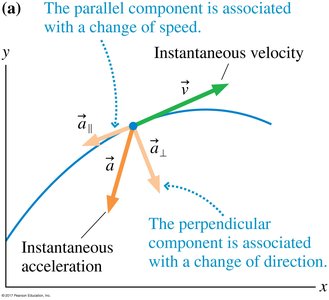
Instantaneous Acceleration: As \( \Delta t \rightarrow 0 \), the acceleration at a point is tangent to the trajectory.
Components of Acceleration:
Parallel component (\( a_{\parallel} \)): Changes speed.
Perpendicular component (\( a_{\perp} \)): Changes direction.
Example: A ball rolling through a valley experiences both parallel and perpendicular acceleration components.
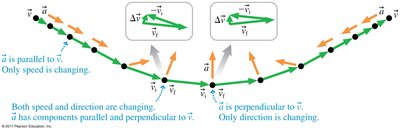
Example: Through the Valley
This example illustrates how a ball's velocity and acceleration change as it moves along a curved path. The motion diagram shows the velocity vectors and how acceleration can be parallel or perpendicular to velocity.
Parallel Acceleration: Only speed changes.
Perpendicular Acceleration: Only direction changes.
Both Components: Both speed and direction change.
Projectile Motion
Definition and Characteristics
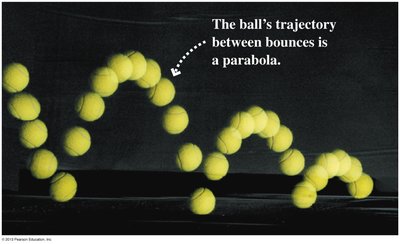
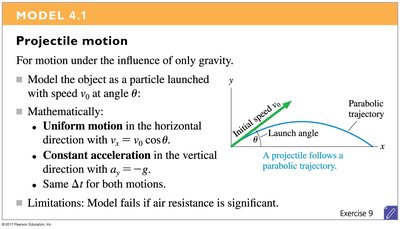
A projectile is an object moving in two dimensions under the influence of only gravity, with air resistance neglected. Projectile motion combines horizontal uniform motion and vertical accelerated motion.
Trajectory: Projectiles follow a parabolic path.
Examples: Baseballs, tennis balls, arrows, and fountain jets.
Key Properties:
Gravity acts downward, causing vertical acceleration.
No horizontal acceleration; horizontal velocity remains constant.
Mathematical Description
The acceleration components for projectile motion are:
Horizontal acceleration:
Vertical acceleration:

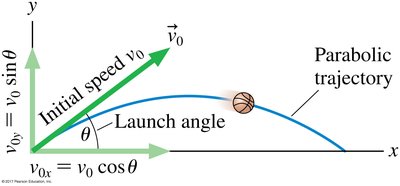
Initial Velocity and Launch Angle
The initial velocity of a projectile can be decomposed into horizontal and vertical components based on the launch angle \( \theta \):
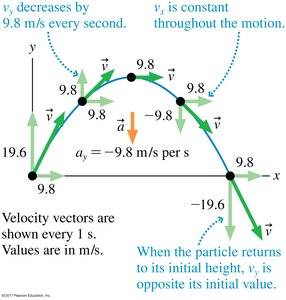
Velocity Changes During Projectile Motion
Throughout the motion, the horizontal velocity remains constant, while the vertical velocity decreases due to gravity.
Vertical velocity: Decreases by 9.8 m/s every second.
Horizontal velocity: Remains constant.
At the peak: Vertical velocity is zero.
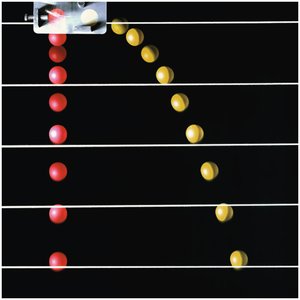
Independence of Horizontal and Vertical Motion
The horizontal and vertical components of projectile motion are independent. For example, a ball launched horizontally and a ball dropped vertically from the same height will hit the ground simultaneously if air resistance is neglected.
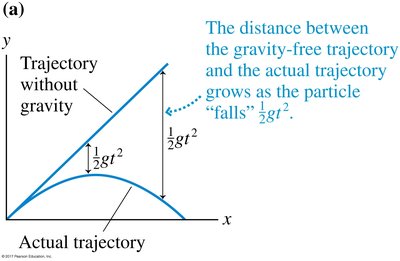
Gravity's Effect on Trajectory
Gravity causes the projectile to fall below the straight-line path it would follow without gravity. The vertical separation grows as .
Projectile Motion Model
The projectile motion model assumes uniform horizontal motion and constant vertical acceleration. The trajectory is parabolic.
Uniform motion:
Constant acceleration:
Limitations: Model fails if air resistance is significant.
Problem-Solving Strategy for Projectile Motion
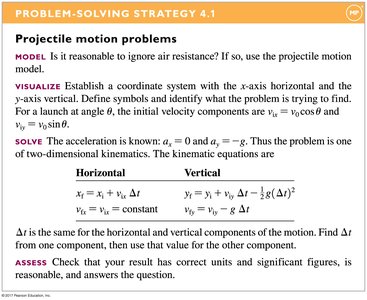
To solve projectile motion problems, establish a coordinate system, define symbols, and use kinematic equations for horizontal and vertical motion.
Horizontal | Vertical |
|---|---|
constant |
|
Range of a Projectile
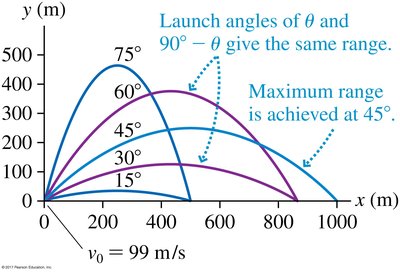
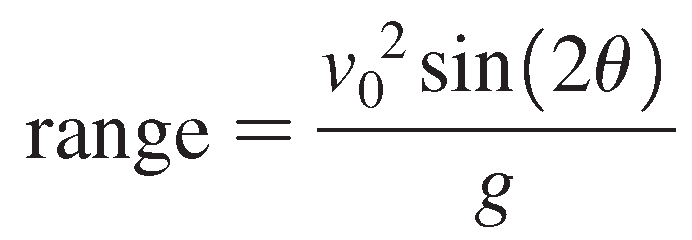
The range is the horizontal distance a projectile travels before returning to its original elevation. The maximum range occurs at a launch angle of 45°.
Range formula:
Launch angles: Angles \( \theta \) and \( 90^ ext{o} - \theta \) give the same range.
Relative Motion
Concept of Relative Velocity
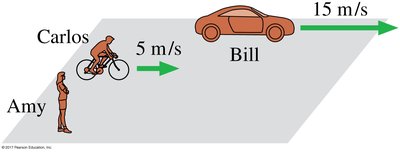
Relative motion describes how the velocity of an object depends on the observer's frame of reference. The velocity of an object relative to one observer can differ from its velocity relative to another observer.
Example: If a cyclist moves at 5 m/s and a car at 15 m/s, their velocities are measured relative to the ground or to each other.
Application: Used in analyzing motion in moving vehicles, conveyor belts, or river crossings.
Summary Table: Key Equations for Two-Dimensional Kinematics
Quantity | Equation | Description |
|---|---|---|
Position Vector | Describes position in the xy-plane | |
Average Acceleration | Change in velocity over time | |
Projectile Acceleration |
| Horizontal and vertical acceleration |
Initial Velocity Components |
| Horizontal and vertical initial velocity |
Range | Maximum horizontal distance |
Additional info: Academic context was added to clarify the independence of horizontal and vertical motion, the decomposition of acceleration, and the practical applications of projectile and relative motion.
