 Back
BackKinematics in Two Dimensions: Motion in a Plane, Projectile and Circular Motion
Study Guide - Smart Notes
 Tailored notes based on your materials, expanded with key definitions, examples, and context.
Motion in Two Dimensions
Position and Displacement Vectors
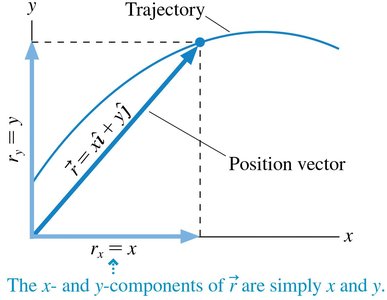
Motion in a plane involves tracking the position of an object using vectors in the x-y coordinate system. The position vector \( \vec{r} \) points from the origin to the object's location and can be expressed as:
\( \vec{r} = x \hat{i} + y \hat{j} \)
The displacement vector \( \Delta \vec{r} \) is the change in position between two points.
Velocity in Two Dimensions
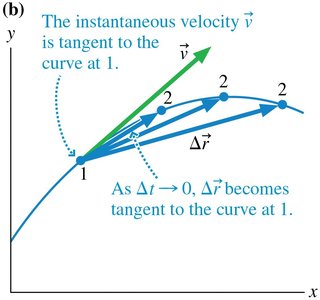
The average velocity is the displacement divided by the time interval:
\( \vec{v}_{avg} = \frac{\Delta \vec{r}}{\Delta t} = \frac{\Delta x}{\Delta t} \hat{i} + \frac{\Delta y}{\Delta t} \hat{j} \)
The instantaneous velocity is the derivative of position with respect to time:
Velocity Components and Direction
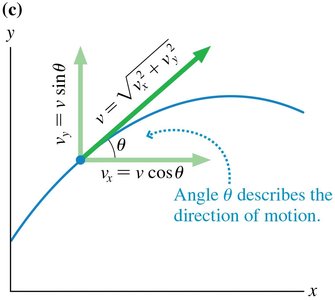
The velocity vector can be broken into x and y components using the angle \( \theta \) from the positive x-axis:
\( v_x = v \cos \theta \)
\( v_y = v \sin \theta \)
The magnitude and direction are given by:
Acceleration in Two Dimensions
Acceleration Vector and Its Components
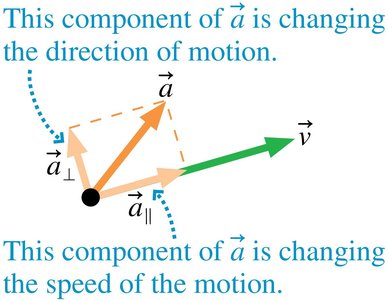
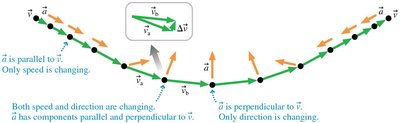
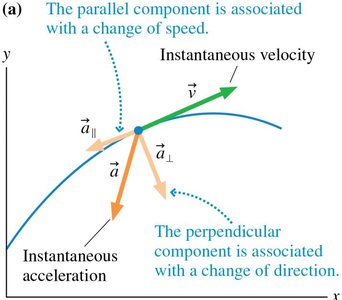
The acceleration vector describes how the velocity changes with time. It can be decomposed into two components:
\( \vec{a}_{\parallel} \): Parallel to velocity, changes speed
\( \vec{a}_{\perp} \): Perpendicular to velocity, changes direction
Finding the Acceleration Vector
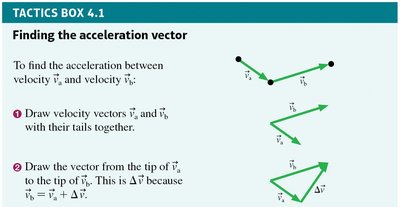
To determine the acceleration between two velocity vectors:
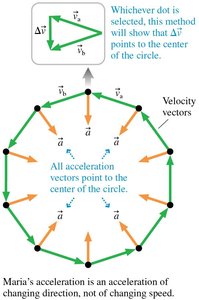
Draw \( \vec{v}_a \) and \( \vec{v}_b \) with their tails together.
Draw \( \Delta \vec{v} \) from the tip of \( \vec{v}_a \) to the tip of \( \vec{v}_b \).
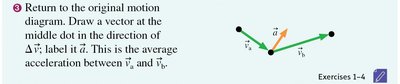
Draw the average acceleration vector \( \vec{a} \) at the midpoint in the direction of \( \Delta \vec{v} \).
Acceleration Along a Curved Path
As an object moves along a curved path, the acceleration vector can have both parallel and perpendicular components to the velocity, affecting speed and direction, respectively.
Component Form of Acceleration
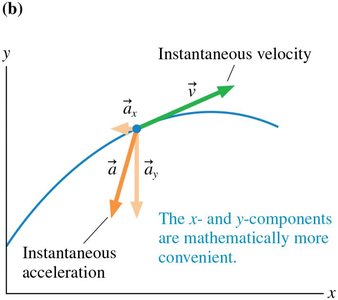
Acceleration can also be expressed in terms of its x and y components:
\( \vec{a} = a_x \hat{i} + a_y \hat{j} = \frac{dv_x}{dt} \hat{i} + \frac{dv_y}{dt} \hat{j} \)
Projectile Motion
Definition and Characteristics
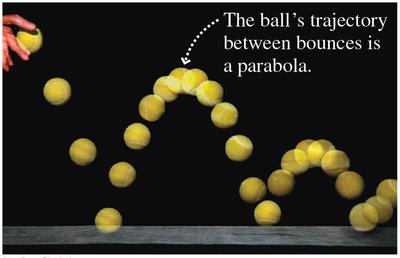
Projectile motion is the two-dimensional motion of an object under the influence of gravity alone (neglecting air resistance). The path followed is a parabola.
Horizontal and vertical motions are independent except for sharing the same time interval.
Horizontal acceleration: \( a_x = 0 \)
Vertical acceleration: \( a_y = -g \) (where \( g = 9.8 \; m/s^2 \))
Projectile Launch and Initial Velocity Components
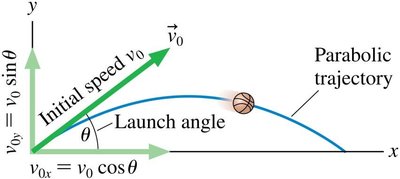
The initial velocity \( \vec{v}_0 \) can be decomposed into horizontal and vertical components using the launch angle \( \theta \):
\( v_{0x} = v_0 \cos \theta \)
\( v_{0y} = v_0 \sin \theta \)
Projectile Motion Example
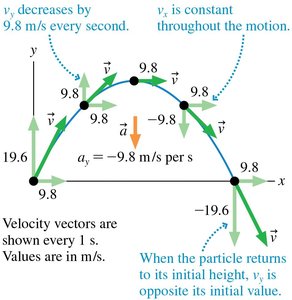
For a projectile launched with \( \vec{v}_0 = (9.8 \hat{i} + 19.6 \hat{j}) \) m/s:
\( v_x \) remains constant
\( v_y \) decreases by 9.8 m/s each second due to gravity
Final velocity at landing: \( \vec{v}_f = 9.8 \hat{i} - 19.6 \hat{j} \) m/s
Independence of Motion in x and y
Horizontal and vertical motions are independent. Two objects dropped from the same height (one projected horizontally, one dropped vertically) hit the ground at the same time if their initial vertical velocities are equal.
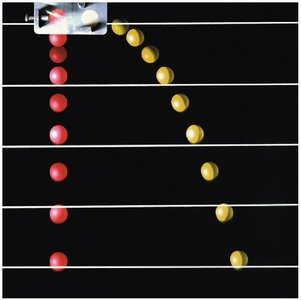
Conceptual Example: Arrow and Falling Coconut
If an arrow is aimed directly at a coconut that falls the instant the arrow is released, both the arrow and coconut experience the same vertical acceleration due to gravity. Thus, the arrow will hit the coconut.
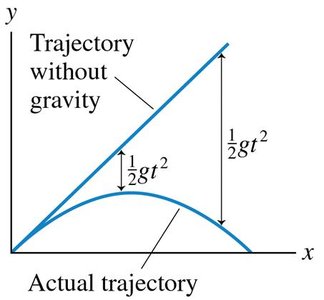
Kinematic Equations for Projectile Motion
The equations for projectile motion are:
Horizontal | Vertical |
|---|---|
(constant) |
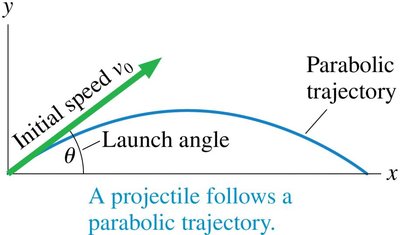
Projectile Range and Launch Angle
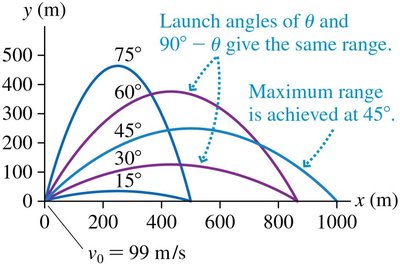
The range (horizontal distance) of a projectile depends on the initial speed and launch angle. Maximum range is achieved at 45°, and launch angles \( \theta \) and \( 90° - \theta \) yield the same range for a given speed.
Relative Motion and Reference Frames
Relative Velocity
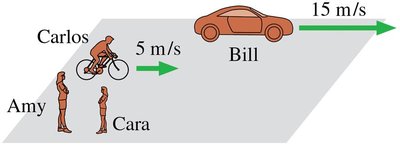
The velocity of an object depends on the observer's frame of reference. The relative velocity is the velocity of one object as measured from another moving reference frame.
Notation: \( v_{AB} \) is the velocity of A relative to B.
Reference Frames and Position Vectors
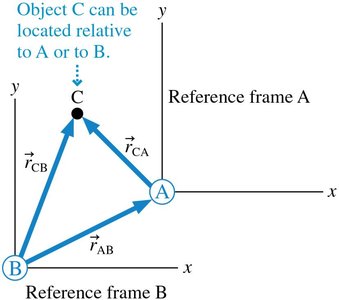
A reference frame is a coordinate system used to measure position and time. Position vectors can be transformed between frames using vector addition.
Circular Motion
Uniform Circular Motion
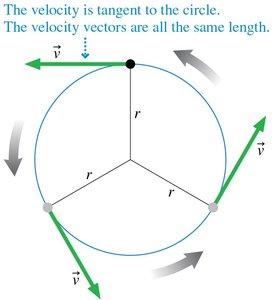
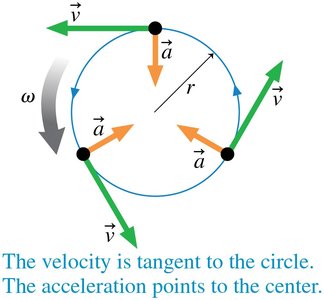
Uniform circular motion occurs when an object moves at constant speed along a circular path of radius r. The velocity vector is always tangent to the circle, and the period T is the time for one revolution:
Speed:
Angular Position, Displacement, and Velocity
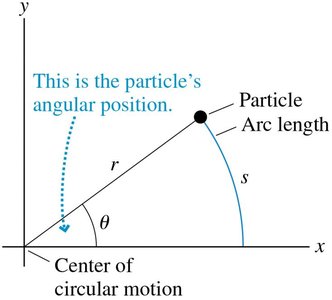
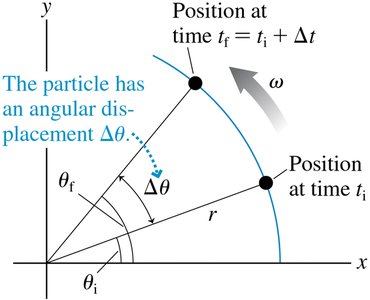
The angular position \( \theta \) is measured in radians or revolutions. The arc length s is related to \( \theta \) by:
(\( \theta \) in radians)
The angular displacement is \( \Delta \theta = \theta_f - \theta_i \), and the angular velocity is:
Tangential Velocity and Centripetal Acceleration
The tangential velocity is related to angular velocity by:
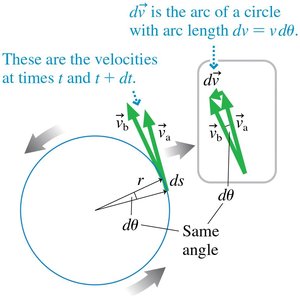
In uniform circular motion, the centripetal acceleration points toward the center of the circle and has magnitude:
Visualizing Centripetal Acceleration
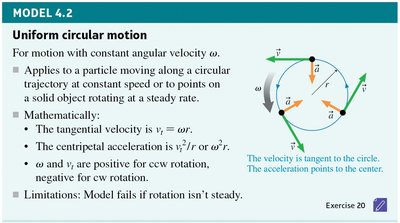
All acceleration vectors in uniform circular motion point toward the center, indicating a change in direction but not speed.
Model: Uniform Circular Motion
For motion with constant angular velocity \( \omega \):
Tangential velocity:
Centripetal acceleration:
Direction: Acceleration always points to the center
Nonuniform Circular Motion and Angular Acceleration
When the angular velocity changes, the object experiences angular acceleration:
Units: rad/s2
Sign depends on whether the angular speed is increasing or decreasing and the direction of rotation.
Tangential and Centripetal Acceleration
In nonuniform circular motion, total acceleration has two components:
Centripetal acceleration (\( a_r \)): Changes direction, points to center
Tangential acceleration (\( a_t \)): Changes speed, tangent to circle
