 Back
BackKinematics in Two Dimensions: Motion, Projectile Motion, and Circular Motion
Study Guide - Smart Notes
 Tailored notes based on your materials, expanded with key definitions, examples, and context.
Chapter 4: Kinematics in Two Dimensions
Motion in Two Dimensions
Motion in two dimensions involves the movement of objects in a plane, described by position, velocity, and acceleration vectors. The trajectory is the path that a particle follows in the x-y plane.
Position Vector: The location of a particle is given by a vector from the origin to its position in the plane.
Average Velocity: Points in the direction of displacement and is calculated as the change in position over time.
Instantaneous Velocity: The limit of average velocity as the time interval approaches zero; always tangent to the trajectory.
Velocity Components: If the velocity vector makes an angle θ with the x-axis, its components are:
Direction of Motion: If velocity components are known, the direction is given by:
Acceleration in Two Dimensions
Acceleration is the rate of change of velocity and can be decomposed into components parallel and perpendicular to the velocity vector.
Average Acceleration:
Instantaneous Acceleration:
Components:
Parallel component changes speed.
Perpendicular component changes direction.
Constant Acceleration
If acceleration is constant, the x- and y-components are constant and can be treated independently. The time interval is the same for both components.
Kinematic Equations: Apply separately to x and y directions.
Projectile Motion
Projectile Motion Fundamentals
A projectile is an object moving in two dimensions under the influence of only gravity, following a parabolic trajectory. Air resistance is neglected.
Launch Angle: The angle θ above the x-axis at which the projectile is launched.
Initial Velocity Components:
Acceleration:
Horizontal:
Vertical: (where )
Independence of Motion: Horizontal and vertical motions are independent but share the same time interval.
Projectile Motion Equations
Horizontal Position:
Vertical Position:
Time of Flight: Determined by vertical motion.
Range: For launch and landing at same elevation:
Example: Projectile Launched from a Cliff
The diagram below illustrates a projectile launched from the origin O with initial velocity at an angle θ. The projectile follows a parabolic path and lands at point P, a horizontal distance D from the base of the cliff.
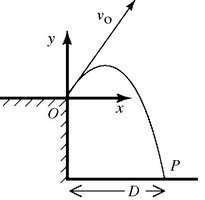
Application: To find the range D, use the kinematic equations for x and y, solve for time using vertical motion, then substitute into the horizontal equation.
Key Point: The horizontal and vertical motions are independent, but the time of flight is the same for both.
Reasoning About Projectile Motion
Two objects dropped from the same height, one horizontally launched and one simply dropped, will hit the ground simultaneously if air resistance is neglected.
The mass of the projectile does not affect the range or time of flight (in the absence of air resistance).
Circular Motion
Uniform Circular Motion
Uniform circular motion describes a particle moving at constant speed around a circle of radius r. The period T is the time for one revolution.
Period:
Angular Position: Measured in radians, degrees, or revolutions.
Angular Velocity: ; for uniform motion,
Tangential Velocity:
Centripetal Acceleration
Even at constant speed, a particle in circular motion is accelerating because its direction changes. The acceleration is directed toward the center of the circle (centripetal acceleration).
Centripetal Acceleration:
Direction: Always points toward the center of the circle.
Nonuniform Circular Motion
When angular velocity changes, the motion is nonuniform. Angular acceleration α is defined as the rate of change of angular velocity.
Angular Acceleration:
Sign of α: Positive if angular speed increases counterclockwise, negative if decreases.
Tangential Acceleration
Tangential Acceleration:
Total Acceleration:
Summary Table: Key Equations in Two-Dimensional Kinematics
Quantity | Equation | Description |
|---|---|---|
Position (x) | Horizontal position | |
Position (y) | Vertical position | |
Range (R) | Horizontal distance for projectile | |
Period (T) | Time for one revolution | |
Angular Velocity (ω) | Rate of change of angular position | |
Centripetal Acceleration (a_c) | Acceleration toward center | |
Tangential Acceleration (a_t) | Acceleration tangent to circle |
Additional info: Academic context and expanded explanations were added to ensure completeness and clarity for exam preparation.
