 Back
BackKinematics in Two Dimensions: Projectile and Circular Motion
Study Guide - Smart Notes
 Tailored notes based on your materials, expanded with key definitions, examples, and context.
Kinematics in Two Dimensions
Projectile Motion
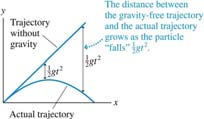
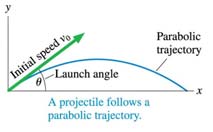
Projectile motion describes the motion of an object launched into the air and moving under the influence of gravity alone. The trajectory is a parabola, and the horizontal and vertical motions are independent of each other.
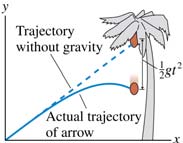
Trajectory without gravity: The object would follow a straight line if gravity were absent.
Trajectory with gravity: Gravity causes the object to fall below the straight line, resulting in a parabolic path.
Vertical displacement: The distance fallen below the straight line is given by .
Launch angle (): The initial velocity is split into horizontal () and vertical () components.
Kinematic equations:
Horizontal:
Vertical:
Range of a projectile: For level ground,
Relative Motion
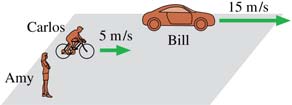
Relative motion refers to how the velocity of an object depends on the observer's frame of reference. There is no absolute velocity; all velocities are measured relative to a chosen reference frame.
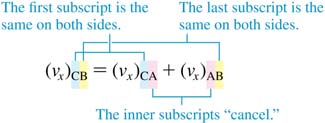
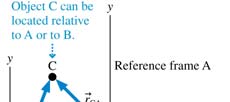
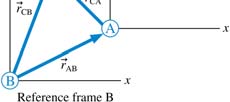
Velocity addition: The velocity of object C relative to B is the sum of its velocity relative to A and the velocity of A relative to B:
Galilean transformation: Used for adding velocities in classical mechanics.
Reference frames: Position and velocity measurements depend on the chosen coordinate system.
Applications of Relative Motion
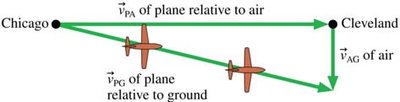
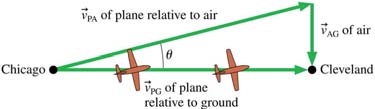
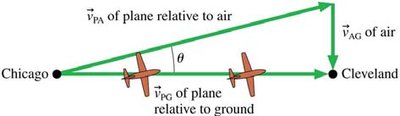
Relative motion is crucial in navigation, such as determining the ground speed and direction of an airplane affected by wind.
Vector addition: The velocity of the plane relative to the ground is the vector sum of its velocity relative to the air and the velocity of the air relative to the ground.
Navigation: Pilots must account for wind direction and speed to reach their intended destination.
Circular Motion
Uniform Circular Motion
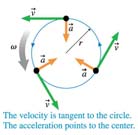
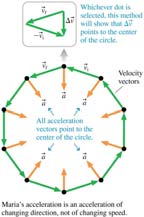
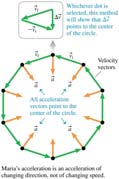
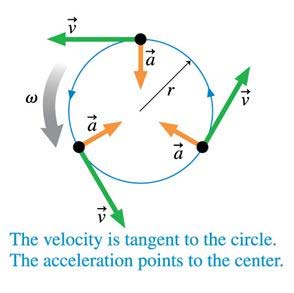
Uniform circular motion occurs when a particle moves at constant speed around a circle. The velocity vector is always tangent to the circle, and the acceleration vector points toward the center (centripetal acceleration).
Period (): The time for one revolution,
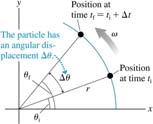
Angular position (): The angle measured in radians,
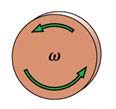
Angular velocity (): ; for uniform motion,
Tangential velocity:
Centripetal acceleration:

Nonuniform Circular Motion
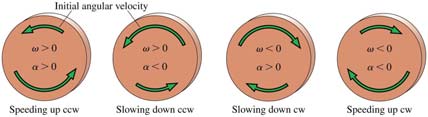
Nonuniform circular motion occurs when the angular velocity changes, resulting in angular acceleration (). The tangential acceleration changes the speed, while the centripetal acceleration changes the direction.
Angular acceleration ():
Sign conventions: The sign of depends on whether the object is speeding up or slowing down, and the direction of rotation (clockwise or counterclockwise).
Rotational kinematics: Analogous to linear kinematics, with equations for angular displacement, velocity, and acceleration.
Summary Table: Rotational vs. Linear Kinematics
Rotational Kinematics | Linear Kinematics |
|---|---|
Additional info: These notes expand on the original slides by providing definitions, formulas, and context for each topic, ensuring completeness and clarity for exam preparation.
