 Back
BackKinematics: Motion Along a Straight Line and Vector Products
Study Guide - Smart Notes
 Tailored notes based on your materials, expanded with key definitions, examples, and context.
Motion Along a Straight Line
Displacement, Velocity, and Acceleration
In kinematics, the motion of objects along a straight line is described using displacement, velocity, and acceleration. These quantities are fundamental for understanding how objects move and change their motion over time.
Displacement (\(\Delta x\)): The change in position of an object, defined as \(\Delta x = x_2 - x_1\).
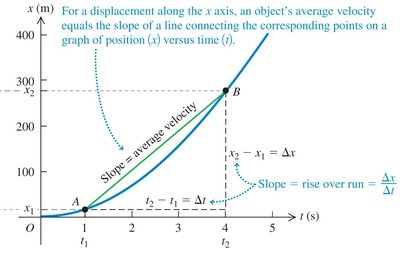
Average Velocity (\(v_{av}\)): The total displacement divided by the total time interval, \(v_{av} = \frac{\Delta x}{\Delta t}\).
Instantaneous Velocity (\(v\)): The velocity at a specific instant, given by the derivative of position with respect to time:
Average Acceleration (\(a_{av}\)): The change in velocity over a time interval, \(a_{av} = \frac{\Delta v}{\Delta t}\).
Instantaneous Acceleration (\(a\)): The acceleration at a specific instant, given by the derivative of velocity with respect to time:
Position-Time and Velocity-Time Graphs
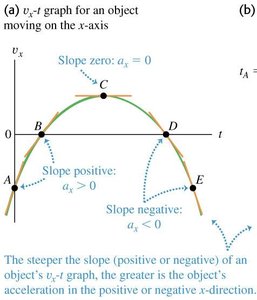
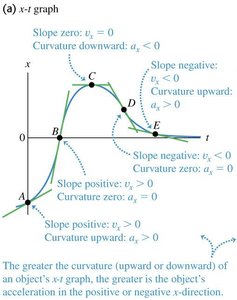
Graphs are essential tools for visualizing motion. The slope of a position-time graph gives velocity, while the slope of a velocity-time graph gives acceleration.
Position-Time (x-t) Graph: The slope at any point represents the instantaneous velocity.
Velocity-Time (v-t) Graph: The slope at any point represents the instantaneous acceleration.
Speeding Up vs. Slowing Down
Whether an object is speeding up or slowing down depends on the direction of velocity and acceleration:
Speeding Up: Velocity and acceleration have the same sign.
Slowing Down: Velocity and acceleration have opposite signs.
1D Kinematic Equations (Constant Acceleration)
For motion with constant acceleration, the following equations are used (where \(x_0\) and \(v_0\) are initial position and velocity):
Velocity at time \(t\):
Position at time \(t\):
Velocity squared:
Average velocity (for constant acceleration):
Free Fall Motion
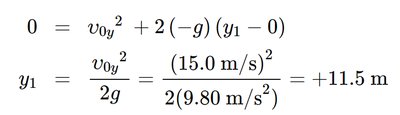
Objects in free fall experience constant acceleration due to gravity (\(g = 9.81\, \mathrm{m/s^2}\)), directed downward. The kinematic equations apply with \(a = -g\) if upward is positive.
Position:
Velocity:
Velocity squared:

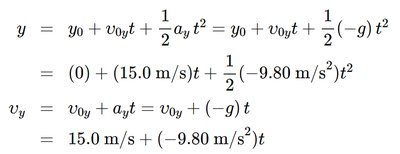

Graphical Representation of Free Fall
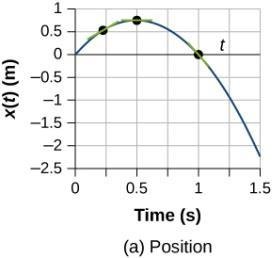
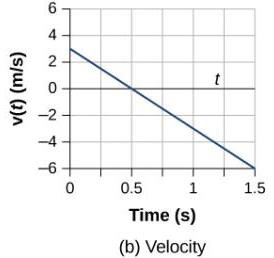
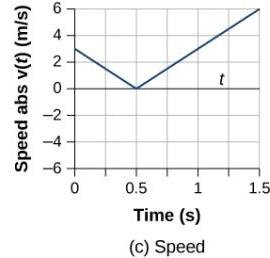
Free fall motion can be represented by three key graphs:
Position vs. Time: Parabolic curve (due to quadratic dependence on time).
Velocity vs. Time: Linear decrease (constant negative slope).
Speed vs. Time: Absolute value of velocity, always positive.
Vector Product (Cross Product)
Definition and Properties
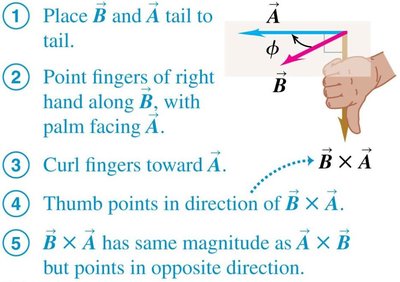
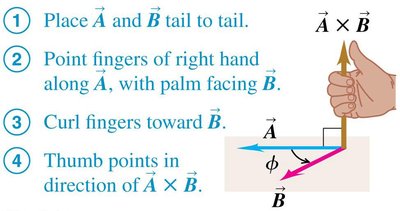
The vector product (cross product) of two vectors \(\vec{A}\) and \(\vec{B}\) is a vector perpendicular to both, with magnitude \(|\vec{A}||\vec{B}|\sin\phi\), where \(\phi\) is the angle between them. The direction is given by the right-hand rule.
Right-Hand Rule: Point fingers of your right hand along the first vector, curl toward the second; your thumb points in the direction of the cross product.
Non-Commutative: \(\vec{A} \times \vec{B} = - (\vec{B} \times \vec{A})\)
Applications
Used to determine directions in rotational motion, torque, and magnetic forces.
Essential in understanding angular momentum and electromagnetic phenomena.
Summary Table: 1D Kinematic Equations (Constant Acceleration)
Equation | Variables Included | Excluded Variable |
|---|---|---|
v, v_0, a, t | x | |
x, x_0, v_0, a, t | v | |
v, v_0, a, x, x_0 | t |
Additional info: The notes above include expanded explanations, definitions, and context for all key concepts and equations relevant to motion along a straight line and the vector product, as covered in introductory college physics.
