 Back
BackKinematics: Motion with Constant Acceleration and Free-Fall
Study Guide - Smart Notes
 Tailored notes based on your materials, expanded with key definitions, examples, and context.
Motion Along a Straight Line
Introduction to Kinematics
Kinematics is the branch of physics that describes the motion of objects without considering the causes of motion. It focuses on quantities such as displacement, velocity, and acceleration, and their relationships through time.
Displacement (x): The change in position of an object.
Velocity (v): The rate of change of displacement with respect to time.
Acceleration (a): The rate of change of velocity with respect to time.
Equations of Motion with Constant Acceleration
Kinematic Equations
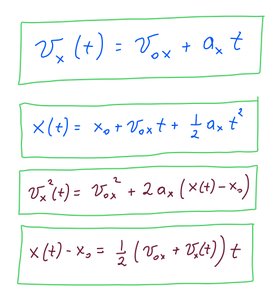
When an object moves with constant acceleration, its motion can be described by a set of kinematic equations. These equations relate displacement, initial velocity, final velocity, acceleration, and time.
First Equation (Velocity-Time):
Second Equation (Position-Time):
Third Equation (Velocity-Displacement):
Fourth Equation (Displacement-Average Velocity):
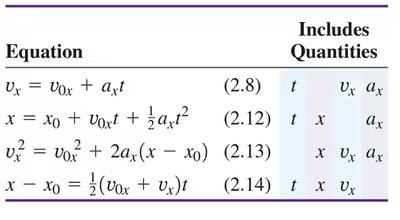
Key Point: These equations are only valid for motion with constant acceleration.
Derivation of Kinematic Equations
The kinematic equations can be derived using algebraic manipulation and calculus. For example, integrating acceleration with respect to time yields velocity, and integrating velocity yields position.
Velocity from Acceleration:
Position from Velocity:
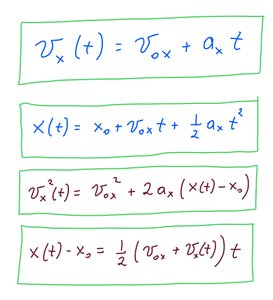
Velocity and Position by Integration
Using Calculus in Kinematics
Integration is a powerful tool in kinematics, allowing us to determine velocity and position functions when acceleration is known. For constant acceleration, the integration process leads directly to the standard kinematic equations.
General Approach: Integrate acceleration to get velocity, then integrate velocity to get position.
Example: If is constant, then and .
Motion with Constant Acceleration: Example Problem
Antelope Problem
Example 2.19: An antelope moving with constant acceleration covers the distance between two points 70.0 m apart in 6.00 s. Its speed as it passes the second point is 15.0 m/s. What are (a) its speed at the first point and (b) its acceleration?
Given: , m, s, m/s
Find: and
Solution Strategy: Use the kinematic equations to solve for the unknowns. First, use the velocity-time equation to relate , , and . Then, use the position-time equation to relate , , , , and .
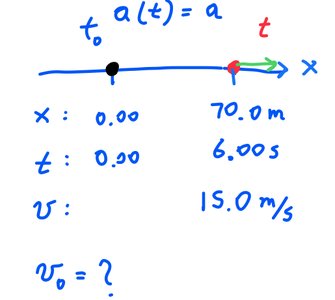
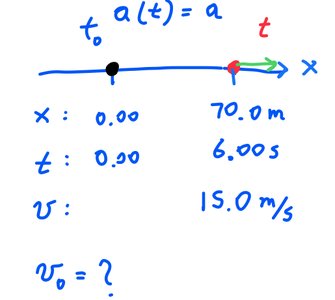
Step-by-step:
Write the equations:
Substitute known values and solve the system of equations for and .
Significant Figures: Always report answers with the correct number of significant figures based on the data provided.

Freely Falling Objects
Acceleration Due to Gravity
Objects in free-fall near the Earth's surface experience a constant acceleration directed downward, called the acceleration due to gravity, denoted as .
Value: m/s2 (downward)
Sign Convention: If upward is positive, then m/s2
Key Point: All objects in free-fall (neglecting air resistance) experience the same acceleration regardless of their mass.
Equations for Free-Fall Motion
The kinematic equations apply to free-fall motion, with replaced by .
Example: Rock Thrown Upward
You throw a rock straight up from the edge of a cliff. It leaves your hand at time moving at 16.0 m/s. Air resistance can be neglected. Find the time at which the rock is 4.00 m above where it left your hand.
Given: m/s, m, m/s2
Find:
Solution: Use and solve for .
Summary Table: Kinematic Equations for Constant Acceleration
Equation | Includes Quantities |
|---|---|
Key Problem-Solving Strategies
Identify known and unknown quantities.
Choose the appropriate kinematic equation based on the variables involved.
Solve algebraically for the unknown before substituting numerical values.
Check units and significant figures in your final answer.
Example Application: These strategies are essential for solving real-world physics problems involving motion, such as calculating the time for a projectile to reach a certain height or the initial speed of a moving object.
Additional info: The notes also reference the use of simulations (e.g., PhET Moving Man) to visualize motion, which can help reinforce understanding of kinematic concepts.
