 Back
Kinematics of Freefall and the Law of Falling Bodies
Study Guide - Smart Notes
 Tailored notes based on your materials, expanded with key definitions, examples, and context.
Kinematics of Freefall
Definition and Conditions for Freefall
Freefall describes the motion of an object when the only force acting upon it is the gravitational attraction of a nearby planet, such as Earth. In this scenario, the object’s weight is the sole force influencing its motion, and all other forces (such as air resistance, propulsion, or contact with a surface) are absent.
Freefall can occur regardless of the object’s initial velocity (it may be dropped, thrown upward, or downward).
Forces that prevent freefall include air resistance, propulsion, support from a surface, or any external push/pull.
Key Point: In freefall near the surface of a planet, the acceleration is always constant in magnitude and directed downward (toward the planet’s center).
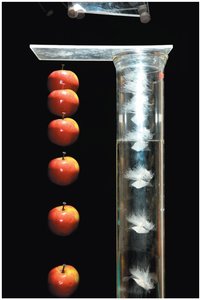
Law of Falling Bodies
The Law of Falling Bodies, first systematically studied by Galileo Galilei, states that all objects in freefall near the surface of a planet experience the same constant acceleration, regardless of their mass.
Acceleration due to gravity (g): The magnitude is approximately constant near the Earth's surface.
Direction: Always downward (toward the center of the Earth).
Independence from mass: All objects, regardless of mass, fall with the same acceleration in the absence of air resistance.


Earth’s Surface Gravity
Value and Variations of g
Near the surface of the Earth, the acceleration due to gravity is approximately:
g = +9.80 \ \mathrm{m/s^2} (standard value for calculations in introductory physics)
g is slightly weaker at the equator (~9.78 \ \mathrm{m/s^2}) and stronger at the poles (~9.82 \ \mathrm{m/s^2}) due to Earth's shape and rotation.
g decreases with altitude above Earth's surface and varies with local geology.
1 "gee" is a common unit for acceleration, where 1 gee = 9.80 \ \mathrm{m/s^2}.
Warning: Do not confuse "g" (acceleration due to gravity) with "gram" (unit of mass).
Kinematic Equations for Freefall
Constant Acceleration Equations
When an object is in freefall, its acceleration is constant and equal to ±g, depending on the choice of coordinate system. The standard kinematic equations for constant acceleration apply:
Displacement:
Velocity:
For freefall, (if upward is positive) or (if downward is positive).
Example: If an object is dropped from rest () and upward is positive, then:
Distance fallen is proportional to the square of the time elapsed.
Direction Choice and Sign Conventions
The sign of acceleration and displacement depends on the choice of coordinate system:
If upward is positive:
If downward is positive:
Consistent use of sign conventions is crucial for correct calculations.
Graphical Analysis of Freefall
Position and Velocity vs. Time Graphs
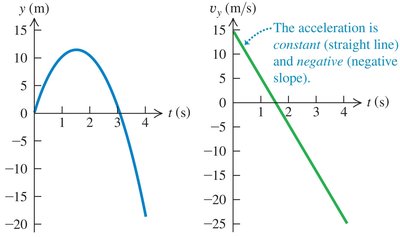
For an object thrown upward and then falling back down:
The position-time graph is a parabola (due to ).
The velocity-time graph is a straight line with a negative slope (for upward positive), indicating constant negative acceleration.
Historical Context: Galileo’s Experiments
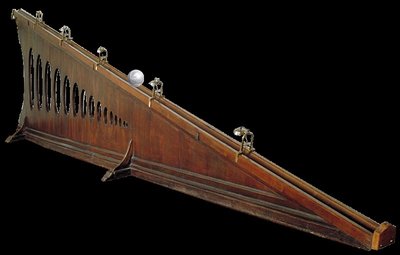
Galileo’s Inclined Plane and Freefall Studies
Galileo used inclined planes to slow down the acceleration of gravity, making it easier to measure and analyze the motion of falling objects. His experiments demonstrated that the distance fallen is proportional to the square of the time elapsed, confirming the law of falling bodies.

Worked Example: Object Dropped from Rest
Numerical Example with Upward Positive
Suppose an object is dropped from rest () and we take upward as positive. For simplicity, let :
[m]
At s, m; at s, m; at s, m, etc.
The total distance fallen at successive intervals follows the sequence of perfect squares (1, 4, 9, 16, 25, ...), and the distance fallen during each interval follows the sequence of odd numbers (1, 3, 5, 7, ...).
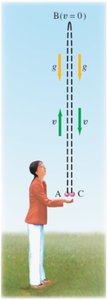
Conceptual Questions: Freefall and Thrown Objects
Review Quiz
Q: What is the ball’s acceleration while it is rising? A: downward (always, regardless of direction of motion).
Q: What is the ball’s acceleration at its highest point? A: downward (acceleration due to gravity is constant).
Q: Does the time of ascent equal the time of descent? A: True (if air resistance is neglected).
Q: What is the ball’s average velocity over its entire path (thrown up and caught at same height)? A: 0 (displacement is zero).
Q: What is the ball’s average speed over its entire path? A: Greater than zero (total distance divided by total time).
Summary Table: Key Properties of Freefall
Property | Description |
|---|---|
Acceleration (g) | Constant, downward near Earth's surface |
Independence from Mass | All objects fall with same acceleration (neglecting air resistance) |
Kinematic Equation | |
Direction Convention | Upward positive: ; Downward positive: |
Distance-Time Relationship | Distance fallen is proportional to |
Additional info:
Galileo’s experiments laid the foundation for modern kinematics and the understanding of acceleration due to gravity.
The Apollo 15 hammer and feather experiment on the Moon dramatically demonstrated the independence of gravitational acceleration from mass in the absence of air resistance.
