 Back
Kinematics: Position, Displacement, Velocity, and Acceleration (Physics with Calculus)
Study Guide - Smart Notes
 Tailored notes based on your materials, expanded with key definitions, examples, and context.
Kinematics
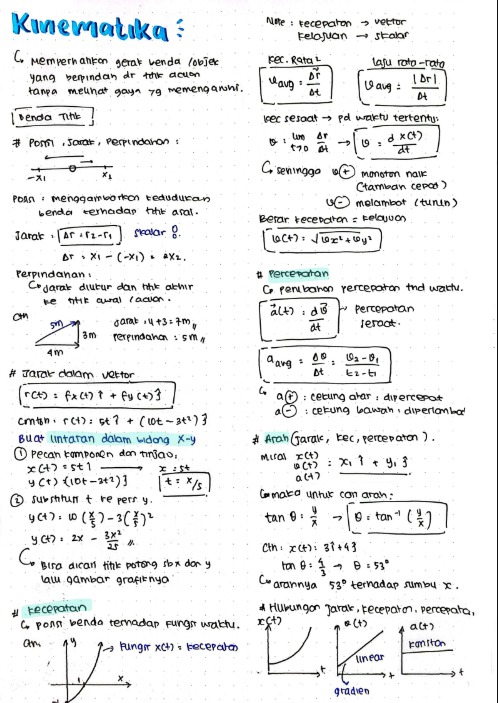
Position, Displacement, and Distance
Kinematics is the study of the motion of objects without considering the forces that cause the motion. The fundamental concepts include position, displacement, and distance.
Position (x): The location of an object relative to a reference point, often denoted as x1 or x2.
Distance: The total length of the path traveled by an object, regardless of direction.
Displacement (Δx): The change in position of an object, defined as Δx = x2 - x1. Displacement is a vector quantity, meaning it has both magnitude and direction.
Example: If an object moves from x1 = 1 m to x2 = 4 m, the displacement is Δx = 4 m - 1 m = 3 m.
Vectors in Kinematics
Vectors are quantities that have both magnitude and direction. In kinematics, displacement, velocity, and acceleration are all vector quantities.
Vector Notation: r(t) = x(t) i + y(t) j
Unit Vectors: i (x-direction), j (y-direction)
Magnitude of a Vector:
Direction (Angle θ):
Example: If r = 3i + 4j, then
Velocity
Velocity describes how quickly and in what direction an object's position changes. It is a vector quantity.
Average Velocity:
Instantaneous Velocity:
Speed: The magnitude of velocity, a scalar quantity.
Example: If an object moves 6 m in 2 s, m/s.
Acceleration
Acceleration is the rate at which velocity changes with time. It is also a vector quantity.
Average Acceleration:
Instantaneous Acceleration:
Example: If velocity changes from 2 m/s to 6 m/s in 2 s, m/s2.
Graphical Representation
Graphs are useful for visualizing kinematic quantities. The slope (gradient) of a position vs. time graph gives velocity, and the slope of a velocity vs. time graph gives acceleration.
Linear Graph: Indicates constant velocity.
Nonlinear Graph: Indicates changing velocity (acceleration).
Example: A straight line in a position-time graph means constant velocity; a curve means acceleration.
Direction and Angle in Kinematics
The direction of motion can be described using angles relative to a reference axis.
Angle θ:
Application: Used to determine the direction of displacement or velocity vectors.
Summary Table: Scalar vs. Vector Quantities
Quantity | Type | Formula |
|---|---|---|
Distance | Scalar | Sum of path lengths |
Displacement | Vector | |
Speed | Scalar | |
Velocity | Vector | |
Acceleration | Vector |
Additional info: The notes include basic vector operations, unit vector notation, and graphical analysis, which are foundational for further study in kinematics and dynamics.
----------------------------------------
