 Back
BackKinematics Study Guide – Physics with Calculus
Study Guide - Smart Notes
 Tailored notes based on your materials, expanded with key definitions, examples, and context.
Q1. Categorize each variable as a scalar or vector quantity: Distance, Speed, Acceleration, Displacement, Velocity.
Background
Topic: Scalars and Vectors in Kinematics
This question tests your understanding of the difference between scalar and vector quantities in physics, which is foundational for analyzing motion.
Key Terms:
Scalar: A quantity with only magnitude (size), no direction.
Vector: A quantity with both magnitude and direction.
Step-by-Step Guidance
Recall the definitions: Scalars have only magnitude; vectors have both magnitude and direction.
Think about each variable: Does it describe only 'how much' or also 'which way'?
For example, distance and speed do not require a direction, while displacement, velocity, and acceleration do.
Assign each variable to the correct category based on these definitions.
Try solving on your own before revealing the answer!
Final Answer:
Scalars: Distance, Speed
Vectors: Acceleration, Displacement, Velocity
Scalars have only magnitude, while vectors have both magnitude and direction.
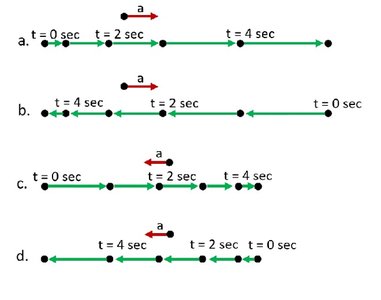
Q2. Match each motion diagram to the best description: Positive acceleration, slowing down; Negative acceleration, speeding up; Positive acceleration, speeding up; Negative acceleration, slowing down.
Background
Topic: Acceleration and Motion Diagrams
This question tests your ability to interpret motion diagrams and relate them to the direction and effect of acceleration.
Key Concepts:
Acceleration: The rate of change of velocity.
Positive acceleration increases velocity in the positive direction; negative acceleration can either slow down or speed up depending on the direction of motion.
Step-by-Step Guidance
Examine each diagram for the direction of motion and the direction of acceleration (indicated by arrows).
Determine if the object is speeding up or slowing down by looking at the spacing between dots (closer = slower, farther = faster).
Match the description to the diagram based on whether acceleration is in the same or opposite direction as velocity.
Try solving on your own before revealing the answer!
Final Answer:
A: Positive acceleration, speeding up
B: Negative acceleration, slowing down
C: Positive acceleration, slowing down
D: Negative acceleration, speeding up
The direction of acceleration relative to velocity determines whether the object speeds up or slows down.
Q3. True or False: Acceleration is the rate of change of velocity. Free fall acceleration is constant. Velocity changes linearly for motion with constant acceleration. Free fall velocity is constant. Free fall velocity is proportional to weight. Acceleration is the rate of change of position. A displacement is positive if it points up or to the right in the Cartesian coordinate system.
Background
Topic: Kinematics Concepts and Definitions
This question checks your understanding of basic definitions and properties in kinematics, especially regarding acceleration, velocity, and displacement.
Key Terms:
Acceleration:
Velocity:
Displacement: Change in position, can be positive or negative depending on direction.
Step-by-Step Guidance
Recall the definitions for acceleration, velocity, and displacement.
Think about free fall: Is acceleration due to gravity constant? Is velocity constant during free fall?
Consider whether velocity changes linearly with time under constant acceleration.
Evaluate each statement based on your understanding of these concepts.
Try solving on your own before revealing the answer!
Final Answer:
Acceleration is the rate of change of velocity: True
Free fall acceleration is constant: True
Velocity changes linearly for motion with constant acceleration: True
Free fall velocity is constant: False
Free fall velocity is proportional to weight: False
Acceleration is the rate of change of position: False
A displacement is positive if it points up or to the right: True
These answers follow from the definitions and properties of kinematic quantities.
Q4. Label the three related graphs: Position vs. Time, Velocity vs. Time, Acceleration vs. Time.
Background
Topic: Graphical Analysis of Motion
This question tests your ability to identify and interpret the three main kinematic graphs used in physics.
Key Concepts:
Position vs. Time: Shows how position changes over time.
Velocity vs. Time: Shows how velocity changes over time.
Acceleration vs. Time: Shows how acceleration changes over time.
Step-by-Step Guidance
Look for the axes labels: Position (x), Velocity (v), Acceleration (a), and Time (t).
Identify which graph shows a curve (position vs. time for constant acceleration), which shows a straight line (velocity vs. time), and which is a horizontal line (acceleration vs. time for constant acceleration).
Match each graph to its correct label based on these characteristics.
Try solving on your own before revealing the answer!
Final Answer:
1: Position vs. Time
2: Velocity vs. Time
3: Acceleration vs. Time
These are the standard forms for kinematic graphs in one dimension.
Q5. The speed of an object moving in multiple directions is the same as the magnitude of the velocity. True or False?
Background
Topic: Speed vs. Velocity
This question tests your understanding of the difference between speed (a scalar) and velocity (a vector).
Key Terms:
Speed: Scalar quantity; total distance traveled divided by time.
Velocity: Vector quantity; displacement divided by time.
Step-by-Step Guidance
Recall that speed is always positive and does not depend on direction, while velocity has both magnitude and direction.
Consider if the magnitude of velocity (the "length" of the velocity vector) is always equal to the speed, especially when the direction changes.
Try solving on your own before revealing the answer!
Final Answer:
False. The speed is only equal to the magnitude of velocity if the motion is in a straight line without changing direction. For motion in multiple directions, speed can be greater than the magnitude of the average velocity.
Q6. The dots in motion diagrams are always equally spaced in _____. (space, time, space and time, none of the above)
Background
Topic: Motion Diagrams
This question tests your understanding of how motion diagrams represent an object's position at equal intervals.
Key Concepts:
Motion diagrams show an object's position at regular time intervals.
Step-by-Step Guidance
Think about what is held constant when creating a motion diagram: is it the time between dots, the distance, or both?
Recall that the spacing between dots changes if the object speeds up or slows down, but the time interval remains constant.
Try solving on your own before revealing the answer!
Final Answer:
Time. The dots are equally spaced in time, not necessarily in space.
Q7. Velocity _____ when acceleration points in the _____ direction as the velocity. (increases; same, increases; opposite, decreases; same, none of the above)
Background
Topic: Relationship Between Velocity and Acceleration
This question tests your understanding of how acceleration affects velocity depending on their relative directions.
Key Concepts:
If acceleration is in the same direction as velocity, the object speeds up.
If acceleration is in the opposite direction, the object slows down.
Step-by-Step Guidance
Recall the effect of acceleration on velocity: same direction means increasing speed, opposite direction means decreasing speed.
Choose the correct combination from the options provided.
Try solving on your own before revealing the answer!
Final Answer:
Increases; same. Velocity increases when acceleration points in the same direction as velocity.
Q8. v = v_0 + at relates _____ and _____. (position; time, position; velocity, velocity; time, velocity; acceleration)
Background
Topic: Kinematic Equations
This question tests your ability to identify what physical quantities are related by the first kinematic equation.
Key Formula:
= final velocity
= initial velocity
= acceleration
= time
Step-by-Step Guidance
Identify the variables in the equation and what they represent.
Determine which two physical quantities are directly related by this equation.
Try solving on your own before revealing the answer!
Final Answer:
Velocity; time. The equation relates velocity and time (with acceleration as the rate of change).
Q9. The velocity of an object at time t can be determined from the slope of the _____ versus time graph at that time. (position, acceleration, velocity, none of the above)
Background
Topic: Graphical Interpretation of Motion
This question tests your understanding of how to extract velocity from a position vs. time graph.
Key Concepts:
The slope of a position vs. time graph gives velocity.
Step-by-Step Guidance
Recall that the derivative (slope) of position with respect to time is velocity.
Identify which graph's slope gives velocity at a given time.
Try solving on your own before revealing the answer!
Final Answer:
Position. The slope of the position vs. time graph gives the velocity at that time.
