 Back
BackKinematics: Translational Motion and Projectile Motion
Study Guide - Smart Notes
 Tailored notes based on your materials, expanded with key definitions, examples, and context.
Kinematics: Translational Motion
Position and Displacement
Kinematics is the branch of physics that describes the motion of objects without considering the forces causing the motion. The position of an object is its location along a coordinate axis, typically denoted as x. Displacement is the change in position over a time interval, represented as Δx = x_2 - x_1.
Position: The location of an object relative to a reference point (origin).
Displacement: The difference between the final and initial positions; can be positive or negative depending on direction.
Trajectory: The path followed by the object.
Example: An electron travels 46 cm in 6 ns; its velocity is calculated as .
Average Velocity
Average velocity is defined as the total displacement divided by the total time interval. It is a vector quantity and is represented by the slope of the line connecting two points on a position-time graph.
Formula:
Example: If a mouse moves according to , with cm/s and cm/s2, the average velocity from to s is cm/s.
Illustration: Position-Time Diagram
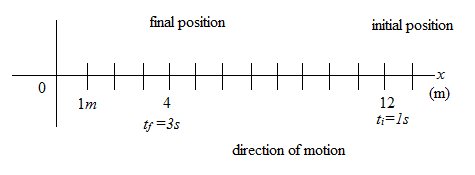
Key Point: The diagram above shows a particle moving from an initial position at m ( s) to a final position at m ( s). The displacement is m, and the average velocity is m/s.
Instantaneous Velocity
Instantaneous velocity is the velocity of an object at a specific instant. It is the limit of the average velocity as the time interval approaches zero, and is mathematically defined as the derivative of position with respect to time.
Formula:
Graphical Interpretation: The instantaneous velocity at a point is the slope of the tangent to the position-time curve at that point.
Example: For , the instantaneous velocity is .
Speed
Speed is the magnitude of velocity and is always positive. It can refer to the instantaneous speed (magnitude of instantaneous velocity) or average speed (total distance traveled divided by total time).
Speed vs. Velocity: Speed is scalar; velocity is vector.
Example: A car travels 90 km in 3 h; average speed is 30 km/h, but if it returns to the starting point, average velocity is zero.
Acceleration
Average and Instantaneous Acceleration
Acceleration is the rate of change of velocity with respect to time. Average acceleration is the change in velocity over a time interval, while instantaneous acceleration is the derivative of velocity with respect to time.
Average Acceleration:
Instantaneous Acceleration:
Relation to Position:
Units: (e.g., m/s2)
Motion with Constant Acceleration
For straight-line motion with constant acceleration, the following kinematic equations apply:
Example: A golf ball released from rest falls under gravity ( m/s2). After 1 s, m/s and m.
Motion in Two Dimensions
Position, Velocity, and Acceleration Vectors
In two-dimensional motion, the position, velocity, and acceleration are described by vectors:
Position Vector:
Velocity Vector:
Acceleration Vector:
Projectile Motion
Projectile motion is a classic example of two-dimensional motion under constant acceleration (gravity). The trajectory is a parabola.
Horizontal Velocity: (constant)
Vertical Velocity:
Horizontal Position:
Vertical Position:
Range:
Maximum Height:
Example: A long jumper leaves the ground at 20° with a speed of 11 m/s. The range is m, and the maximum height is m.
Summary Table: Kinematic Equations
Equation | Description |
|---|---|
Velocity as a function of time | |
Position as a function of time | |
Velocity-position relation | |
Projectile range | |
Projectile maximum height |
Additional info: Academic context and expanded explanations have been added to ensure completeness and clarity for exam preparation.
