 Back
BackKinetic Molecular Theory and Molecular Speed Distributions
Study Guide - Smart Notes
 Tailored notes based on your materials, expanded with key definitions, examples, and context.
Chapter 18: Thermal Properties of Matter
Kinetic Molecular Theory: Postulates and Applications
The Kinetic Molecular Theory provides a microscopic explanation for the behavior of matter in all states, especially gases. It is foundational for understanding thermal properties and gas laws.
All matter is composed of particles (atoms and molecules).
Molecules are very small compared to macroscopic objects.
Molecules are in constant random motion, colliding with each other and with container walls.
Collisions between molecules are elastic, meaning kinetic energy is conserved.
Assumptions for Ideal Gases
A large number of identical molecules (~) are present.
Molecules behave as point particles, much smaller than the container and the average distance between them.
Constant random motion and perfectly elastic collisions with rigid container walls.
Experimental Demonstration of Molecular Speed Distribution
The distribution of molecular speeds in a gas can be experimentally measured using specialized apparatus. Fast-moving molecules are directed through slits and detected after passing through rotating disks, allowing determination of their speed distribution.
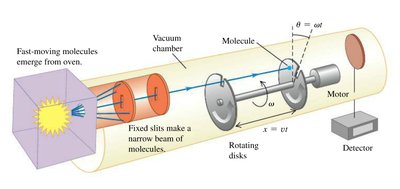
Maxwell–Boltzmann Distribution of Molecular Speeds
The Maxwell–Boltzmann distribution describes the probability that a molecule in a gas has a certain speed at a given temperature. This function, , is derived from statistical mechanics and agrees with experimental results.
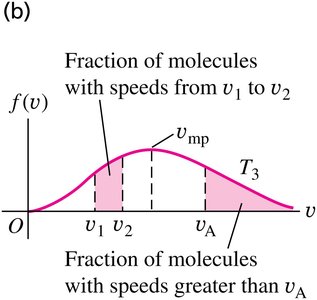
gives the probability that a randomly chosen molecule has a speed between and .
At low speeds:
At high speeds:
The most probable speed () is the speed at which is maximized.
Formula for the Maxwell–Boltzmann distribution:
Interpretation of the Distribution
vmp is the most probable speed, but molecules possess a range of speeds.
The area under the curve between and gives the fraction of molecules with speeds in that interval.
The area to the right of gives the fraction with speeds greater than .
Temperature Dependence of Molecular Speed Distribution
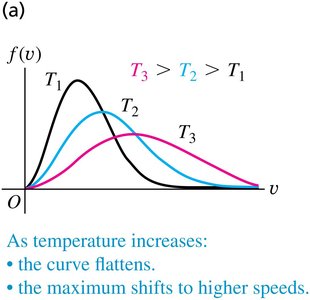
The shape of the Maxwell–Boltzmann distribution changes with temperature. As temperature increases:
The curve flattens, indicating a wider spread of speeds.
The maximum shifts to higher speeds, meaning molecules move faster on average.
Key Equations
Most probable speed:
Mean speed:
Root-mean-square speed:
Example: Application in Gas Behavior
Understanding the distribution of molecular speeds is crucial for predicting gas properties such as pressure, diffusion rates, and effusion. For instance, at higher temperatures, gases exert greater pressure due to increased molecular speeds.
Comparison Table: Characteristic Speeds in Maxwell–Boltzmann Distribution
Speed Type | Formula | Description |
|---|---|---|
Most Probable Speed () | Peak of the distribution | |
Mean Speed () | Average speed of molecules | |
Root-Mean-Square Speed () | Square root of average squared speed |
Additional info: The Maxwell–Boltzmann distribution is fundamental for understanding thermodynamic properties and kinetic theory in physics, especially in the context of ideal gases.
