 Back
BackKinetic Theory and Heat Capacities of Gases
Study Guide - Smart Notes
 Tailored notes based on your materials, expanded with key definitions, examples, and context.
Kinetic Theory and Heat Capacity
Translational Kinetic Energy and Temperature
The kinetic theory of gases provides a microscopic explanation for temperature and heat capacity. The average translational kinetic energy of a molecule in an ideal gas is directly proportional to the absolute temperature:
Translational kinetic energy per molecule:
Translational kinetic energy per mole:
Key terms: m = mass of a molecule, M = molar mass, k = Boltzmann constant, R = universal gas constant, T = temperature in Kelvin.
Example: For a monatomic ideal gas, the average kinetic energy per mole at 300 K is .
Molar Heat Capacity at Constant Volume ()
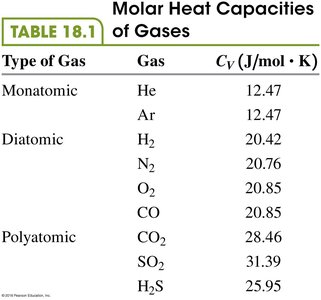
The molar heat capacity at constant volume, , is the amount of heat required to raise the temperature of one mole of a substance by one Kelvin at constant volume. For an ideal monatomic gas, kinetic theory predicts:
This value matches experimental results for monatomic gases such as helium and argon.
However, diatomic and polyatomic gases have higher values due to additional degrees of freedom.
Example: The measured for helium (He) is 12.47 J K-1 mol-1, matching the theoretical value.
Type of Gas | Gas | (J/mol·K) |
|---|---|---|
Monatomic | He | 12.47 |
Monatomic | Ar | 12.47 |
Diatomic | H2 | 20.42 |
Diatomic | N2 | 20.76 |
Diatomic | O2 | 20.85 |
Diatomic | CO | 20.85 |
Polyatomic | CO2 | 28.46 |
Polyatomic | SO2 | 31.39 |
Polyatomic | H2S | 25.95 |
Degrees of Freedom and Molecular Motion
Types of Molecular Motion
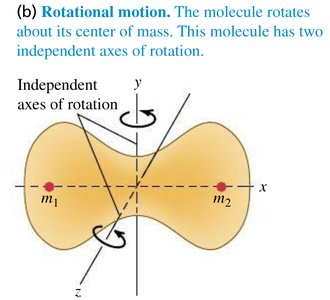
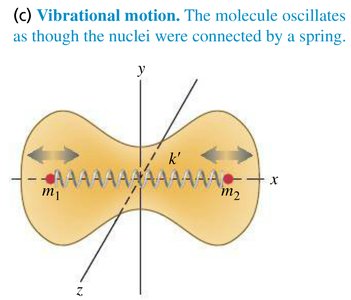
Molecules can store energy in several forms, not just translational motion. The independent ways a molecule can store energy are called degrees of freedom:
Translational: Movement along x, y, and z axes (all molecules).
Rotational: Rotation about axes through the center of mass (diatomic and polyatomic molecules).
Vibrational: Oscillation of atoms within a molecule (mainly polyatomic, and diatomic at high T).
Monatomic molecules (e.g., He, Ar): 3 translational degrees of freedom.
Diatomic molecules (e.g., H2, O2): 3 translational + 2 rotational degrees of freedom (vibrational modes are "frozen out" at low-to-moderate T).
Polyatomic molecules: 3 translational, 3 rotational, and multiple vibrational degrees of freedom (3N-6, where N is the number of atoms).
Equipartition of Energy Principle
The principle of equipartition of energy states that each degree of freedom contributes, on average, to the energy per molecule. For an ideal gas:
Monatomic: 3 degrees of freedom (translation only):
Diatomic: 5 degrees of freedom (3 translation + 2 rotation):
Polyatomic: More degrees of freedom, including vibration at high T.
Note: Vibrational degrees of freedom are only active at high temperatures; at low-to-moderate temperatures, they are "frozen out" due to quantum effects.
Temperature Dependence of Heat Capacity
Variation of with Temperature
The molar heat capacity of gases varies with temperature, especially for diatomic and polyatomic molecules. At low temperatures, only translational motion contributes. As temperature increases, rotational and then vibrational modes become accessible, increasing in steps:
Below ~50 K: Only translation contributes ().
Above ~50 K: Rotational motion contributes ().
Above ~600 K: Vibrational motion contributes ( increases further).
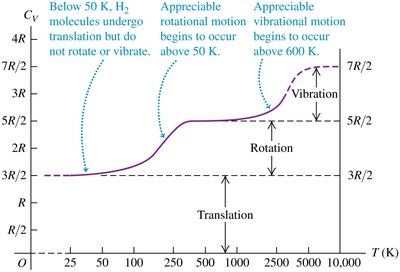
Example: For hydrogen gas (H2), increases from at low T to at moderate T, and approaches at high T as vibrational modes become active.
Comparison of Theory and Experiment
The calculated values for using kinetic theory and the equipartition principle agree well with experimental measurements for monatomic and diatomic gases, validating the model at moderate temperatures. Deviations at low and high temperatures are explained by quantum effects and the activation of additional degrees of freedom.
