 Back
BackKinetic Theory of Gases and Thermal Properties of Matter
Study Guide - Smart Notes
 Tailored notes based on your materials, expanded with key definitions, examples, and context.
Thermal Properties of Matter
Macroscopic and Microscopic Descriptions
Thermodynamics describes the behavior of matter using macroscopic variables such as pressure (p), volume (V), and temperature (T). The properties of gases are often summarized by equations of state, including the Ideal Gas Equation and the van der Waals Equation. These macroscopic behaviors can be interpreted at the molecular level using the Molecular Kinetic Theory of Gases.
Macroscopic Variables: Pressure, volume, temperature.
Equation of State: Relates these variables for a given substance.
Microscopic Interpretation: Explains macroscopic properties in terms of molecular motion and interactions.
Key Equations:
Ideal Gas Law:
van der Waals Equation:
States of Matter and Molecular Motion
The physical state of a substance (gas, liquid, or solid) is determined by the arrangement and motion of its molecules. The kinetic energy of molecules varies across these states, influencing their behavior and properties.
Gas: Molecules move freely and independently, with high kinetic energy.
Liquid: Molecules are closer together, with moderate kinetic energy and some order.
Solid: Molecules are tightly packed in a well-ordered structure, with low kinetic energy.
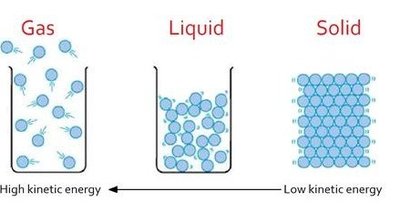
Postulates of the Kinetic Molecular Theory
The kinetic molecular theory provides a microscopic explanation for the properties of matter.
All matter is composed of particles (molecules and atoms).
Molecules are very small compared to the distances between them.
Molecules are in constant random motion.
Collisions between molecules are elastic, meaning kinetic energy is conserved.
Molecules and Intermolecular Forces
Nature of Intermolecular Forces
The force between molecules depends on their separation distance (r).
At large distances, intermolecular forces are weak and usually attractive.
At short distances, forces become strong and repulsive.
The potential energy of the system is minimized at a specific separation, forming a potential well.
Solids: Molecules are fixed in place.
Liquids and gases: Molecules have more freedom to move.
Force and Potential Energy Relationship:
Examples of Molecular Properties
Structure of Solids: Many solids, such as sodium chloride (NaCl), form crystal lattices where ions or atoms occupy fixed positions.
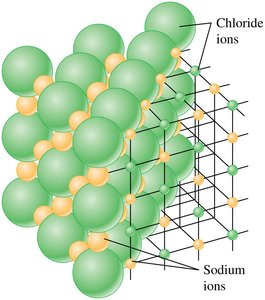
Atomic Arrangement: Scanning tunneling microscopy reveals the arrangement of atoms on the surface of crystals, such as silicon, showing a nearly perfect array.

Moles and Avogadro’s Number
Quantifying Matter
The amount of substance is measured in moles, which is a fundamental unit in chemistry and physics.
Mole: One mole contains as many elementary entities (atoms or molecules) as there are atoms in 12 grams of carbon-12.
Avogadro’s Number (): molecules/mol.
Molar Mass (M): The mass of one mole of a substance.
Atomic Mass: Used when dealing with atomic systems instead of molecular systems.
Example:
One mole of water (H2O) contains molecules and has a mass of 18 grams.
Additional info: Academic context was added to clarify the relationship between macroscopic and microscopic descriptions, and to expand on the examples of molecular properties and quantification of matter.
