 Back
BackKinetic Theory of Gases: Pressure, Molecular Speeds, and Collisions
Study Guide - Smart Notes
 Tailored notes based on your materials, expanded with key definitions, examples, and context.
Kinetic Theory of Gases
Calculation of Pressure: Molecule in a Box
The kinetic theory of gases provides a microscopic explanation for the pressure exerted by a gas. By modeling gas molecules as particles in a cubical box with perfectly elastic walls, we can derive the relationship between molecular motion and macroscopic pressure.
Model Assumptions: Gas molecules move randomly in a cube of volume and undergo elastic collisions with the walls.
Velocity Components: The velocity of a molecule can be resolved into , , and .
Collisions with Walls: When a molecule collides with a wall perpendicular to the x-axis, reverses sign, while and remain unchanged.
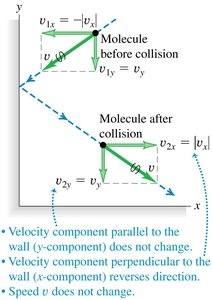
Momentum Change: The change in momentum normal to the wall (A1) is .
Momentum Transfer: The wall receives per collision due to conservation of momentum.
Collision Frequency: The time for a round trip between two walls is , so the collision rate is .
Force on Wall: The rate of momentum transfer (force) by one molecule is .
Total Force: Summing over all molecules, .
Pressure: Since , .
Density Relation: , so .
Isotropy of Motion: .
Final Pressure Formula:
Significance: This equation links the microscopic properties of molecules (mass, speed) to the macroscopic observable (pressure). The result holds even when molecular collisions are considered, and pressure is uniform throughout the gas (Pascal's law).
Temperature and Molecular Kinetic Energies
The kinetic energy of gas molecules is directly related to the absolute temperature. This provides a molecular interpretation of temperature.
Total Translational Kinetic Energy: The total kinetic energy of all molecules is proportional to temperature .
Average Kinetic Energy per Molecule: , where is Boltzmann's constant.
Gas Constant Relation: , where is Avogadro's number.
Molecular Speeds
The root-mean-square (rms) speed is a key characteristic of molecular motion in a gas.
Definition: , where is the mean of the squares of molecular speeds.
Calculation from Kinetic Theory:
Alternative (using pressure and density):
Example (Hydrogen Gas at 0°C): For kg/mol, K:
This is approximately 1.1 miles per second or 4100 mph.
Collisions Between Molecules: Mean Free Path and Time
In real gases, molecules frequently collide with each other. The mean free path and mean free time are important parameters describing these collisions.
Mean Free Path (): The average distance a molecule travels between collisions. It is inversely proportional to the number density and the square of the molecular radius.
Typical Values: At room temperature and 1 atm, m (100 nm) for air—much larger than the molecular diameter (~0.3 nm).
Mean Free Time: The average time between collisions is about s (0.1 ns), corresponding to about collisions per second.
Applications: These parameters are crucial for understanding transport phenomena such as diffusion, heat conduction, and viscosity in fluids.
Summary Table: Key Equations in Kinetic Theory
Quantity | Equation | Description |
|---|---|---|
Pressure | Relates pressure to molecular speed and density | |
Average Kinetic Energy | Average energy per molecule | |
Root-mean-square speed | Characteristic speed of molecules | |
Mean Free Path | Average distance between collisions |
Additional info: The mean free path formula is simplified; the exact expression includes a factor of in the denominator. The kinetic theory also provides the foundation for understanding thermodynamic properties such as heat capacities and the behavior of real gases.
