 Back
BackLight and Optics: Refraction, Snell’s Law, and Pinhole Imaging
Study Guide - Smart Notes
 Tailored notes based on your materials, expanded with key definitions, examples, and context.
Q1. A beam of light travels from air (n₁ = 1.000) into plastic (n₂ = 1.540). The beam has an angle of incidence θ₁ = 55° in air.
Background
Topic: Refraction and Snell’s Law
This question tests your understanding of how light bends when passing from one medium to another, specifically using Snell’s Law to relate the angles and indices of refraction.
Key Terms and Formulas
Index of Refraction (): A measure of how much a material slows down light.
Angle of Incidence (): The angle between the incoming ray and the normal (perpendicular) to the surface.
Angle of Refraction (): The angle between the refracted ray and the normal.
Snell’s Law:
Step-by-Step Guidance
Draw a boundary between air and plastic. Draw the normal (a line perpendicular to the surface at the point of incidence).
Draw the incoming ray in air, making an angle of with the normal. Label this angle .
Write down Snell’s Law: .
Plug in the known values: , , .
Rearrange Snell’s Law to solve for :
Try solving on your own before revealing the answer!
Q2. Given the index of refraction for Air (1.000), Fiberglass (1.56), and Milk (1.35), use Snell’s law to complete the path the light ray follows as it refracts from one medium to another. Label and calculate the angles of incidence and refraction from air to fiberglass and from fiberglass to milk.
Background
Topic: Multiple Refractions and Snell’s Law
This question tests your ability to apply Snell’s Law sequentially as light passes through multiple media, calculating the angles at each interface.
Key Terms and Formulas
Snell’s Law for each interface:
Step-by-Step Guidance
Draw the boundaries between air, fiberglass, and milk. Draw the normals at each interface.
Label the angle of incidence in air as and the angle of refraction in fiberglass as .
Apply Snell’s Law at the air-fiberglass boundary:
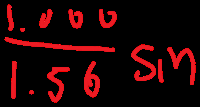
Once is found, use it as the angle of incidence for the fiberglass-milk boundary. Apply Snell’s Law again:
Try solving on your own before revealing the answer!
Q3. Given the diagram below and using that the refraction index of Benzene is 1.501 and the refraction index of kerosene is 1.39, complete the path of the light ray as it is refracted from Benzene to kerosene. Label and calculate the angles of incidence and refraction and make sure to use Snell’s Law.
Background
Topic: Refraction at a Liquid-Liquid Interface
This question tests your ability to apply Snell’s Law to light passing from one liquid to another, requiring careful labeling and calculation of angles.
Key Terms and Formulas
Snell’s Law:
Step-by-Step Guidance
Draw the boundary between benzene and kerosene. Draw the normal at the interface.
Label the angle of incidence in benzene as and the angle of refraction in kerosene as .
Write Snell’s Law for this interface:
Rearrange to solve for :
Try solving on your own before revealing the answer!
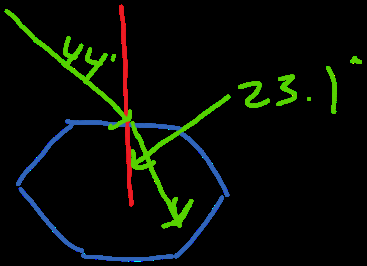
Q4. When the angle of incidence from a beam of light from the air creates an angle of incidence in the jewel of 44°, the resulting refracted angle is 23.1°. Use the given indexes of refraction to determine which jewel you will be receiving (Diamond = 2.42, Emerald = 1.58, Ruby = 1.77).
Background
Topic: Identifying Materials Using Refraction
This question tests your ability to use Snell’s Law and experimental data to identify an unknown material based on its index of refraction.
Key Terms and Formulas
Snell’s Law:
Step-by-Step Guidance
Identify the known values: (air), , .
Write Snell’s Law for the air-jewel interface:
Rearrange to solve for :
Calculate the value and compare it to the given indices for diamond, emerald, and ruby to identify the jewel.
Try solving on your own before revealing the answer!
Q5. What is the speed of light in the jewel that you will be receiving?
Background
Topic: Speed of Light in a Medium
This question tests your understanding of how the index of refraction relates to the speed of light in a material.
Key Terms and Formulas
Speed of light in a medium ():
is the speed of light in vacuum ( m/s)
is the index of refraction of the material
Step-by-Step Guidance
Use the value of you found in the previous question for the jewel.
Plug into the formula .
Set up the calculation using m/s.
Try solving on your own before revealing the answer!
Q6. A candle is placed on a tiny shelf in a pinhole imaging box. The object distance cm and the image distance cm. Construct the image on the screen using 2 rays.
Background
Topic: Pinhole Camera and Magnification
This question tests your understanding of image formation in a pinhole camera and how to use ray diagrams and magnification formulas.
Key Terms and Formulas
Object distance (): Distance from the object to the pinhole.
Image distance (): Distance from the pinhole to the screen.
Magnification ():
Step-by-Step Guidance
Draw the setup: object (candle), pinhole (mask), and screen. Mark and .
Draw two rays from the top of the candle: one straight through the pinhole, and one from the bottom through the pinhole to the screen.
Use the magnification formula to relate the image and object heights: .
Try solving on your own before revealing the answer!
Q6a. Using and , find what the magnification of this system is.
Background
Topic: Magnification in Pinhole Imaging
This part focuses on calculating the magnification using the distances from the object and image to the pinhole.
Key Terms and Formulas
Magnification ():
Step-by-Step Guidance
Plug in the given values: cm, cm.
Set up the calculation: .
Try solving on your own before revealing the answer!
Q6b. If the candle is 3.0 cm, what would be the image of the candle on the screen?
Background
Topic: Image Height Calculation
This part tests your ability to use magnification to find the image height from the object height.
Key Terms and Formulas
Image height ():
Step-by-Step Guidance
Use the magnification found in part a.
Plug in the object height cm.
Set up the calculation: cm.
Try solving on your own before revealing the answer!
Q6c. If you want the image to be 2.9 cm instead, what would the height of the candle need to be?
Background
Topic: Solving for Object Height
This part tests your ability to rearrange the magnification formula to solve for the object height given the desired image height.
Key Terms and Formulas
Object height ():
Step-by-Step Guidance
Use the desired image height cm and the magnification from part a.
Set up the calculation: .
Try solving on your own before revealing the answer!
Q6d. If you want the image of the candle to be 12 cm, how far and in what direction will you need to move the mask with the pinhole from the screen to achieve this? What will be the new dimensions for both and ?
Background
Topic: Adjusting Object and Image Distances for Desired Magnification
This part tests your ability to use the magnification formula to solve for new object and image distances to achieve a specific image size.
Key Terms and Formulas
Magnification ():
Step-by-Step Guidance
Set up the equation: (using the original candle height).
Choose a value for either or and solve for the other to achieve the desired magnification.
Determine the direction to move the mask (closer to or farther from the screen) based on the new values.
Try solving on your own before revealing the answer!
