 Back
BackLight Emission and the Bohr Model: Atomic Spectra, Excitation, and Modern Light Sources
Study Guide - Smart Notes
 Tailored notes based on your materials, expanded with key definitions, examples, and context.
Light Emission & The Bohr Model
Introduction
This chapter explores the quantum nature of light emission from atoms, the development of the Bohr model, and the physical principles underlying atomic spectra, luminescence, and modern lighting technologies. Understanding these concepts is essential for interpreting the structure of matter and the universe.
Discrete Spectra
Discovery of Discrete Spectra
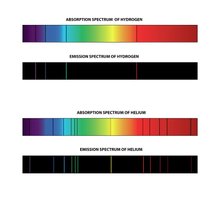
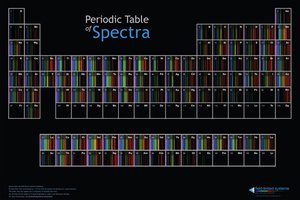
Discrete spectra are patterns of distinct spectral lines, each corresponding to a specific wavelength of light emitted by an element.
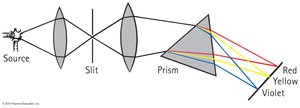
In the early 1800s, scientists observed that hot gases emit light at specific wavelengths, not as a continuous spectrum.
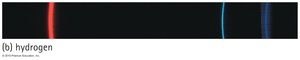
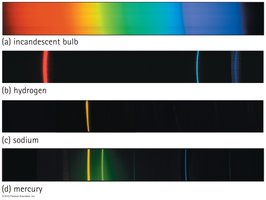
Each chemical element has a unique discrete spectrum, serving as a 'fingerprint' for identification.
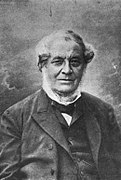
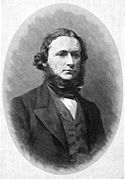
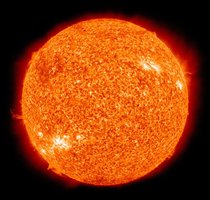
Helium was first discovered in the Sun’s spectrum using spectroscopy before being found on Earth.
Key Points
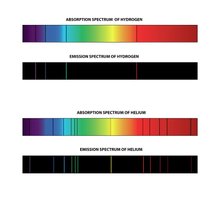
Emission spectrum: The set of wavelengths emitted by an element when its electrons drop from higher to lower energy levels.
Absorption spectrum: The set of wavelengths absorbed by an element as electrons are excited to higher energy levels.
The Bohr Model of the Atom & Atomic Excitation
Historical Context and Quantum Mystery
Early 20th-century physics faced two mysteries: why electrons do not spiral into the nucleus and the origin of discrete atomic spectra.
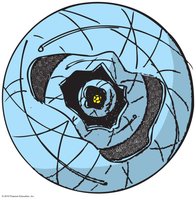
Niels Bohr (1913) proposed a model where electrons occupy quantized energy levels.
Bohr Model Fundamentals
Electrons can only occupy specific, quantized energy levels (shells).
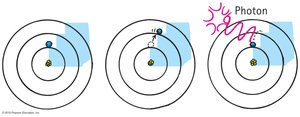
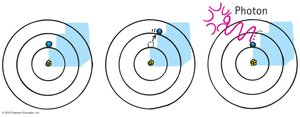
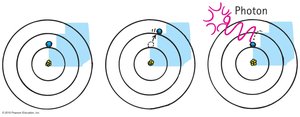
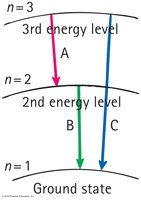
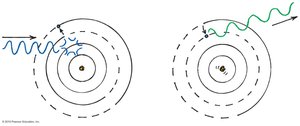
Transitions between these levels involve absorption or emission of photons with energy equal to the difference between the levels.
Energy levels are labeled as ground state (lowest) and excited states (higher).
Atomic Excitation and De-excitation
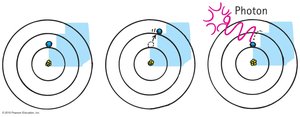
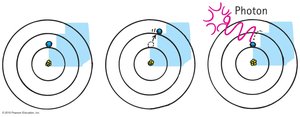
Excitation: An electron absorbs energy (from a photon or collision) and jumps to a higher energy level.
De-excitation: The electron returns to a lower energy level, emitting a photon whose energy equals the difference between the two states.
Formula:
Quantization and Energy Levels
Only photons with energy exactly matching the energy gap between levels can be absorbed.
Energy levels are often measured in electron volts (eV).
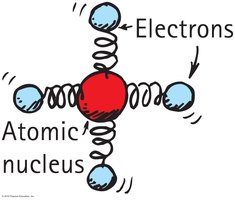
Spring Model Analogy
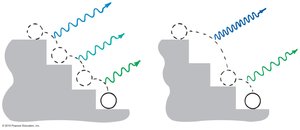
Energy levels can be visualized as different springs, each with a specific energy.
Emission and Absorption Spectra
Emission Spectra
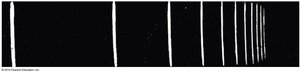
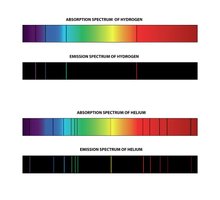
When electrons drop from higher to lower energy levels, they emit photons at specific frequencies, producing an emission spectrum.
Each element’s emission spectrum is unique and can be used for identification.
Emission spectra extend beyond visible light into infrared, ultraviolet, and X-rays.
Applications of Emission Spectra
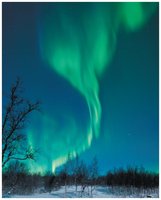
Used in neon lights, flame tests, and auroras.

Absorption Spectra
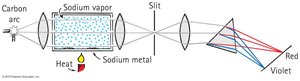
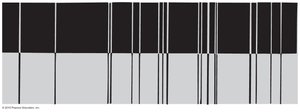
When white light passes through a gas, atoms absorb specific wavelengths, producing dark lines in the spectrum (absorption spectrum).
Absorption lines occur at the same wavelengths as emission lines for a given element.
Astrophysical Applications
Analysis of absorption spectra from stars reveals their composition, radial speed, and rotational speed.
Discovery of helium in the Sun’s spectrum is a key historical example.
Luminescence and Lamps
Incandescence
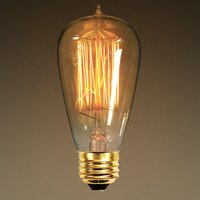
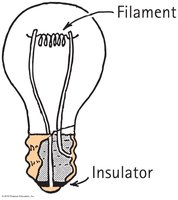
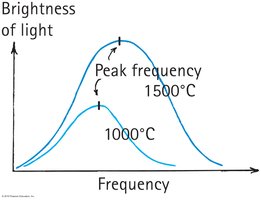
Incandescence: Light emission due to high temperature.
Incandescent lamps use a tungsten filament in an inert gas; most energy is emitted as infrared, with only a small fraction as visible light.
Efficiency is typically around 10%.
Fluorescence
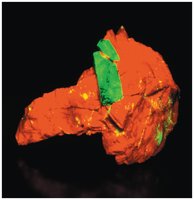
Fluorescence: Emission of visible (or invisible) light by a substance that has absorbed light or other electromagnetic radiation of a higher frequency.
Common in minerals, lamps, and glow-in-the-dark materials.

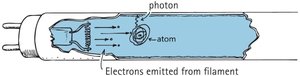
Fluorescent Lamps
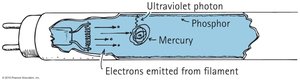
Primary emission: UV light from excited mercury vapor.
Secondary emission: UV light excites phosphor coating, which emits visible light (fluorescence).
Compact fluorescent lamps (CFLs) are more efficient than incandescent bulbs but contain mercury.

Phosphorescence
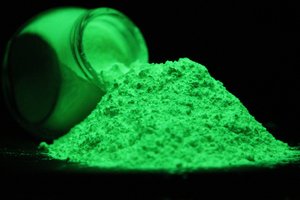
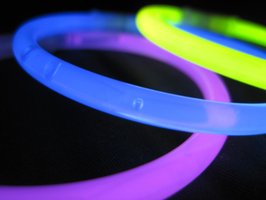
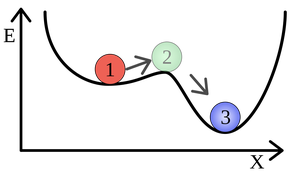
Phosphorescence: Similar to fluorescence, but with a delayed emission due to electrons being trapped in metastable states.
Materials continue to glow after the excitation source is removed.
Light-Emitting Diodes (LEDs)
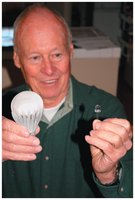
LEDs emit light when electrons recombine with holes in a semiconductor, releasing energy as photons.
Highly efficient and widely used in modern lighting.
Bioluminescence
Bioluminescence: Light produced by living organisms through chemical reactions, often involving the enzyme luciferase.
Examples include fireflies, certain fungi, and deep-sea organisms.
Summary Table: Comparison of Light Emission Mechanisms
Mechanism | Source of Excitation | Emission Type | Example |
|---|---|---|---|
Incandescence | Thermal (heat) | Continuous spectrum | Incandescent bulb, Sun |
Fluorescence | UV or X-ray absorption | Discrete, visible | Fluorescent lamp, minerals |
Phosphorescence | Light absorption | Delayed, visible | Glow-in-the-dark materials |
LED emission | Electron-hole recombination | Discrete, visible/IR/UV | LED lamps |
Bioluminescence | Chemical reaction | Discrete, visible | Fireflies, deep-sea organisms |
Key Equations
Photon energy:
Energy difference between levels:
Conclusion
The study of light emission and atomic spectra has revolutionized our understanding of atomic structure and the universe. The Bohr model, though superseded by quantum mechanics, provides a foundational framework for interpreting discrete spectra, luminescence, and the operation of modern light sources.
