 Back
BackLight Quanta, Wave-Particle Duality, and Quantum Physics: Study Notes
Study Guide - Smart Notes
 Tailored notes based on your materials, expanded with key definitions, examples, and context.
Light Quanta and the Photoelectric Effect
Problems with the Wave Theory of Light
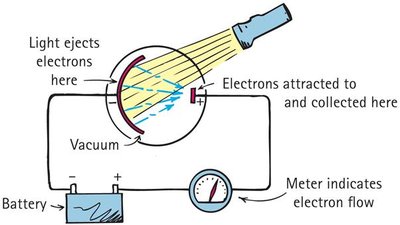
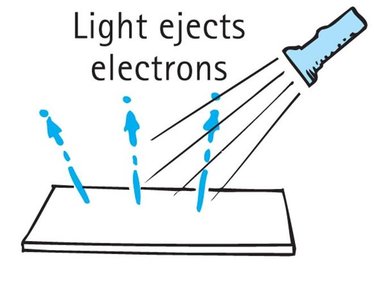
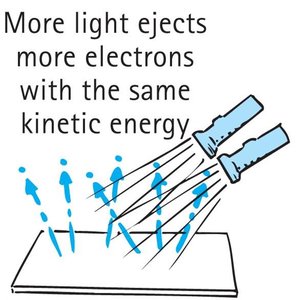
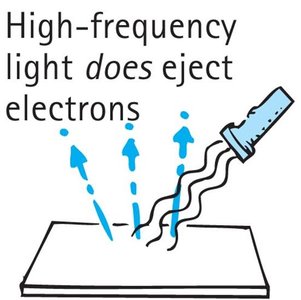
At the end of the 19th century, experiments revealed phenomena that could not be explained by the classical wave theory of light. When light was shone on a metal plate, electrons were ejected only if the light's frequency was above a certain threshold, regardless of its intensity. This effect, known as the photoelectric effect, demonstrated that the energy of ejected electrons depended solely on the frequency of the incident light, not its amplitude.
Photoelectric Effect: The emission of electrons from a metal surface when exposed to light of sufficient frequency.
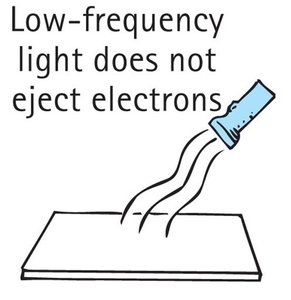
Key Observation: Increasing the intensity (amplitude) of low-frequency light does not cause electron emission; only frequency matters.
Significance: This contradicted the wave theory, which predicted that higher intensity (regardless of frequency) should increase electron energy.
Einstein's Explanation: Light as Photons
Albert Einstein resolved the paradox by proposing that light consists of discrete packets of energy called photons. Each photon carries energy proportional to its frequency. Only photons with sufficient energy (high enough frequency) can eject electrons from the metal.
Photon: A quantum (discrete packet) of electromagnetic energy.
Energy of a Photon: where is energy, is Planck's constant ( J·s), and is frequency.
Key Point: High-energy (high-frequency) photons can dislodge electrons; low-frequency photons cannot, regardless of intensity.
Wave–Particle Duality of Light
Dual Nature of Light
Physicist Niels Bohr and others established that light exhibits both wave-like and particle-like properties, a concept known as wave–particle duality. Light behaves as a wave when propagating and as a particle (photon) when interacting with matter.
Wave Behavior: Interference and diffraction patterns (e.g., double-slit experiment).
Particle Behavior: Discrete energy exchanges (e.g., photoelectric effect, photon detection).
Significance: Both aspects are necessary to explain all observed phenomena involving light.
Double-Slit Experiment
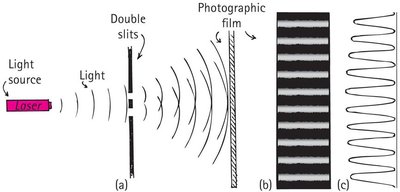
The double-slit experiment demonstrates the wave nature of light through interference patterns. When monochromatic light passes through two slits, it creates a pattern of bright and dark fringes due to constructive and destructive interference.
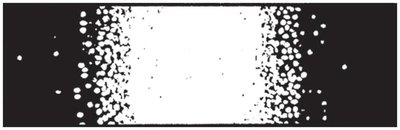
Single Photon Behavior: Even when light is so dim that only one photon passes at a time, the interference pattern gradually emerges as more photons are detected, indicating each photon interferes with itself as a wave.
Single Slit: Blocking one slit removes the interference pattern, showing only a diffraction pattern.

Light Emission and Atomic Structure
Quantum States and Excitation
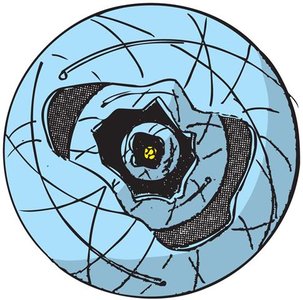
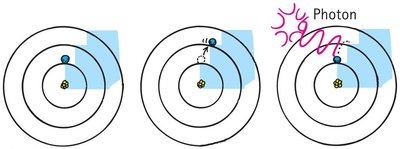
Atoms have discrete energy levels, or quantum states. When an atom absorbs energy, an electron may be excited to a higher energy level. When the electron returns to a lower energy state, it emits a photon with energy equal to the difference between the two levels.
Excitation: The process of boosting an electron to a higher energy level.
De-excitation: The process of an electron returning to a lower energy level, emitting a photon.
Photon Energy: (where is the energy difference between levels).
Emission and Absorption Spectra
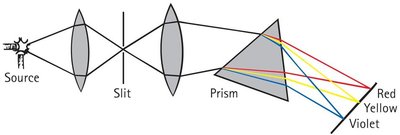
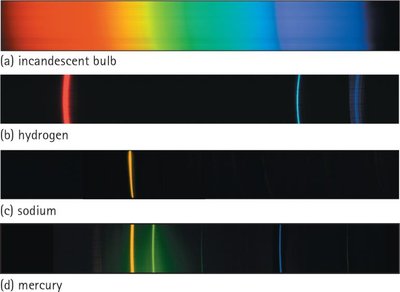
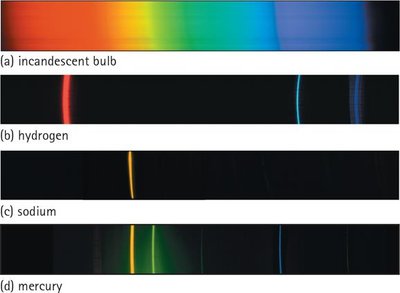
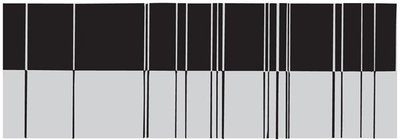
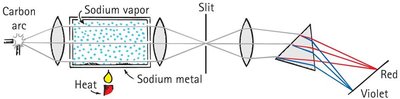
When light from a glowing element is analyzed with a spectroscope, it produces an emission spectrum—a series of bright lines at specific wavelengths. Each element has a unique pattern of spectral lines. Conversely, when white light passes through a gas, the gas absorbs light at the same frequencies it emits, producing an absorption spectrum with dark lines.
Emission Spectrum: Bright lines corresponding to photon energies emitted by electrons dropping to lower energy levels.
Absorption Spectrum: Dark lines where specific frequencies are absorbed by electrons moving to higher energy levels.
Hydrogen Spectrum: Shows a simple, orderly pattern; other elements have more complex spectra.
Birth of Quantum Theory
Quantization and Planck’s Constant
Quantum physics introduced the idea that energy is quantized in the microworld. Max Planck proposed that radiant energy is emitted in discrete bundles (quanta), each with energy . The smallest unit of light is the photon.
Quantization: Only certain energy values are allowed; energy changes occur in steps, not continuously.
Planck’s Constant (): J·s, the proportionality constant relating energy and frequency.
Wave–Particle Duality of Matter
de Broglie Hypothesis
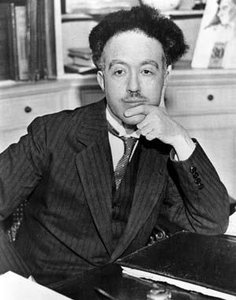
Louis de Broglie extended wave–particle duality to matter, proposing that all particles have an associated wavelength, called the de Broglie wavelength. This was confirmed by electron diffraction experiments.
de Broglie Wavelength: where is wavelength, is Planck’s constant, and is momentum.
Experimental Evidence: Electron beams produce interference patterns, confirming their wave nature.

Heisenberg’s Uncertainty Principle
Limits of Measurement
Werner Heisenberg formulated the uncertainty principle, which states that it is impossible to simultaneously know both the exact position and momentum of a particle. The more precisely one is known, the less precisely the other can be known.
Uncertainty Principle: where is the uncertainty in momentum, is the uncertainty in position, and .
Energy-Time Uncertainty:
Significance: The uncertainty principle is significant only at atomic and subatomic scales; it is negligible for macroscopic objects.
Summary Table: Key Quantum Concepts
Concept | Description | Key Equation |
|---|---|---|
Photon Energy | Energy of a light quantum | |
de Broglie Wavelength | Wavelength associated with a particle | |
Uncertainty Principle | Limits on simultaneous measurement of position and momentum |
Additional info: These notes cover material from Chapters 30–31 of a college-level conceptual physics course, focusing on quantum phenomena, the photoelectric effect, wave–particle duality, atomic spectra, and the uncertainty principle. All equations are provided in LaTeX format for clarity and academic rigor.
