 Back
BackLight Reflection, Transmission, Thin Film Interference, and Diffraction Gratings
Study Guide - Smart Notes
 Tailored notes based on your materials, expanded with key definitions, examples, and context.
Light Reflection and Transmission
Reflection and Transmission at Boundaries
When a light wave encounters a boundary between two media with different indices of refraction, part of the wave is reflected and part is transmitted. This behavior is analogous to mechanical waves on a string encountering a boundary between two different mass densities.
Reflected Wave: The portion of the wave that bounces back into the original medium.
Transmitted Wave: The portion of the wave that passes into the new medium.
Phase Change: If the wave reflects off a medium with a higher index of refraction, it undergoes a phase change of (inversion). If it reflects off a medium with a lower index, there is no phase change.
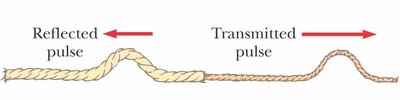
Additional info: The analogy with mechanical waves helps visualize why phase changes occur at boundaries.
Thin Film Interference
Principles of Thin Film Interference
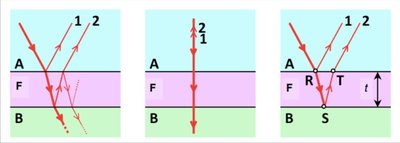
Thin film interference arises when light reflects off the two surfaces of a thin layer, such as a soap bubble or oil slick. The reflected rays can interfere constructively or destructively, depending on the path difference and any phase changes upon reflection.
Path Difference: The extra distance traveled by one ray compared to another, typically for perpendicular incidence, where is the film thickness.
Phase Change: A phase shift occurs if reflection is from a higher-index medium; no phase shift if from a lower-index medium.
Wavelength in Medium: The relevant wavelength is , where is the index of refraction of the film.
Conditions for Constructive and Destructive Interference
The conditions for constructive and destructive interference depend on whether there is a phase shift upon reflection:
No Relative Phase Shift (e.g., both reflections from higher or lower index):

Half-Cycle Phase Shift (e.g., one reflection from higher index, one from lower):
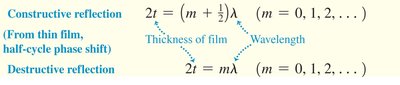
Additional info: The integer represents the order of the interference fringe.
Applications and Examples of Thin Film Interference
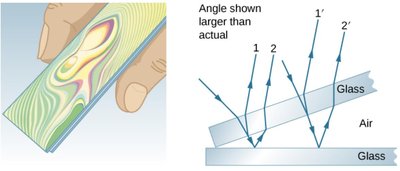
Thin film interference is responsible for colorful patterns in soap bubbles, oil slicks, and antireflection coatings on lenses. It is also used to test the flatness of surfaces and measure small distances.
Antireflection Coatings: Thin films are engineered to minimize reflection at specific wavelengths, improving optical device performance.
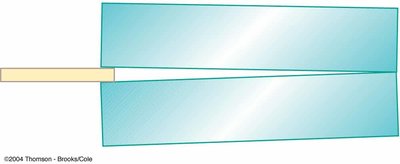
Measurement of Small Gaps: Interference patterns can reveal variations in thickness on the order of the wavelength of light.
Diffraction Gratings
Introduction to Diffraction Gratings
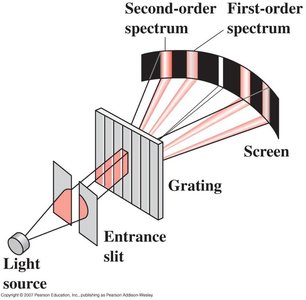
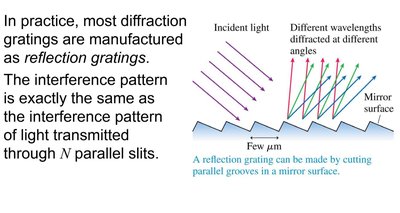
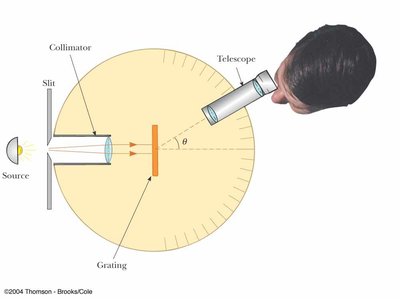
A diffraction grating consists of many closely spaced parallel slits or grooves. When light passes through or reflects from the grating, it is diffracted and produces an interference pattern of bright and dark bands.
Transmission Grating: Light passes through slits.
Reflection Grating: Light reflects from grooves cut into a surface.
Diffraction Grating Equation and Variables
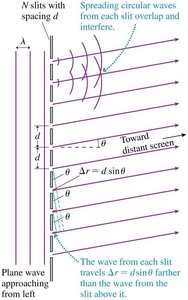
The positions of the bright bands (maxima) are given by the grating equation:
Grating Equation:
Variables:
= distance between adjacent slits (grating spacing)
= angle of the bright fringe
= order of the maximum ()
= wavelength of light
Maximum Order: The maximum order is limited by , so .
Additional info: The small angle approximation cannot be used for gratings; always solve for directly.
Polychromatic Light and Spectroscopy
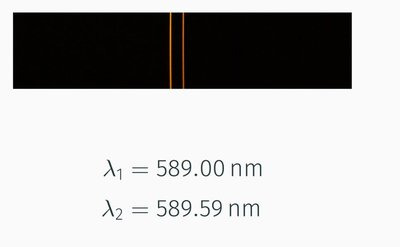
When white light (containing multiple wavelengths) passes through a grating, each wavelength is diffracted at a different angle, producing a spectrum. This property is used in spectroscopy to analyze the composition of light sources.
Spectroscopy: The science of measuring and analyzing the wavelengths of light emitted or absorbed by substances.
Grating Spectrometer: An instrument that uses a diffraction grating to separate and measure the wavelengths in a light source.
Example Problems
Thin Film Example: Calculating the color most strongly reflected by a soap bubble or oil film using the interference conditions and the wavelength in the film.
Diffraction Grating Example: Finding the number of grooves in a grating given the order, angle, and wavelength of a spectral line.
Additional info: These examples illustrate practical applications of the equations and concepts discussed above.
