 Back
BackLight: Wave-Particle Duality, Probability, and Uncertainty
Study Guide - Smart Notes
 Tailored notes based on your materials, expanded with key definitions, examples, and context.
Light: Wave-Particle Duality, Probability, and Uncertainty
Wave-Particle Duality of Light
The nature of light is fundamentally dual: it exhibits both wave-like and particle-like properties. This duality is central to quantum mechanics and is demonstrated in experiments such as the double-slit experiment.
Wave Description: Explains interference and diffraction patterns observed in single- and double-slit experiments.
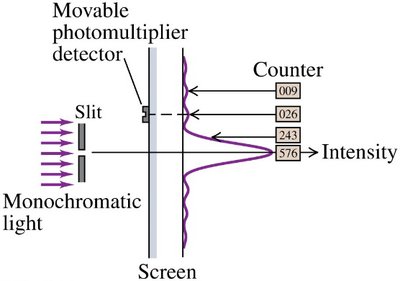
Particle Description: Accounts for the detection of individual photons by devices such as photomultiplier detectors.
Statistical Distribution: The pattern observed on a screen is a statistical distribution, representing the probability that a photon will strike a given location.
Conundrum: The path of an individual photon is unpredictable, but the overall pattern is determined by wave properties.
Example: In the double-slit experiment, photons create an interference pattern even when sent one at a time, indicating wave behavior, but are detected as discrete particles.
Probability and Uncertainty in Diffraction
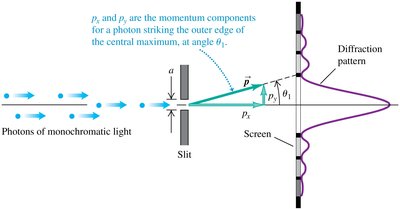
Quantum mechanics introduces the concepts of probability and uncertainty in the measurement of physical quantities. The single-slit diffraction experiment illustrates how measuring both the position and momentum of a photon is fundamentally limited.
Position of Dark Fringes: The minima in the diffraction pattern are given by , where is the slit width, is the angle, is an integer, and is the wavelength.
Momentum Components: Photons passing through the slit have momentum components and , with determined by the angle at the edge of the central maximum.
Uncertainty Relation: The uncertainty in is at least as great as .
Example: Narrower slits (smaller ) produce broader diffraction patterns, increasing the uncertainty in .
Heisenberg Uncertainty Principle
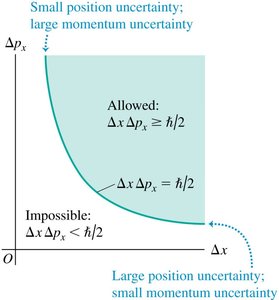
The Heisenberg uncertainty principle states that it is impossible to simultaneously determine both the position and momentum of a particle with arbitrary precision. This principle is a cornerstone of quantum mechanics.
Mathematical Form: , where is the uncertainty in position, is the uncertainty in momentum, and is the reduced Planck constant.
Statistical Interpretation: Uncertainties are described by standard deviations.
Implications: Small uncertainty in position leads to large uncertainty in momentum, and vice versa.
Example: In a single-slit experiment, the slit width defines the uncertainty in position, and the resulting diffraction pattern defines the uncertainty in momentum.
Wave Properties and Uncertainty
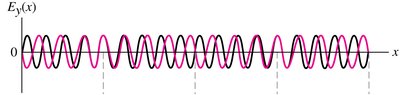
The uncertainty principle can also be understood in terms of wave properties. A pure sine wave has a definite wavelength and momentum, but is completely delocalized in space.
Wave Equations: ,
Photon Description: ,
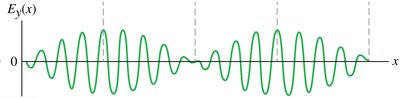
Localization: Superimposing multiple waves (wave packets) increases localization in space but introduces uncertainty in momentum.
Example: A single sine wave extends infinitely, so and .
Uncertainty in Energy and Time
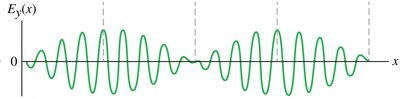
There is also an uncertainty principle involving energy and time. Combining waves of slightly different frequencies produces beats, which localize the photon in time but introduce uncertainty in energy.
Energy-Time Uncertainty:
Beats: Superposition of waves with different frequencies results in amplitude modulation (beats), localizing the photon in time.
Implications: The more precisely a photon is localized in time, the less precisely its energy can be known.
Example: Listening to beats in sound waves is analogous to observing energy-time uncertainty in photons.
Summary Table: Heisenberg Uncertainty Relations
Quantity Pair | Uncertainty Relation | Physical Meaning |
|---|---|---|
Position () & Momentum () | Cannot simultaneously know position and momentum precisely | |
Energy () & Time () | Cannot simultaneously know energy and time precisely |
Additional info: The notes expand on the statistical interpretation of quantum mechanics, the mathematical forms of uncertainty relations, and the physical implications for experiments involving photons and wave packets.
