 Back
BackLinear Momentum and Collisions: Impulse, Conservation, and Collision Types
Study Guide - Smart Notes
 Tailored notes based on your materials, expanded with key definitions, examples, and context.
Momentum, Impulse, and Collisions
Linear Momentum
Linear momentum is a fundamental concept in physics, describing the quantity of motion an object possesses. It is a vector quantity, meaning it has both magnitude and direction, and is defined as the product of an object's mass and velocity.
Definition: The linear momentum p of an object of mass m moving with velocity v is given by:
Units: The SI unit of momentum is kg·m/s.
Vector Nature: Since velocity is a vector, momentum points in the same direction as velocity. Pay attention to signs when calculating momentum.
Newton's Second Law and Momentum
Newton's Second Law can be expressed in terms of momentum. The net force acting on an object is equal to the rate of change of its momentum.
Mathematical Formulation:
This equation shows that a net force causes a change in momentum over time.
Impulse
Impulse is the effect of a force acting over a time interval, resulting in a change in momentum. It is also a vector quantity and points in the direction of the force.
Definition: Impulse J is given by:
Impulse can be calculated even if the force is not constant, by integrating the force over the time interval.
Impulse-Momentum Theorem
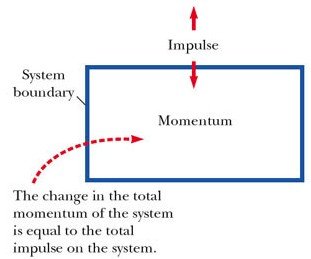
The impulse-momentum theorem states that the impulse acting on a system is equal to the change in momentum of the system.
Mathematical Statement:
This theorem is useful for analyzing collisions and other interactions where forces act over short time intervals.
Example: Car Crash and Impulse
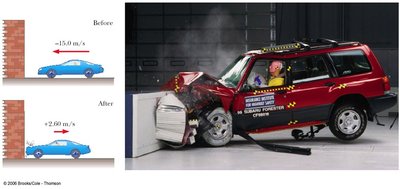
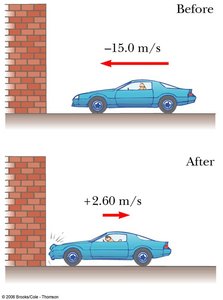
Consider a car of mass kg colliding with a wall and rebounding. If the initial and final velocities are m/s and m/s, and the collision lasts s:
Impulse delivered to the car:
kg·m/s
Average force exerted on the car:
N$
Impulse-Momentum Theorem: Bouncing Ball Example
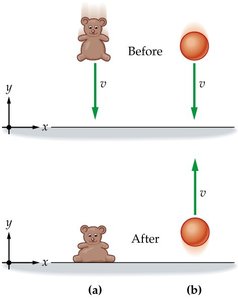
A 100 g superball changes velocity from 10 m/s downward to 10 m/s upward in 0.1 s. The impulse imparted is:
Convert mass: $100= 0.1$ kg
kg·m/s
Average force: N
Conservation of Momentum
Principle of Conservation of Momentum
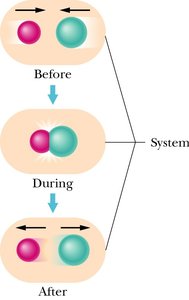
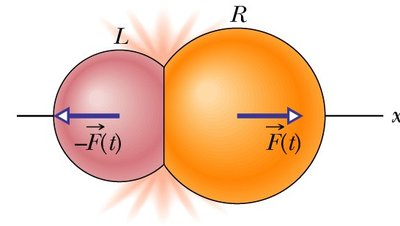
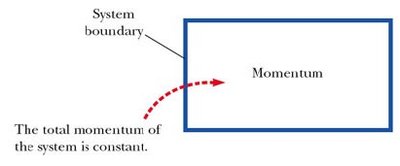
In an isolated and closed system (no external forces and no mass entering or leaving), the total momentum remains constant over time. The momentum of individual objects may change, but the total system momentum does not.
Mathematical Statement:
This principle is fundamental in analyzing collisions and explosions.
Example: Archer on Ice
An archer (mass 60 kg) stands on frictionless ice and fires a 0.5 kg arrow at 50 m/s. Find the archer's recoil velocity.
Initial momentum: $0$ (system at rest)
Final momentum:
m/s

Types of Collisions
Elastic and Inelastic Collisions
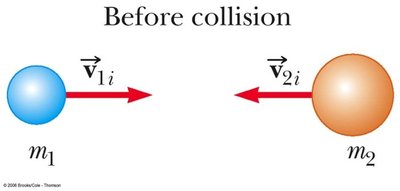
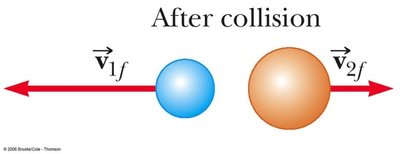
Collisions are classified based on how kinetic energy and momentum are conserved:
Elastic Collisions: Both momentum and kinetic energy are conserved. Objects bounce off each other and remain separate (e.g., billiard balls).
Inelastic Collisions: Momentum is conserved, but kinetic energy is not. Objects may deform or stick together.
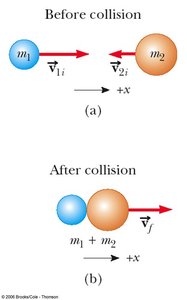
Perfectly Inelastic Collisions: A special case where objects stick together after the collision, moving with a common velocity.
Equations for Collisions
Elastic Collision (1D):
Perfectly Inelastic Collision: (objects stick together)
Example: Head-On Inelastic Collision
An object of mass m moves right at speed v and collides head-on with an object of mass 3m moving left at speed v/3. If they stick together, the final speed is:
Total mass:
Initial momentum:
Final velocity: $0$ (the combined object is at rest)
Summary Table: Types of Collisions
Type of Collision | Momentum Conserved? | Kinetic Energy Conserved? | Objects Stick Together? |
|---|---|---|---|
Elastic | Yes | Yes | No |
Inelastic | Yes | No | Sometimes |
Perfectly Inelastic | Yes | No | Yes |
Additional info: In real-world collisions, some kinetic energy is often transformed into heat, sound, or deformation energy, making most collisions inelastic to some degree.
