 Back
BackLinear Momentum: Concepts, Problems, and Applications
Study Guide - Smart Notes
 Tailored notes based on your materials, expanded with key definitions, examples, and context.
Linear Momentum
Introduction to Momentum
Momentum is a fundamental concept in physics that quantifies the motion of an object. It is defined for any object with mass moving at a velocity and is a vector quantity, meaning it has both magnitude and direction.
Definition: Momentum (p) is given by the product of an object's mass (m) and its velocity (\vec{v}).
Formula:
Units: kg·m/s
Direction: The direction of momentum is the same as the velocity of the object.
If an object moves in the negative direction, both its velocity and momentum are negative.
Example: A 4,000 kg truck moves to the right at 10 m/s, and an 800 kg racecar moves to the left at 50 m/s. Their momenta are:
Truck: (right)
Racecar: (left)
Impulse and Change in Momentum
Impulse is the effect of a force acting over a time interval, resulting in a change in momentum. It is closely related to Newton's Second Law and is essential for understanding collisions and force interactions.
Definition: Impulse (J) is the product of the average force (F) and the time interval (\Delta t) during which the force acts.
Formula:
Units: N·s or kg·m/s (equivalent)
Impulse is a vector and points in the direction of the force applied.
Example: You push a 50 kg crate at rest with a 100 N force for 8 seconds. The impulse delivered is , and the crate's final speed is .
Impulse from Force vs. Time Graphs
Impulse can also be determined graphically as the area under a force vs. time graph. This is particularly useful when the force varies over time.
Area under F vs. t graph: Represents the impulse delivered to an object.
Areas above the time axis correspond to positive impulse; areas below correspond to negative impulse.
Example: If a force varies with time, calculate the impulse by finding the area under the curve (using geometric shapes like rectangles and triangles as appropriate).
Total Momentum of a System
The total momentum of a system is the vector sum of the momenta of all objects within the system. This is crucial for analyzing interactions such as collisions.
Formula:
Momentum is conserved in an isolated system (no external forces).
Example: Two objects, A (4 kg, 12 m/s right) and B (5 kg, 9 m/s left), have total momentum (right).
Conservation of Momentum
In the absence of external forces, the total momentum of a system remains constant before and after an interaction (such as a collision or explosion).
Conservation Law:
Applies to all types of collisions and push-away problems.
Example: Two balls collide; use the conservation equation to solve for unknown velocities after the collision.
Types of Collisions
Collisions are classified based on whether kinetic energy is conserved and whether objects stick together after the collision.
Type | Momentum Conserved? | Kinetic Energy Conserved? | Objects Stick Together? |
|---|---|---|---|
Elastic | Yes | Yes | No |
Inelastic | Yes | No | No |
Completely Inelastic | Yes | No | Yes |
Check Process for Collision Type:
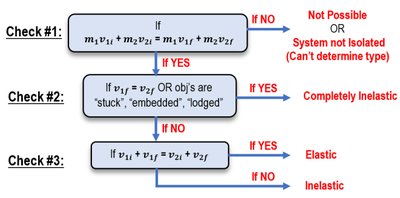
Check #1: Is momentum conserved? If not, the system is not isolated or the collision is not possible.
Check #2: Do objects stick together? If yes, it's completely inelastic.
Check #3: Is kinetic energy conserved? If yes, it's elastic; if not, it's inelastic.
Completely Inelastic Collisions
In a completely inelastic collision, two objects stick together after colliding and move with the same final velocity. Momentum is conserved, but kinetic energy is not.
Conservation Equation:
Example: A 1 kg block moving at 20 m/s collides with a 9 kg block at rest. After sticking together, .
Elastic Collisions
In elastic collisions, both momentum and kinetic energy are conserved. These collisions often require solving a system of equations to find final velocities.
Momentum Conservation:
Kinetic Energy Conservation:
Relative Velocity Equation: (for 1D elastic collisions)
Example: Two blocks (5 kg and 3 kg) collide head-on; use the above equations to solve for final velocities.
Center of Mass
The center of mass (C.O.M.) of a system is the weighted average position of all the mass in the system. It is useful for simplifying the analysis of motion for complex systems.
Formula (1D):
The center of mass is closer to the more massive objects in the system.
Example: Two objects (10 kg each) at x = 0 and x = 4 m: .
Collisions with Energy Considerations
Some problems involve both conservation of momentum (during collision) and conservation of energy (after collision, such as motion up an incline, compression of a spring, or pendulum motion).
Momentum Conservation (during collision):
Energy Conservation (after collision):
Example: A crate sticks to another crate and moves up an incline; use momentum conservation for the collision and energy conservation for the subsequent motion.
Summary Table: Types of Collisions
Type | Momentum Conserved? | Kinetic Energy Conserved? | Objects Stick Together? |
|---|---|---|---|
Elastic | Yes | Yes | No |
Inelastic | Yes | No | No |
Completely Inelastic | Yes | No | Yes |
Additional info: In all collision problems, always start by drawing diagrams for before and after, writing the appropriate conservation equations, and solving for the unknowns. For multi-dimensional problems, apply conservation laws separately to each axis.
