 Back
BackLinear Motion: Speed, Velocity, and Acceleration
Study Guide - Smart Notes
 Tailored notes based on your materials, expanded with key definitions, examples, and context.
Linear Motion
Speed
Speed is a fundamental concept in physics that describes how fast an object is moving. It is defined as the distance covered per unit of time, and its standard unit is meters per second (m/s).
Definition: Speed is the rate at which distance is traveled.
Formula:
Units: meters per second (m/s), kilometers per hour (km/h), miles per hour (mi/h)
Example: If a girl runs 20 meters in 10 seconds, her speed is .

Table Purpose: Comparison of speed values in different units.
Speed (m/s) | Speed (mi/h) | Speed (km/h) |
|---|---|---|
5 | 11 | 18 |
10 | 22 | 36 |
20 | 45 | 72 |
30 | 67 | 107 |
40 | 89 | 142 |
50 | 112 | 180 |
Average Speed
Average speed is calculated by dividing the total distance traveled by the total time taken. It does not account for variations in speed during the journey.
Formula:
Example: Driving 200 km in 2 hours gives an average speed of .
Key Point: Average speed can be the same for different combinations of distance and time, as long as their ratio is equal.
Instantaneous Speed
Instantaneous speed is the speed of an object at a specific moment in time. It is what is shown on a speedometer.
Definition: The speed at any given instant.
Example: The speedometer in a car shows the instantaneous speed.
Velocity
Velocity describes both the speed and direction of an object's motion. It is a vector quantity, meaning it has both magnitude and direction.
Definition: Velocity is the speed of an object in a specified direction.
Vector Quantity: Has both magnitude (speed) and direction (e.g., north, south).
Constant Velocity: Requires both constant speed and constant direction (straight-line motion).
Speed and Velocity Comparison
While speed is a scalar quantity (only magnitude), velocity is a vector (magnitude and direction). Constant speed does not imply constant velocity unless the direction is also constant.
Acceleration
Acceleration is the rate at which velocity changes over time. It can result from changes in speed, direction, or both. Galileo formulated the concept of acceleration through experiments with inclined planes.
Definition: Acceleration is the rate of change of velocity.
Formula:
Units: meters per second squared (m/s2)
Example: If a car's speed increases from 40 km/h to 45 km/h in 5 seconds, its acceleration is .
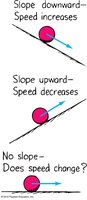
Image Explanation: The diagram illustrates how speed increases on a downward slope, decreases on an upward slope, and remains unchanged on a flat surface.
Acceleration: Change in Speed or Direction
Acceleration can occur due to a change in speed, a change in direction, or both. For example, a car rounding a curve at constant speed is still accelerating because its direction changes.

Image Explanation: The car rounding a curve demonstrates acceleration due to a change in direction, even if speed is constant.
Galileo's Inclined Plane Experiments
Galileo increased the inclination of planes to study acceleration. Steeper inclines resulted in greater acceleration, and a vertical incline matched the acceleration of free-falling objects.
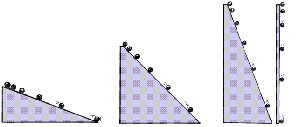
Image Explanation: The image shows balls rolling down inclines of increasing steepness, illustrating how acceleration increases with slope.
Free Fall
Free fall refers to motion under the influence of gravity alone, with negligible air resistance. On Earth, the acceleration due to gravity is approximately 10 m/s2 (more precisely, 9.8 m/s2).
Definition: Motion under gravity only, no air resistance.
Acceleration:
Key Point: All objects fall with the same acceleration when air resistance is negligible.
Free Fall: Velocity and Distance
The velocity and distance of a freely falling object starting from rest can be calculated using the following equations:
Velocity after time t:
Distance after time t:
Example: After 4 seconds, the distance fallen is .
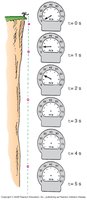
Image Explanation: The image shows speedometer readings at each second during free fall, illustrating how velocity increases linearly with time.
Summary of Key Equations
Speed:
Average Speed:
Acceleration:
Velocity in free fall:
Distance in free fall:
For non-free fall: and
Summary of Galilean Motion
Galileo discovered that all falling objects experience the same acceleration due to gravity, allowing predictions of how fast and how far objects fall (ignoring air resistance).
Conceptual Questions and Applications
Example: If a rock takes 10 seconds to fall from a cliff, the height can be calculated using .
Example: A ball kicked straight up to 125 m will be in the air for a certain time, and its velocity at the top will be zero.
Additional info: These notes expand on brief points with academic context, definitions, and examples to ensure completeness and clarity for exam preparation.
