 Back
Linear Motion: Speed, Velocity, and Acceleration
Study Guide - Smart Notes
 Tailored notes based on your materials, expanded with key definitions, examples, and context.
Linear Motion
Introduction to Linear Motion
Linear motion describes the movement of objects along a straight path. This chapter introduces the foundational concepts of speed, velocity, and acceleration, which are essential for understanding motion in physics. All motion is measured relative to a reference frame, typically the Earth unless otherwise specified.
Motion Is Relative
Reference Frames
Motion is always described relative to something else, known as a reference frame. For example, a person walking on the road is moving relative to the Earth, but since the Earth itself is moving around the Sun, the person's motion relative to the Sun is different.
Reference Frame: The perspective from which motion is observed and measured.
Example: Walking on a moving train—relative to the train you may be stationary, but relative to the ground you are moving.
Speed
Definition and Calculation
Speed is defined as the distance covered per unit of time. It is a scalar quantity, meaning it has magnitude but no direction. The standard unit for speed is meters per second (m/s).
Formula:
Example: If a girl runs 4 meters in 2 seconds, her speed is .
Average Speed
Average speed is the total distance traveled divided by the total time taken. It does not account for variations in speed during the journey.
Formula:
Example: Driving 200 km in 2 hours gives an average speed of .
Instantaneous Speed
Instantaneous speed is the speed of an object at a specific instant in time. It can be read directly from a speedometer in a car.
Example: While driving, your speed may vary, but the speedometer shows your instantaneous speed at any moment.
Velocity
Definition and Properties
Velocity is a vector quantity that describes both the speed and direction of an object's motion. It is often referred to as "directed speed." The magnitude of velocity is the speed, and its direction is specified relative to a reference frame.
Formula: , where is the displacement vector and is the time interval.
Constant velocity: Both speed and direction remain unchanged (straight-line motion with no acceleration).
Example: A car moving at 60 km/h north has a velocity of 60 km/h north.
Acceleration
Definition and Calculation
Acceleration is the rate at which velocity changes with time. It is a vector quantity and can result from changes in speed, direction, or both. Galileo first formulated the concept of acceleration through his experiments with inclined planes.
Formula: , where is the change in velocity and is the time interval.
Unit: Meters per second squared (m/s2).
Example: If a car's speed increases from 40 km/h to 45 km/h in 5 seconds, .
Types of Acceleration
Change in speed: Speeding up or slowing down in a straight line.
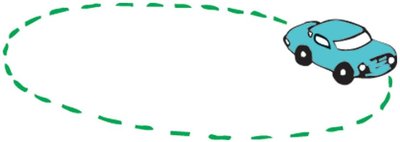
Change in direction: Turning at constant speed (e.g., car rounding a curve).
Both: Changing both speed and direction simultaneously.
Galileo's Inclined Plane Experiments
Galileo discovered that the acceleration of an object increases with the steepness of the incline. When the incline is vertical, the acceleration is at its maximum, equal to that of a freely falling object. When air resistance is negligible, all objects fall with the same acceleration regardless of mass.
Free Fall
Definition and Acceleration Due to Gravity
Free fall refers to the motion of an object under the influence of gravity alone, with air resistance neglected. On Earth, the acceleration due to gravity is approximately (often rounded to 10 m/s2 for estimation).
Formula for velocity after time t (starting from rest):
Example: After 3 seconds, .
Distance Fallen in Free Fall
The distance an object falls from rest under constant acceleration is given by:
Formula:
Example: After 4 seconds, .
Vectors
Vector Addition and Resultants
Vectors are quantities that have both magnitude and direction, such as velocity and acceleration. When two vectors are combined, the result is called the resultant. The parallelogram rule is used to find the resultant of two vectors that are not in the same direction.
Example: An airplane flying with a crosswind. If the plane's velocity is 80 km/h and the wind's velocity is 60 km/h, the resultant velocity is found using the Pythagorean theorem: .
Angle Calculation: If both vectors are equal (e.g., 80 km/h each), the resultant makes a 45-degree angle with each vector.
Relative Motion and Vector Components
When moving in two dimensions, such as running in the rain or flying in a crosswind, the actual velocity relative to the ground or another reference frame is found by vector addition.
Example: Running horizontally at 4 m/s in rain falling vertically at 4 m/s results in a resultant velocity at a 45-degree angle to the vertical, with magnitude .
Summary Table: Key Quantities in Linear Motion
Quantity | Definition | Formula | Unit | Type |
|---|---|---|---|---|
Speed | Distance per unit time | m/s | Scalar | |
Velocity | Displacement per unit time (with direction) | m/s | Vector | |
Acceleration | Change in velocity per unit time | m/s2 | Vector |
Additional info: This summary includes expanded academic context and examples to ensure the notes are self-contained and suitable for college-level Physics with Calculus students.
