 Back
BackMagnetic Field and Magnetic Forces: Study Notes
Study Guide - Smart Notes
 Tailored notes based on your materials, expanded with key definitions, examples, and context.
Magnetic Field and Magnetic Forces
Introduction to Magnetism
Magnetism is a fundamental force of nature, closely related to electricity. It arises from the motion of electric charges and is responsible for the behavior of magnets and magnetic materials. This chapter explores the properties of magnets, the forces they exert, and the effects of magnetic fields on moving charges and currents.
Magnetic Poles and Magnetic Materials
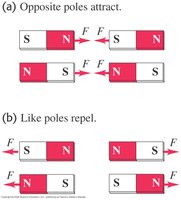
Magnetic Poles: Every magnet has two poles: North (N) and South (S). Opposite poles attract, while like poles repel each other.
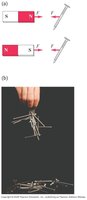
Magnetism in Metals: Certain metals, such as iron, cobalt, and nickel, are attracted to magnets due to their atomic structure.
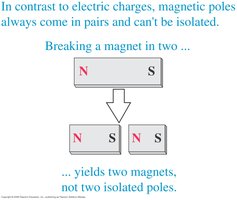
Magnetic Monopoles: Unlike electric charges, isolated magnetic poles (monopoles) have never been observed. Breaking a magnet results in two smaller magnets, each with both a north and a south pole.
Magnetic Field Lines
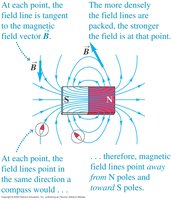
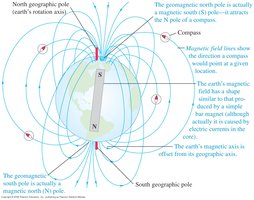
Magnetic field lines provide a visual representation of the direction and strength of a magnetic field. They emerge from the north pole and enter the south pole of a magnet. The density of the lines indicates the strength of the field.
Direction: At any point, the tangent to a field line gives the direction of the magnetic field vector B.
Field Strength: The closer the lines, the stronger the field.
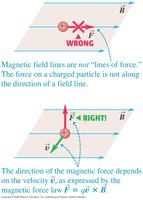
Not Lines of Force: Magnetic field lines are not the same as lines of force; the force on a charged particle is not along the field line but is perpendicular to both the velocity and the field.
Earth’s Magnetic Field
The Earth itself acts as a giant magnet, with a magnetic field similar to that of a bar magnet. The geographic north pole is actually a magnetic south pole, which attracts the north pole of a compass needle.
Electric Currents and Magnetism
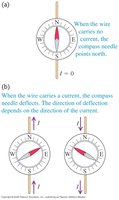
Oersted’s Discovery: In 1820, Hans Oersted found that a current-carrying wire deflects a nearby compass needle, revealing the connection between electricity and magnetism.
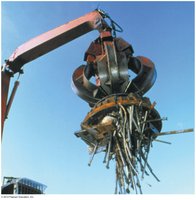
Electromagnets: A coil of wire carrying current produces a strong magnetic field, which can be used in devices such as cranes for lifting scrap metal.
Applications: Magnetic Fields in MRI
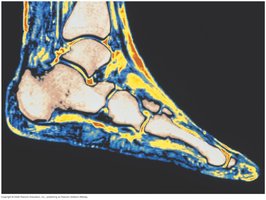
Magnetic Resonance Imaging (MRI) uses strong magnetic fields (typically 1.5 T or higher) to produce detailed images of the inside of the human body, revolutionizing medical diagnostics.

The Magnetic Field (B)
Definition: The magnetic field B is a vector field produced by moving charges (currents) and magnetic materials.
Units: The SI unit of magnetic field is the Tesla (T).
Force on a Moving Charge in a Magnetic Field
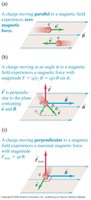
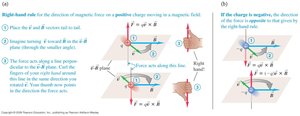
A moving charge in a magnetic field experiences a force given by the vector equation:
Formula:
Magnitude:
Direction: The force is perpendicular to both the velocity of the charge and the magnetic field, determined by the right-hand rule for positive charges and the left-hand rule for negative charges.
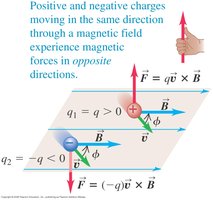
Magnetic Force: Positive vs. Negative Charges
Charges of equal magnitude but opposite sign moving in the same direction in a magnetic field experience forces in opposite directions.
Magnetic Field Lines: Not Lines of Force
It is important to distinguish between magnetic field lines and lines of force. The force on a charged particle is not along the field line but is given by the cross product of velocity and magnetic field.
Magnetic Flux
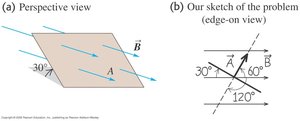
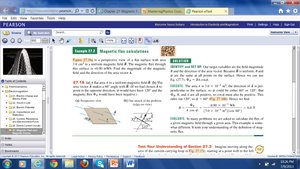
Magnetic flux quantifies the amount of magnetic field passing through a given surface. It is defined as:
Formula:
Closed Surfaces: The net magnetic flux through any closed surface is zero, reflecting the absence of magnetic monopoles.
Motion of Charged Particles in a Magnetic Field
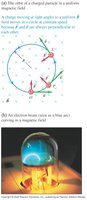
Circular Motion: If the velocity of a charged particle is perpendicular to the magnetic field, it moves in a circle of radius .
Cyclotron Frequency: The number of revolutions per unit time is .
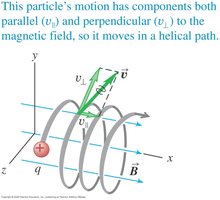
Helical Motion: If the velocity has both parallel and perpendicular components to the field, the path is a helix.
Charged Particles in Electric and Magnetic Fields: The Lorentz Force
When both electric and magnetic fields are present, the total force on a charged particle is the sum of the electric and magnetic forces, known as the Lorentz force:
Formula:
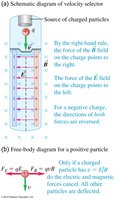
Velocity Selector
A velocity selector uses perpendicular electric and magnetic fields to allow only particles with a specific velocity to pass through undeflected.
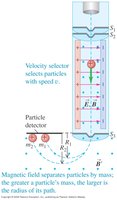
Mass Spectrometer
A mass spectrometer measures the masses of ions by first selecting particles of a specific velocity and then separating them by mass using a magnetic field. The radius of curvature in the magnetic field is .
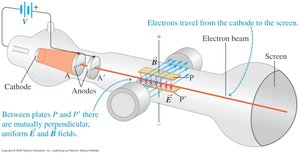
Thomson’s e/m Experiment
Thomson measured the charge-to-mass ratio of the electron using crossed electric and magnetic fields. The key equations are:
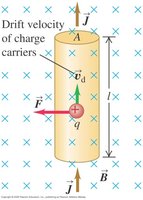
Magnetic Force on a Current-Carrying Conductor
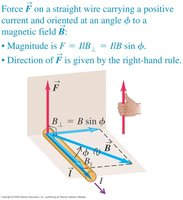
A current-carrying wire in a magnetic field experiences a force given by:
Formula:
Direction: Determined by the right-hand rule.
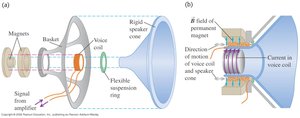
Applications: Loudspeakers
Loudspeakers use the force on a current-carrying coil in a magnetic field to produce sound. The oscillating current causes the speaker cone to vibrate at the same frequency as the input signal.
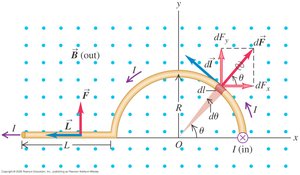
Magnetic Force on a Curved Conductor
The force on a curved conductor in a magnetic field can be analyzed by breaking the conductor into small segments and integrating the force over the path.
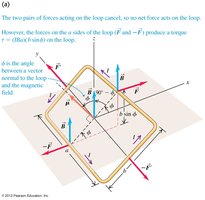
Force and Torque on a Current Loop
A current loop in a uniform magnetic field experiences zero net force but generally experiences a net torque, which tends to align the loop with the field.
Torque Formula:
Magnetic Dipole Moment: (where is current and is area)
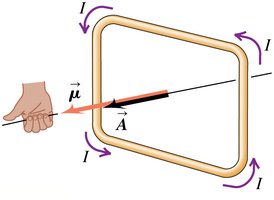
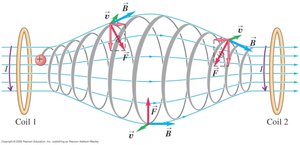
Nonuniform Magnetic Fields and Magnetic Bottles
Nonuniform magnetic fields can trap charged particles, as seen in magnetic bottles and the Earth's Van Allen radiation belts, which protect the planet from solar wind and cosmic rays.
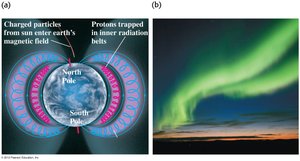
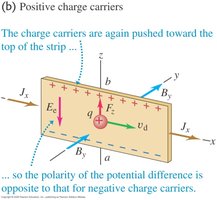
The Hall Effect
The Hall effect occurs when a current-carrying conductor is placed in a magnetic field, resulting in a measurable voltage perpendicular to both the current and the field. This effect is used to determine the type and density of charge carriers in a material.
Summary Table: Key Magnetic Quantities and Equations
Quantity | Symbol | SI Unit | Equation |
|---|---|---|---|
Magnetic Field | B | Tesla (T) | — |
Magnetic Force (charge) | F | Newton (N) | |
Magnetic Force (wire) | F | Newton (N) | |
Magnetic Flux | Weber (Wb) | ||
Torque on Loop | Newton-meter (N·m) | ||
Magnetic Dipole Moment | A·m2 |
Additional info:
Magnetic fields are essential in many modern technologies, including electric motors, generators, MRI machines, and particle accelerators.
The study of magnetic forces on moving charges and currents is foundational for understanding electromagnetism and its applications in physics and engineering.
