Back
BackMagnetic Field and Magnetic Forces: Study Notes
Study Guide - Smart Notes
 Tailored notes based on your materials, expanded with key definitions, examples, and context.
Magnetic Field and Magnetic Forces
Introduction to Magnetism
Magnetism is a fundamental interaction that arises from moving electric charges. The most familiar examples are permanent magnets, which can attract unmagnetized iron objects and interact with other magnets. The alignment of a compass needle with Earth's magnetic field is a classic demonstration of this phenomenon.

Magnetic Poles
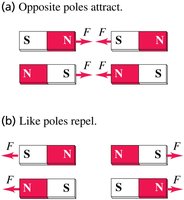
Magnets have two poles: a north (N) pole and a south (S) pole. If a bar magnet is free to rotate, one end points north (N pole), and the other points south (S pole). Opposite poles attract, while like poles repel each other.
Opposite poles attract: N attracts S.
Like poles repel: N repels N, S repels S.
Magnetism and Certain Metals
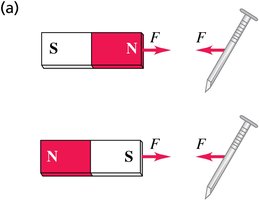
Objects containing iron, even if not magnetized, are attracted by either pole of a permanent magnet. This explains why a refrigerator magnet sticks to a steel door.
Magnetic Monopoles
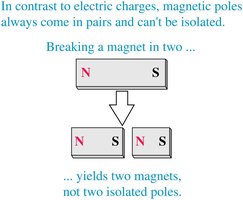
Unlike electric charges, magnetic poles always come in pairs. Breaking a magnet in two results in two smaller magnets, each with a north and south pole. There is no experimental evidence for isolated magnetic monopoles.
Electric Current and Magnets
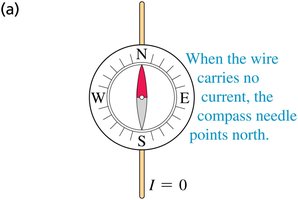
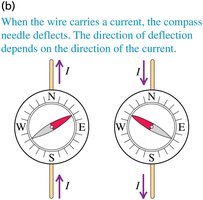
A compass needle near a wire with no current points north. When current flows through the wire, the compass needle deflects, indicating the presence of a magnetic field generated by the current.
The Magnetic Field
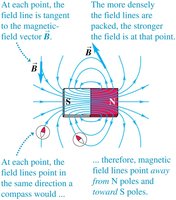
A moving charge or electric current creates a magnetic field (B) in the surrounding space. The magnetic field is a vector field, meaning it has both magnitude and direction at every point in space. The direction of B at any point is the direction a compass needle would point.
Magnetic Force on Moving Charges
Dependence on Velocity
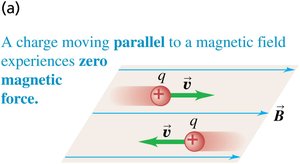
The magnetic force on a moving charge depends on the component of velocity perpendicular to the magnetic field. If the charge is at rest or moves parallel to the field, it experiences no magnetic force.
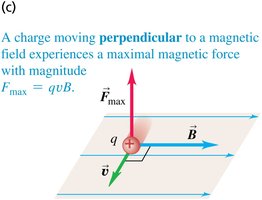
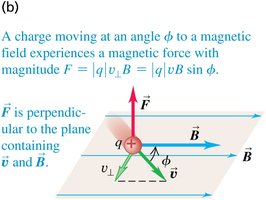
Force is maximal when velocity is perpendicular to the field:
Force is zero when velocity is parallel to the field:
General case:
Magnetic Force as a Vector Product
The magnetic force on a charge moving with velocity in a magnetic field is given by the vector cross product:
Right-Hand Rule for Magnetic Force
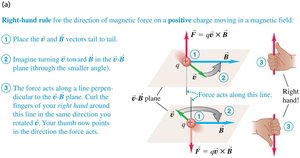
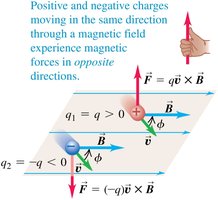
The right-hand rule determines the direction of the force on a positive charge:
Place and tail to tail.
Rotate toward through the smaller angle.
Your thumb points in the direction of the force .
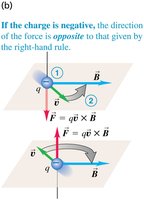
If the charge is negative, the force direction is opposite to that given by the right-hand rule.
Equal Velocities but Opposite Signs
Charges of equal magnitude but opposite sign, moving with the same velocity in the same magnetic field, experience forces of equal magnitude but opposite direction.
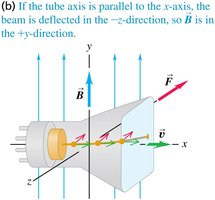
Application: Cathode-Ray Tube (CRT)
In a CRT, an electron beam is deflected by a magnetic field, allowing images to be formed on a screen. The direction of deflection depends on the orientation of the magnetic field relative to the electron velocity.
Magnetic Field Lines
Representation and Properties
Magnetic fields are represented by field lines, which are tangent to the direction of the magnetic field at every point. The density of lines indicates the strength of the field. Field lines never intersect and point from the north pole to the south pole outside the magnet.
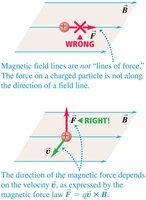
Field Lines Are Not Lines of Force
Unlike electric field lines, magnetic field lines are not lines of force. The force on a charged particle is not along the direction of a field line but is perpendicular to both the velocity and the field.
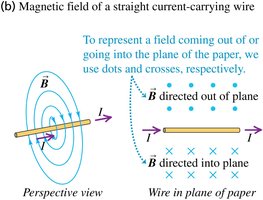
Magnetic Field of a Straight Current-Carrying Wire
A straight wire carrying current produces a magnetic field in concentric circles around the wire. The direction of the field is given by the right-hand rule: if the thumb points in the direction of current, the fingers curl in the direction of the magnetic field.
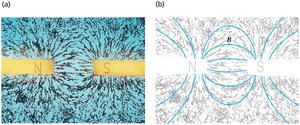
Magnetic Field Lines of Two Permanent Magnets
Iron filings align along magnetic field lines, visually demonstrating the field pattern between two magnets. The field lines are denser where the field is stronger.
Magnetic Flux
Definition and Calculation
Magnetic flux () through a surface is a measure of the number of magnetic field lines passing through that surface. For a surface element , the flux is:
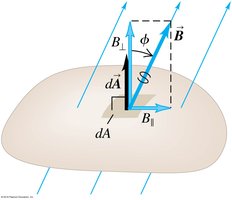
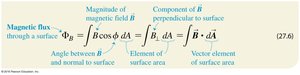
The total magnetic flux through a surface is:
The magnetic flux through any closed surface is always zero:
Units of Magnetic Field and Magnetic Flux
Magnetic field (B): tesla (T), where
Magnetic flux (): weber (Wb), where
Another unit for B: gauss (G), where
Motion of Charged Particles in a Magnetic Field
Circular and Helical Motion
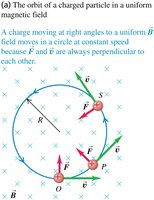
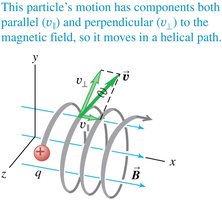
A charged particle moving perpendicular to a uniform magnetic field moves in a circle at constant speed, as the force is always perpendicular to the velocity. If the velocity has both perpendicular and parallel components to the field, the path is a helix.
The Van Allen Radiation Belts
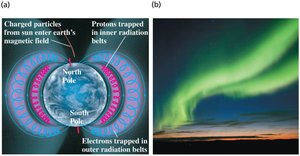
Charged particles from the sun are trapped by Earth's magnetic field, forming the Van Allen radiation belts. Near the poles, these particles can enter the atmosphere, causing auroras.
Bubble Chamber
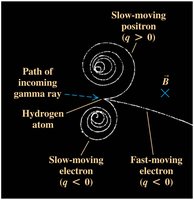
In a bubble chamber, charged particles moving in a magnetic field leave spiral tracks, allowing physicists to study particle interactions and properties.
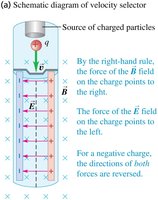
Velocity Selector
A velocity selector uses perpendicular electric and magnetic fields to select particles of a specific speed. Only particles with pass through undeflected.
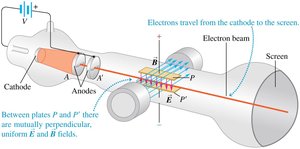
Thomson’s e/m Experiment
Thomson measured the charge-to-mass ratio () for the electron using crossed electric and magnetic fields in a cathode-ray tube.
Magnetic Force on Current-Carrying Conductors
Force on a Straight Wire
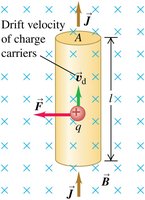
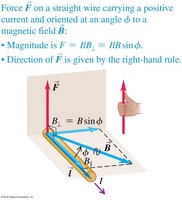
The magnetic force on a straight segment of current-carrying wire of length in a magnetic field is:

Force and Torque on a Current Loop
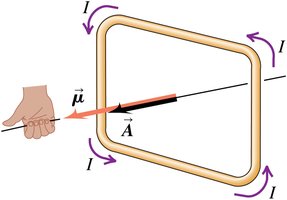
The net force on a current loop in a uniform magnetic field is zero, but the loop experiences a torque. The magnetic moment of the loop is , where is the current and is the area. The torque is:

Magnetic Dipole in a Nonuniform Magnetic Field
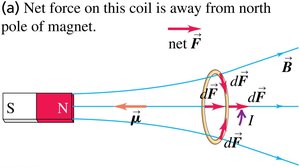
A current loop in a nonuniform magnetic field experiences a net force, causing it to move toward regions of stronger or weaker field depending on its orientation.
How Magnets Work
Magnetization of Iron
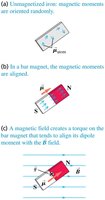
In unmagnetized iron, atomic magnetic moments are randomly oriented. In a magnetized piece, these moments align, giving rise to a net magnetic moment from the south pole to the north pole.
Attraction of Unmagnetized Iron
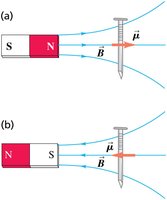
A bar magnet attracts an unmagnetized iron nail by inducing a magnetic moment in the nail, which is then attracted toward the magnet, regardless of which pole is closer.
Applications
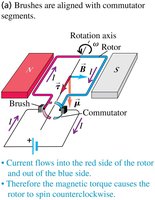
The Direct-Current Motor
A simple DC motor consists of a current-carrying loop (rotor) in a magnetic field. The magnetic torque causes the rotor to spin, converting electrical energy into mechanical rotation.
The Hall Effect
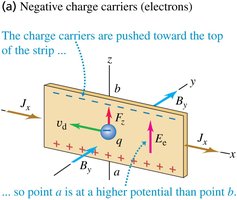
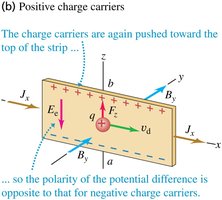
The Hall effect occurs when a current-carrying conductor is placed in a magnetic field, producing a transverse voltage (Hall emf). The sign of the Hall voltage reveals whether the charge carriers are negative (electrons) or positive.