 Back
BackMagnetic Field and Magnetic Forces – Study Notes
Study Guide - Smart Notes
 Tailored notes based on your materials, expanded with key definitions, examples, and context.
Magnetic Field and Magnetic Forces
Introduction to Magnetism
Magnetism is a fundamental interaction that arises from moving electric charges. The most familiar examples are permanent magnets, which can attract or repel other magnets and attract unmagnetized iron objects. The earth itself acts as a giant magnet, influencing compass needles to align with its magnetic field.
Magnetic Poles
Definition: A bar magnet has two poles: a north (N) pole and a south (S) pole. If free to rotate, the N pole points north.
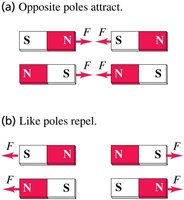
Interaction: Opposite poles attract, while like poles repel.
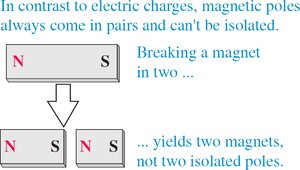
Magnetic monopoles: Magnetic poles always come in pairs; breaking a magnet results in two smaller magnets, each with both a north and south pole. There is no experimental evidence for isolated magnetic monopoles.
Magnetism and Certain Metals
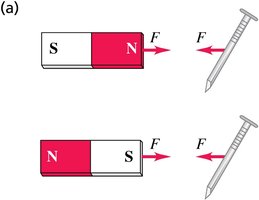
Unmagnetized iron objects are attracted to either pole of a magnet due to the alignment of their atomic magnetic domains.
This explains why a refrigerator door (often made of steel) is attracted to a magnet.
Earth’s Magnetic Field
The Earth acts as a giant magnet, with its geographic north pole near its magnetic south pole.
The angle between the magnetic and geographic axes causes magnetic declination (variation from true north).
The angle of the field above or below the horizontal is called magnetic inclination.
Electric Current and Magnets
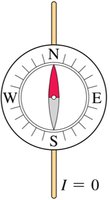
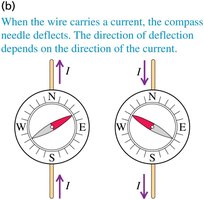
A compass needle aligns with the Earth's magnetic field when no current is present in a nearby wire.
When current flows through the wire, the compass needle deflects, demonstrating that electric currents produce magnetic fields.
The Magnetic Field (B)
A magnetic field is a vector field produced by moving charges (currents).
The direction of B at any point is the direction a compass needle points.
The field exerts a force on other moving charges or currents in the region.
Magnetic Force on a Moving Charge
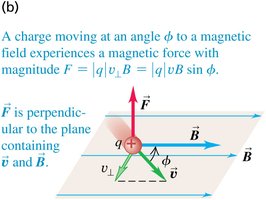
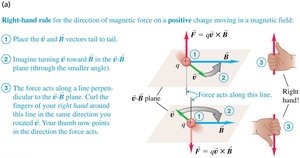
The force on a charge q moving with velocity \vec{v} in a magnetic field \vec{B} is given by:
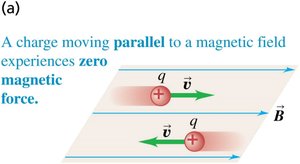
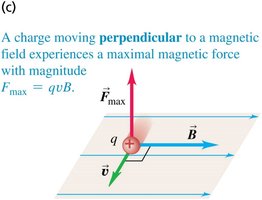
The force is maximum when \vec{v} is perpendicular to \vec{B} and zero when parallel.
The magnitude is where is the angle between \vec{v} and \vec{B}.
Right-Hand Rule for Magnetic Force
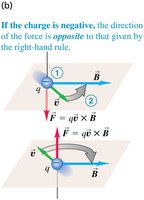
For a positive charge, point your fingers in the direction of \vec{v}, curl them toward \vec{B}, and your thumb points in the direction of the force \vec{F}.
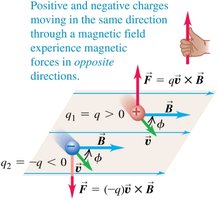
For a negative charge, the force is in the opposite direction.
Equal Velocities but Opposite Signs
Charges of equal magnitude but opposite sign, moving with the same velocity in the same magnetic field, experience forces of equal magnitude but opposite direction.
Units of Magnetic Field
The SI unit of magnetic field B is the tesla (T): .
Another unit is the gauss (G), where .
Magnetic Field Lines
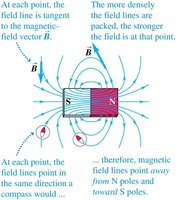
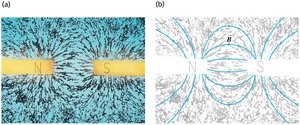
Magnetic fields are represented by field lines that are tangent to the direction of \vec{B} at each point.
Field lines never intersect and their density indicates the strength of the field.
Field lines emerge from the north pole and enter the south pole of a magnet.
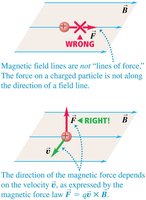
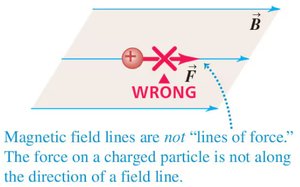
Magnetic Field Lines Are Not Lines of Force
Unlike electric field lines, magnetic field lines do not indicate the direction of force on a charged particle.
The force depends on both the velocity of the particle and the direction of the field, as given by the cross product.
Magnetic Field of a Straight Current-Carrying Wire
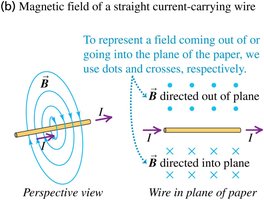
A current-carrying wire produces a magnetic field that forms concentric circles around the wire.
The direction of the field is given by the right-hand rule: thumb in the direction of current, fingers curl in the direction of \vec{B}.
Magnetic Field Lines of Two Permanent Magnets
Iron filings align with magnetic field lines, visually demonstrating the field pattern between two magnets.
Magnetic Flux
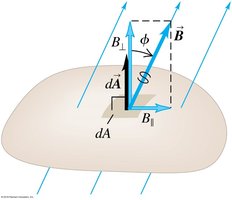
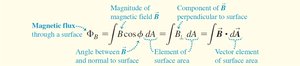
Magnetic flux through a surface is a measure of the number of magnetic field lines passing through that surface.
For a surface element and field , the flux is:
Total flux through a surface :
For any closed surface, the net magnetic flux is zero (Gauss's law for magnetism):

Motion of Charged Particles in a Magnetic Field
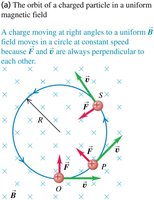
A charged particle moving perpendicular to a uniform magnetic field moves in a circle at constant speed.
The magnetic force provides the centripetal force:
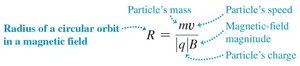
Radius of the circular path:
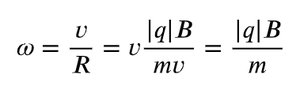
Angular frequency (cyclotron frequency):
Helical Motion
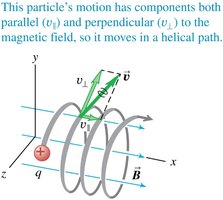
If the velocity has a component parallel to the field, the particle moves in a helix.
The parallel component remains constant, while the perpendicular component causes circular motion.
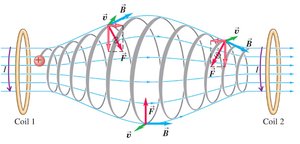
The Magnetic Bottle
A magnetic bottle uses magnetic fields to confine charged particles in a helical path, useful in plasma confinement and fusion research.
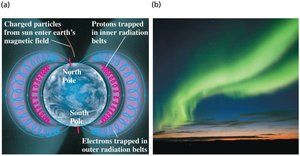
The Van Allen Radiation Belts
The Earth's magnetic field traps charged particles from the solar wind, forming the Van Allen belts.
Near the poles, these particles can enter the atmosphere, causing auroras.
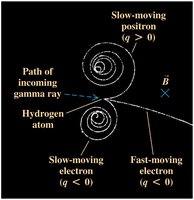
Bubble Chamber
A bubble chamber is used to visualize the paths of charged particles in a magnetic field, revealing their charge and energy by the curvature of their tracks.
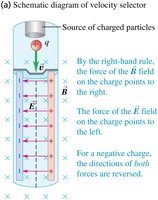
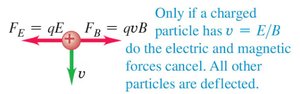
Velocity Selector
A velocity selector uses perpendicular electric and magnetic fields to allow only particles with a specific velocity to pass through undeflected.
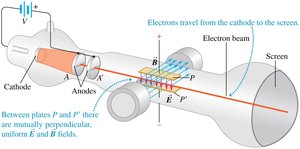
Thomson's e/m Experiment
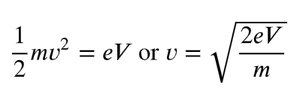
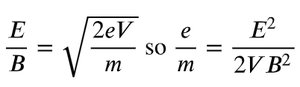
J.J. Thomson measured the charge-to-mass ratio of the electron using crossed electric and magnetic fields in a cathode-ray tube.
The velocity of electrons is determined by the balance of electric and magnetic forces.
Magnetic Force on a Current-Carrying Conductor
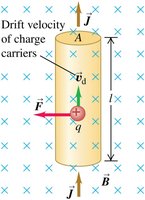
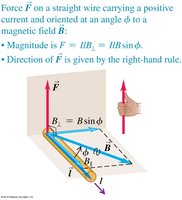
A current-carrying wire in a magnetic field experiences a force given by:
For a wire of length l carrying current I in a field \vec{B}.
If the wire is not straight, the force on an infinitesimal segment is:


Force and Torque on a Current Loop
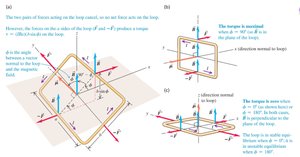
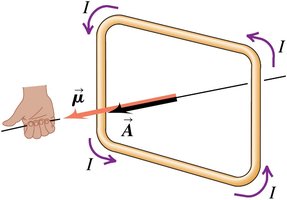
A current loop in a uniform magnetic field experiences a torque but no net force.
The magnetic dipole moment of a loop is (for a single loop; for N loops).
The torque on the loop is:
The magnitude is where is the angle between the normal to the loop and the field.

Potential Energy for a Magnetic Dipole
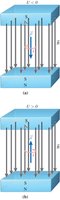
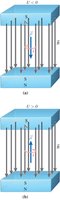
The potential energy of a magnetic dipole in a magnetic field is:
It is minimum (most negative) when the dipole is aligned with the field, and maximum (most positive) when anti-aligned.

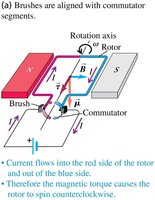
The Direct-Current Motor
A DC motor converts electrical energy into mechanical rotation using the torque on a current-carrying loop in a magnetic field.
The commutator reverses the current direction every half turn, ensuring continuous rotation.
Additional info: This summary covers the main concepts, equations, and applications of magnetic fields and forces as presented in a typical introductory university physics course. All equations are provided in LaTeX format for clarity and academic rigor.
