 Back
BackMagnetic Fields and Forces: Sources, Properties, and Applications
Study Guide - Smart Notes
 Tailored notes based on your materials, expanded with key definitions, examples, and context.
Chapter 24: Magnetic Fields and Forces
Sources of Magnetism
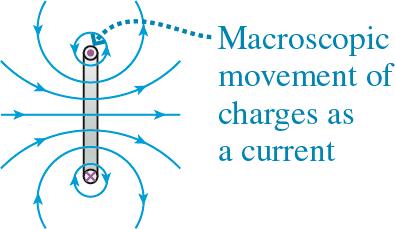
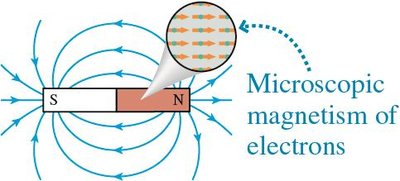
Magnetic fields arise from two primary sources: electric currents and permanent magnets. The fundamental unit of magnetism is the magnetic dipole, which consists of a north and a south pole. Magnetic fields exert long-range forces on magnetic materials and on moving charges or currents.
Electric currents generate magnetic fields due to the macroscopic movement of charges.
Permanent magnets exhibit magnetism due to the microscopic alignment of electron magnetic moments.
Unlike poles of magnets attract; like poles repel.
Magnetic fields exert forces on moving charged particles and on other currents.
Magnetic Dipoles and Forces
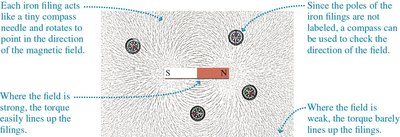
A magnetic dipole experiences a torque in a magnetic field, tending to align its axis with the field. This is the basis for the operation of compasses and many magnetic devices.
Magnetic fields exert torques on dipoles, aligning them with the field direction.
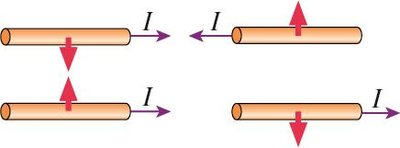
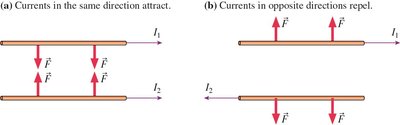
Parallel wires with currents in the same direction attract; opposite directions repel.
Representing the Magnetic Field
Magnetic Field Lines and Vectors
The magnetic field of a magnet points away from the north pole and toward the south pole. Magnetic field lines provide a visual representation of the field's direction and strength.
The direction of the magnetic field is the direction a north pole of a compass needle points.
Magnetic field vectors are used to represent the field at a specific point, while field lines show the overall structure.
Right-Hand Rule for Magnetic Fields
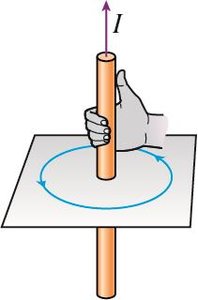
The direction of the magnetic field due to a current can be found using the right-hand rule. The strength of the field is proportional to the torque on a compass needle and is measured in tesla (T).
Right-hand rule: Thumb points in the direction of current, fingers curl in the direction of the magnetic field lines.
1 tesla (T) is a large field; typical fields are much smaller.
Magnetic Forces on Charges
Force on a Moving Charge
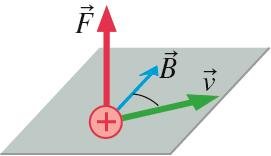
The magnitude of the magnetic force on a moving charge depends on the charge, its speed, the magnetic field strength, and the angle between the velocity and the field:
Formula:
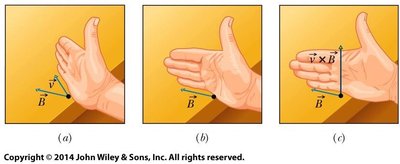
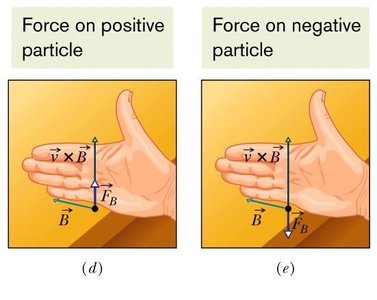
The direction of the force is given by the right-hand rule for forces.
Fields Due to Common Currents
Magnetic Field Formulas
Magnetic fields are produced by various current configurations. The most common are long straight wires, circular loops, and solenoids.
Long straight wire:
Circular loop (center):
Solenoid (center):
Where is the permeability of free space.
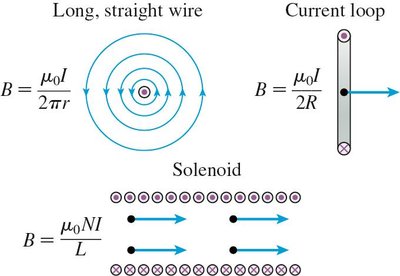
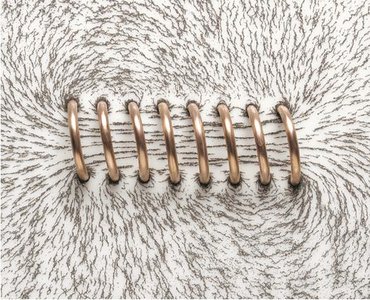
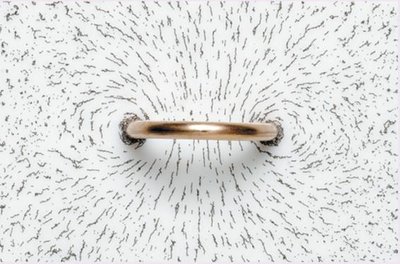
Typical Magnetic Field Strengths
The table below summarizes typical magnetic field strengths for various sources:
Field Source and Location | Field Strength (T) |
|---|---|
10 cm from a wire with 1 A current | |
Surface of the Earth | |
1 cm from a wire with 10 A current | |
Refrigerator magnet | |
100-turn coil, 1 cm diameter, 1 A current | |
Surface of the sun (sunspot) | |
Near a rare-earth magnet | 1 |
MRI solenoid | 1 |
World’s strongest magnet | 45 |
Paths of Charged Particles in Magnetic Fields
Circular Motion in a Magnetic Field
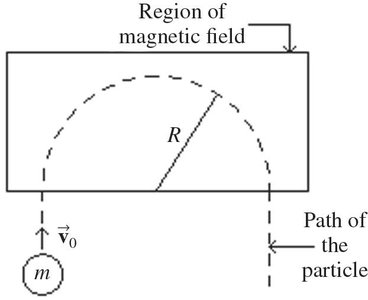
A charged particle moving perpendicular to a uniform magnetic field undergoes uniform circular motion at constant speed. The magnetic force provides the necessary centripetal force:
Equating forces:
Radius of path:
Applications: Cyclotrons and Magnetic Dipoles
Magnetic fields are used in devices such as cyclotrons to accelerate charged particles and in MRI scanners to probe the orientation of magnetic dipoles.
A magnetic dipole is stable when aligned with the external field and unstable when opposite.
In MRI, the flipping of dipoles between orientations is measured.
Forces Between Currents
Interaction of Parallel Currents
Two parallel current-carrying wires exert forces on each other due to their magnetic fields. These forces form a Newton’s third law action/reaction pair.
Force per unit length:
Currents in the same direction attract; opposite directions repel.
Summary Table: Key Equations
Situation | Equation |
|---|---|
Force on moving charge | |
Magnetic field (straight wire) | |
Magnetic field (center of loop) | |
Magnetic field (solenoid) | |
Radius of particle path | |
Force per unit length (wires) |
Additional info: This guide covers the essential concepts, equations, and applications of magnetic fields and forces, including their sources, effects on charges and currents, and practical uses in technology and research.
