 Back
BackMagnetic Fields and Forces: Study Notes for Physics College Students
Study Guide - Smart Notes
 Tailored notes based on your materials, expanded with key definitions, examples, and context.
Magnetic Fields
Definition and Properties
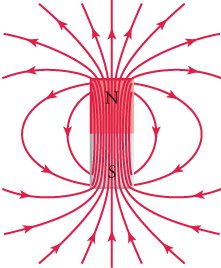
A magnetic field (B) is a vector field that describes the magnetic influence on moving electric charges, electric currents, and magnetized materials. The direction of B at any location is the direction in which the north pole of a compass needle points at that location. Magnetic fields are visually represented by magnetic field lines, which have the following properties:
The B field is tangent to the magnetic field line at every point.
Field strength is proportional to the line density.
Field lines cannot cross.
Field lines form continuous, closed loops.
Magnetic Field Patterns
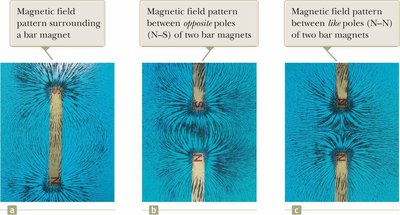
Magnetic field patterns can be observed around bar magnets and between pairs of magnets:
Field lines emerge from the north pole and enter the south pole.
Between opposite poles (N–S), field lines are concentrated and straight.
Between like poles (N–N), field lines repel and curve outward.
Earth’s Magnetic Field
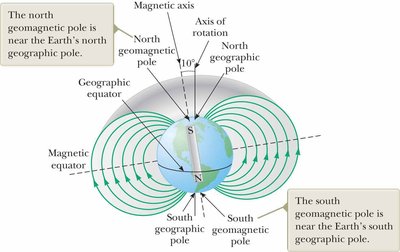
The Earth acts like a giant bar magnet, with its magnetic field resembling that of a dipole. The north geomagnetic pole is near the Earth's north geographic pole, and the south geomagnetic pole is near the south geographic pole. The magnetic axis is tilted relative to the axis of rotation.
Magnetic Force on Moving Charges
Force Equation and Direction
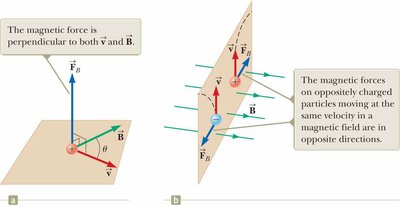
The existence of a magnetic field at a point is determined by measuring the magnetic force (FB) exerted on a test particle with charge q placed at that point. The force is given by:
Vector form:
Magnitude:
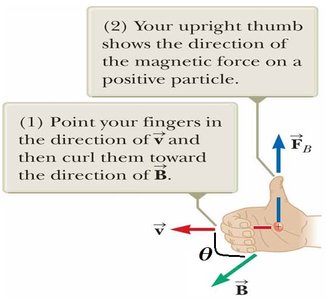
Direction: Determined by the right-hand rule (RHR) for positive charges; for negative charges, the direction is opposite.
Right-Hand Rule (RHR)
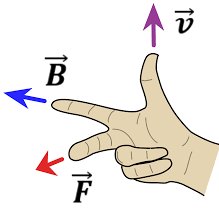
The right-hand rule is used to determine the direction of the magnetic force:
Point your fingers in the direction of v (velocity).
Curl them toward B (magnetic field).
Your thumb points in the direction of FB for a positive charge.
For a negative charge, FB is in the opposite direction.
Comparison: Electric vs. Magnetic Forces
Electric force acts along the direction of the electric field and can do work on a charged particle whether it is moving or not.
Magnetic force acts perpendicular to both the velocity and the magnetic field, and only affects moving charges. It does no work on the particle since the force is always perpendicular to the displacement.
Motion of Charged Particles in Magnetic Fields
Circular Motion in Uniform Magnetic Field
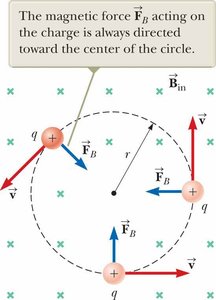
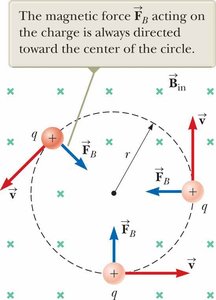
When a charged particle moves perpendicular to a uniform magnetic field, it undergoes uniform circular motion:
Radius:
Angular frequency:
Period:
Frequency:
Helical Motion
If the velocity of the particle is at an angle to the magnetic field, the path becomes a helix. The component of velocity parallel to the field remains constant, while the perpendicular component causes circular motion.
Radius:
Angular frequency:
Applications of Magnetic Fields
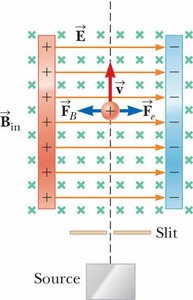
Velocity Selector
A velocity selector uses both electric and magnetic fields to allow only particles with a specific velocity to pass through undeflected. The condition for straight-line motion is:
Mass Spectrometer
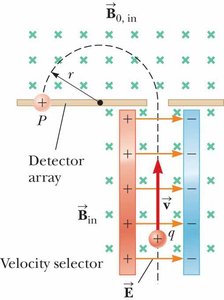
A mass spectrometer separates ions based on their mass-to-charge ratio using a velocity selector and a magnetic field:
Or,
Cyclotron
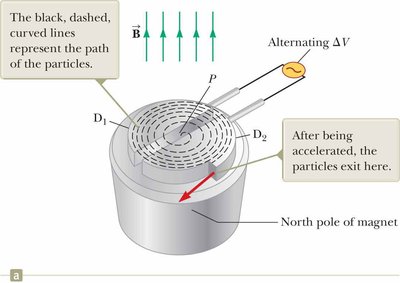
A cyclotron accelerates charged particles using a magnetic field and alternating electric potential. The period of revolution is independent of speed and radius:
Kinetic energy:
Magnetic Force on Current-Carrying Conductors
Straight Wire in Magnetic Field
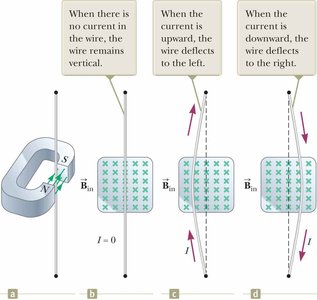
A current-carrying wire placed in a magnetic field experiences a force:
Vector form:
Magnitude:
Direction: Determined by the right-hand rule.
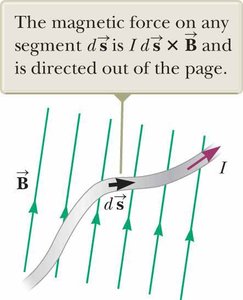
Force on Wire of Any Shape
The force on a small segment ds of wire is:
Total force:
Torque on a Current Loop
Magnetic Dipole Moment and Torque
A current loop in a uniform magnetic field experiences a torque:
Magnetic dipole moment:
Torque:
Potential energy:
The Hall Effect
Hall Voltage
When a current-carrying conductor is placed in a magnetic field, a potential difference (Hall voltage) is generated perpendicular to both the current and the field:
Hall voltage:
Drift speed:
Substituting:
In semiconductors, the Hall voltage is larger due to lower carrier density n.
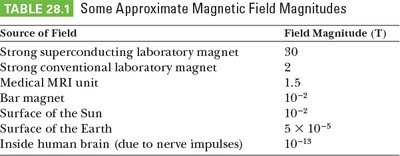
Summary Table: Magnetic Field Magnitudes
Source of Field | Field Magnitude (T) |
|---|---|
Strong superconducting laboratory magnet | 30 |
Strong conventional laboratory magnet | 2 |
Medical MRI unit | 1.5 |
Bar magnet | 10-2 |
Surface of the Sun | 10-2 |
Surface of the Earth | 5 × 10⁻⁵ |
Inside human brain (due to nerve impulses) | 10-13 |
Key Formulas
Magnetic force on moving charge:
Magnetic force on current-carrying wire:
Torque on current loop:
Radius of circular motion:
Period of circular motion:
Biot-Savart Law:
Ampere’s Law:
