 Back
BackMagnetic Fields and Magnetic Forces
Study Guide - Smart Notes
 Tailored notes based on your materials, expanded with key definitions, examples, and context.
Magnetic Fields and Magnetic Forces
Introduction to Magnetism
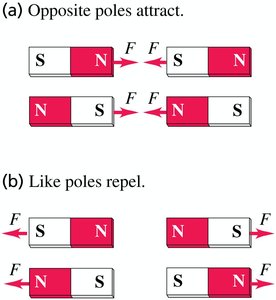
Magnetism is a fundamental force of nature, most commonly observed in permanent magnets. These magnets can attract objects made of iron, cobalt, or nickel, and can also attract or repel other magnets. The basic properties of magnets are governed by their poles: every magnet has a north (N) and a south (S) pole. Opposite poles attract, while like poles repel each other.
Magnetic Poles: Every magnet has two poles, north and south. Opposite poles attract, like poles repel.
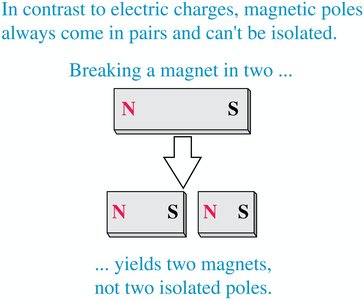
Magnetic Monopoles: There is no experimental evidence for the existence of magnetic monopoles; magnetic poles always come in pairs.
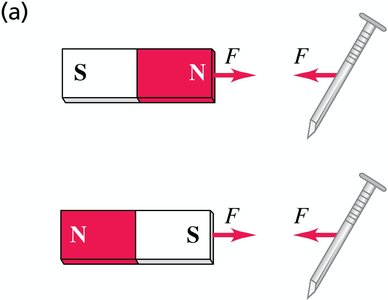
Magnetization of Materials: Objects containing iron but not magnetized are attracted by either pole of a magnet.
Earth's Magnetic Field
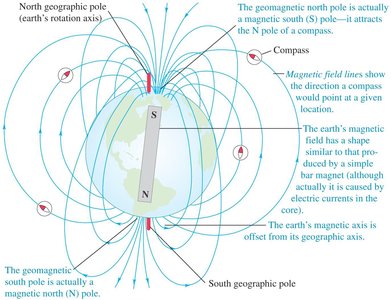
The Earth itself acts as a giant magnet, with a magnetic field that is not perfectly aligned with its geographic poles. The angle between the magnetic field and the Earth's surface is called the magnetic inclination (or angle of dip), while the deviation from the geographic north is called the magnetic variation (or angle of declination).
Compass Needles: A compass aligns with the Earth's magnetic field, not the geographic north.
Magnetic Field Lines: These lines indicate the direction a compass would point at any location on Earth.
Magnetic Axis: The Earth's magnetic axis is offset from its geographic axis.
Electric Current, Magnets, and Magnetic Fields
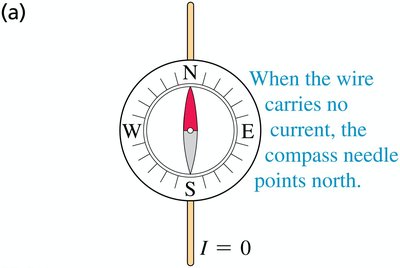
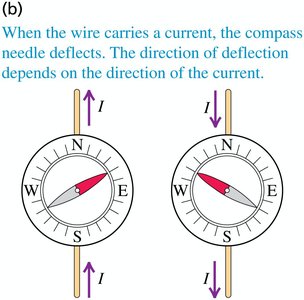
Magnetism is fundamentally linked to moving electric charges. A current-carrying wire produces a magnetic field, which can be detected by the deflection of a nearby compass needle. If there is no current, the compass is unaffected.
Moving Charges: Only moving charges (currents) create magnetic fields.
Interaction: A magnetic field exerts a force on other moving charges or currents present in the field.
Electric and Magnetic Fields: Comparison
Both electric and magnetic fields are vector fields, but they interact with charges differently:
Electric Field: Created by charges at rest; exerts a force on any charge in the field.
Magnetic Field: Created by moving charges; exerts a force only on moving charges.
Vector (Cross) Product and the Right-Hand Rule
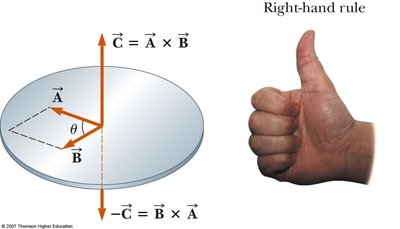
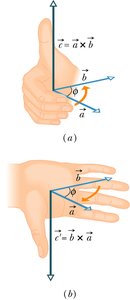
The force exerted by a magnetic field on a moving charge is determined by the vector (cross) product. The direction of the resulting vector is found using the right-hand rule.
Cross Product: The magnitude is given by , where is the angle between the vectors.
Direction: Perpendicular to both vectors, as determined by the right-hand rule.
Properties: The cross product is zero if the vectors are parallel, and maximal if they are perpendicular.
Magnetic Force on a Moving Charge
The magnetic force on a moving charge is given by the equation:
Formula:
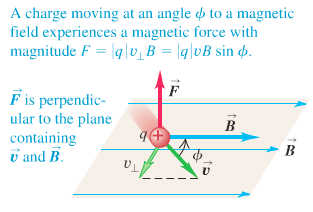
Magnitude: , where is the angle between and .
Units: The SI unit for magnetic field is the Tesla (T): ; another unit is the gauss (G), where .
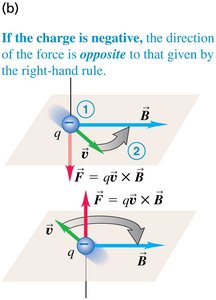
Direction: Determined by the right-hand rule for positive charges; for negative charges, the force is in the opposite direction.
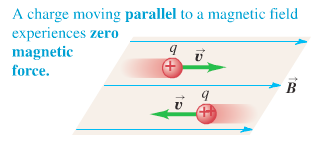
Special Cases: If the velocity is parallel to the field, the force is zero. If perpendicular, the force is maximal.
Examples
Example 1: A particle with charge and velocity in a magnetic field experiences a force calculated using the cross product formula.
Example 2: A proton () moves at through a field along the -axis, with velocity at to the -axis. The force is in the direction.
Summary Table: Magnetic Force on a Moving Charge
Condition | Magnetic Force | Direction |
|---|---|---|
Charge at rest | None | |
Velocity parallel to | None | |
Velocity perpendicular to | Right-hand rule (positive q), opposite for negative q | |
Velocity at angle to | Perpendicular to plane of and |
Additional info: The right-hand rule is a fundamental tool for determining the direction of vector products in physics, especially in electromagnetism. The cross product is anti-commutative: .
