 Back
BackMagnetic Fields and Magnetic Forces: Foundations and Applications
Study Guide - Smart Notes
 Tailored notes based on your materials, expanded with key definitions, examples, and context.
Magnetic Fields and Magnetic Forces
Introduction to Magnetic Fields
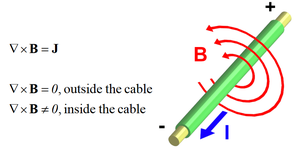
Magnetic fields are a fundamental aspect of electromagnetism, closely related to electric fields. They are produced by moving charges and are essential for understanding the behavior of charged particles, electromagnetic waves, and many technological applications. Magnetic fields are vector quantities, possessing both magnitude and direction.
Electromagnetic Waves: Electromagnetic (EM) waves consist of oscillating electric and magnetic fields that are perpendicular to each other and to the direction of propagation. The magnitudes of these fields are equal, and they interact with charged particles in unique ways.
Inductors: Inductors are coils of wire that generate magnetic fields when electric current passes through them. They are widely used in RL circuits and electromagnetic devices.
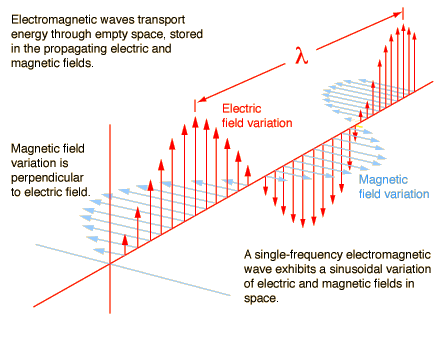
Comparison of Magnetic and Electric Fields
Electric and magnetic fields are both generated by charges, but their properties and interactions differ:
Electric Field (E): Can exist even if the charge is stationary. Field lines start on positive charges and end on negative charges.
Magnetic Field (B): Only produced by moving charges (currents). Field lines emerge from the north pole and enter the south pole of a magnet.
Relationship: A changing electric field produces a magnetic field and vice versa, as described by Maxwell's equations.
Wave-Particle Duality: Light can be described as both a wave (EM wave) and as particles (photons), a concept central to quantum physics.
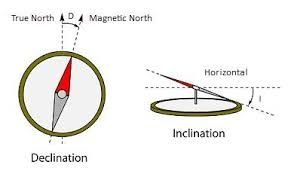
Earth's Magnetic Field
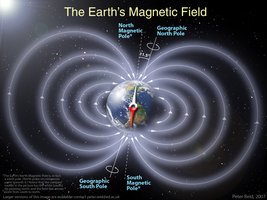
The Earth acts as a giant magnet due to the motion of molten iron and nickel in its core. The magnetic field protects life by deflecting harmful solar radiation.
Magnetic Poles: The North Magnetic Pole is actually located in the southern hemisphere and vice versa for the South Magnetic Pole.
Field Lines: Magnetic field lines are denser where the field is stronger and spread out as the field weakens.
Angle of Declination: The angle between geographic north and the direction a compass points (magnetic north). Typically about 12°, but varies by location.
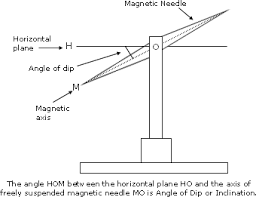
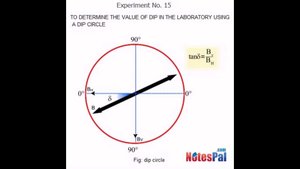
Angle of Dip (Inclination): The angle between the horizontal plane and the Earth's magnetic field at a given location. Zero at the magnetic equator, increases toward the poles.

Key Equations
Angle of Declination:
Angle of Dip:
Magnetic Field and Force on Moving Charges
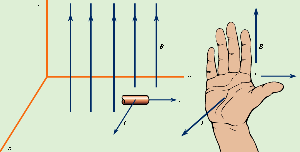
Magnetic fields exert forces on moving charges, but do not do work on them. The force is always perpendicular to both the velocity of the charge and the magnetic field direction.
Magnetic Force:
Work Done by Magnetic Field: (For , )
SI Unit: Tesla (T), where
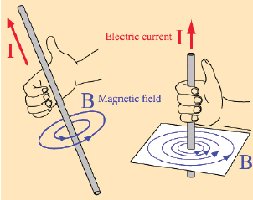
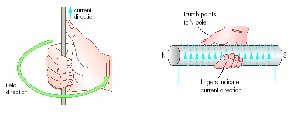
Right-Hand Rule (RHR): Used to determine the direction of the force, field, or current.
Motion of Charges in Magnetic Fields
When a charged particle moves perpendicular to a uniform magnetic field, it undergoes circular or helical motion due to the magnetic force acting as a centripetal force.
Circular Motion: The radius of the path is determined by the charge, velocity, and magnetic field strength.
Centripetal Force:
Magnetic Force as Centripetal Force:
Radius of Path:
Force on a Current-Carrying Wire
A current-carrying wire in a magnetic field experiences a force given by:
Force on a Straight Wire:
For Non-Straight Wires (Calculus):
Materials That Can Be Magnetized
Only certain materials, called ferromagnetic materials, can be easily magnetized. This is due to the alignment of electron spins at the atomic level.
Examples: Iron, Nickel, Cobalt, Chromium dioxide, AlNiCo
Earth's Core: The Earth's magnetic field is generated by the motion of these materials in the core.
Applications of Magnetic Fields
Transportation: Magnetic levitation (maglev) trains use magnetic fields for frictionless, high-speed travel.
Medical Imaging: Nuclear Magnetic Resonance Imaging (NMRI) utilizes the body's magnetic field for diagnostic imaging.
Electronics: Inductors, transformers, and motors rely on magnetic fields for operation.
Nuclear Fission and Magnetic Fields
Magnetic fields play a role in controlling nuclear reactions and in the operation of devices that utilize nuclear fission and fusion.
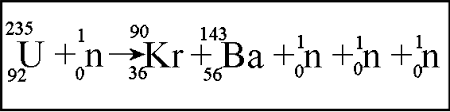
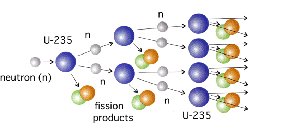
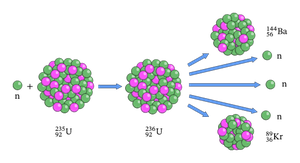
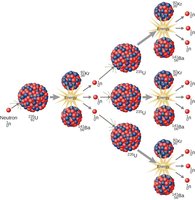
Nuclear Fission: The process by which a heavy nucleus splits into smaller nuclei, releasing energy and neutrons.
Chain Reaction: Released neutrons can induce further fission events, leading to a self-sustaining chain reaction.
Equation Example:
Summary Table: Key Differences Between Electric and Magnetic Fields
Property | Electric Field (E) | Magnetic Field (B) |
|---|---|---|
Source | Stationary or moving charges | Moving charges (currents) |
Field Lines | Start on +q, end on -q | Exit north pole, enter south pole |
Work on Charges | Can do work | Does no work (force is perpendicular to motion) |
SI Unit | Volt/meter (V/m) | Tesla (T) |
Additional info: The notes above integrate foundational concepts from electromagnetism, including the behavior of magnetic fields, their interaction with charges, and their applications in technology and nature. The included images directly support the explanations of field lines, right-hand rules, Earth's magnetic field, and nuclear fission processes.
