 Back
BackChapter 27 Part I - Magnetic Fields and Magnetic Forces: Foundations and Applications
Study Guide - Smart Notes
 Tailored notes based on your materials, expanded with key definitions, examples, and context.
Magnetic Fields and Magnetic Forces
Introduction to Magnetic Fields
Magnetic fields are a fundamental aspect of electromagnetism, closely related to electric fields. They are produced by moving charges and are essential for understanding the behavior of charged particles, electromagnetic waves, and many technological applications.
Electromagnetic Waves: Electric and magnetic fields oscillate perpendicular to each other and to the direction of wave propagation. Their magnitudes are equal, and they are always 90° apart.
Inductors: Devices such as inductors use loops of wire to generate magnetic fields when current flows through them.
Key Principle: A magnetic field is only produced by moving charges, unlike electric fields, which can exist even if the charge is stationary.
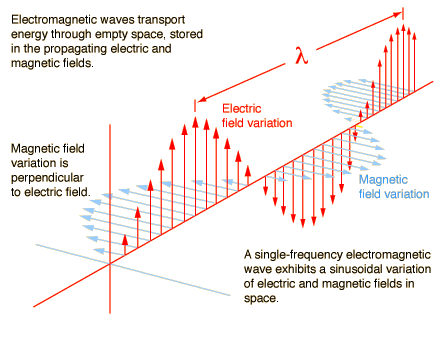
Comparison of Magnetic and Electric Fields
Both magnetic and electric fields originate from charged particles, but their properties and interactions differ:
Electric Field (E): Can exist with stationary charges; field lines start on positive charges and end on negative charges.
Magnetic Field (B): Requires moving charges; field lines emerge from the north pole and enter the south pole of a magnet.
Wave-Particle Duality: Light can be described as both a wave (EM wave) and as particles (photons).
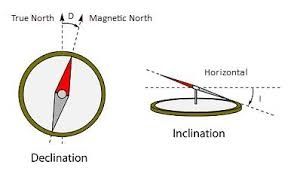
Earth’s Magnetic Field
The Earth acts as a giant magnet due to its spinning iron and nickel core. The magnetic field protects life by deflecting harmful solar radiation.
Magnetic Poles: The North Magnetic Pole is actually in the southern hemisphere and vice versa.
Field Lines: Magnetic field lines are denser where the field is stronger and spread out as the field weakens.
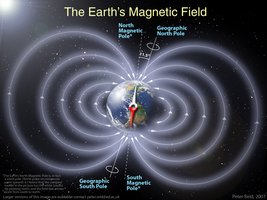
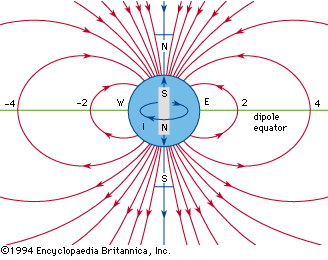
Magnetic Declination and Dip
Magnetic declination is the angle between geographic north and the direction a compass points (magnetic north). The angle of dip (or inclination) is the angle between the horizontal plane and the Earth's magnetic field at a given location.
Declination: Varies by location and is typically about 12° off true north.
Dip: Zero at the magnetic equator and increases toward the poles.
Equations:

Applications of Magnetic Fields
Magnetic fields are used in various technologies, including transportation (maglev trains), medical imaging (MRI), and advanced automotive suspension systems. The interaction of magnetic fields with moving charges is the basis for many modern devices.
Maglev Trains: Use alternating magnetic fields for levitation and propulsion.
MRI: Uses the body's magnetic field for imaging internal structures.
Properties and Effects of Magnetic Fields
Magnetic Field as a Vector
The magnetic field (B) has both magnitude and direction, making it a vector quantity. Its primary effect is to exert a force on moving charges, steering them in specific paths.
Lasers: Magnetic fields are crucial in the operation of lasers and other devices that manipulate charged particles.
Sun’s Stability: Magnetic pressure helps counteract gravitational collapse in stars.
Magnetic Force on Moving Charges
The force experienced by a moving charge in a magnetic field is always perpendicular to both the velocity of the charge and the direction of the field. This force does no work on the charge, as shown by the following equation:
For a charge moving perpendicular to the field (), , so .
Magnetic Force Equation:
SI Unit: Tesla (T), where
Gauss:
Right-Hand Rule (RHR)
The direction of the magnetic force on a moving charge or current can be determined using the right-hand rule:
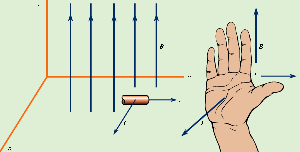
Open Palm (RHR 1): Point your fingers in the direction of velocity (v), curl them toward the magnetic field (B), and your thumb points in the direction of the force (F) for a positive charge.
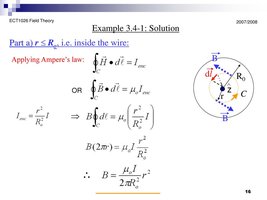
Curled Fingers (RHR 2): For a current-carrying wire, thumb points in the direction of current (I), and curled fingers show the direction of the magnetic field around the wire.
Deflection of Charges in Magnetic and Electric Fields
Charged particles moving through electric or magnetic fields experience forces that can alter their paths:
Electric Field: Deflects positive and negative charges in opposite directions; neutrons are unaffected.
Magnetic Field: Causes charged particles to move in circular or helical paths; neutrons remain unaffected.
Circular Motion in a Magnetic Field
When a charged particle moves perpendicular to a uniform magnetic field, it undergoes uniform circular motion due to the magnetic force acting as a centripetal force:
Solving for the radius of the path:
Magnetic Force on a Current-Carrying Wire
A current-carrying wire in a magnetic field experiences a force given by:
Where is the current, is the length of the wire in the field, and is the angle between the wire and the field.
For wires of arbitrary shape, use integration:
Magnetism in Materials
Ferromagnetic Materials
Only certain materials can be magnetized, meaning their atomic magnetic moments align to produce a net magnetic field. These are called ferromagnetic materials.
Examples: Iron, Nickel, Cobalt, Chromium dioxide, AlNiCo
Earth’s Core: The Earth's magnetic field is generated by the motion of ferromagnetic materials in its core.
Nuclear Fission and Magnetic Fields
Nuclear Fission Chain Reaction
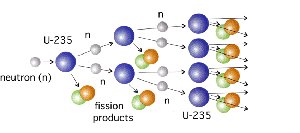
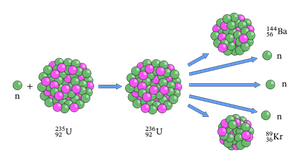
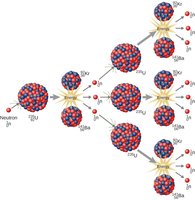
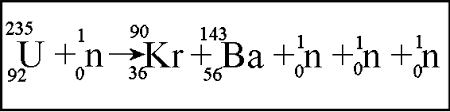
Nuclear fission is a process where a heavy nucleus splits into smaller nuclei, releasing energy and more neutrons, which can induce further fission events. This chain reaction is fundamental to nuclear reactors and atomic bombs.
Example Reaction:
Additional info: The study of magnetic fields is foundational for understanding electromagnetism, quantum physics, and many modern technologies. The equations and concepts here are essential for further study in physics and engineering.
